Sharks
Pelagic Thresher Shark
Alopias pelagicus · Cartilaginous fish, family Alopiidae
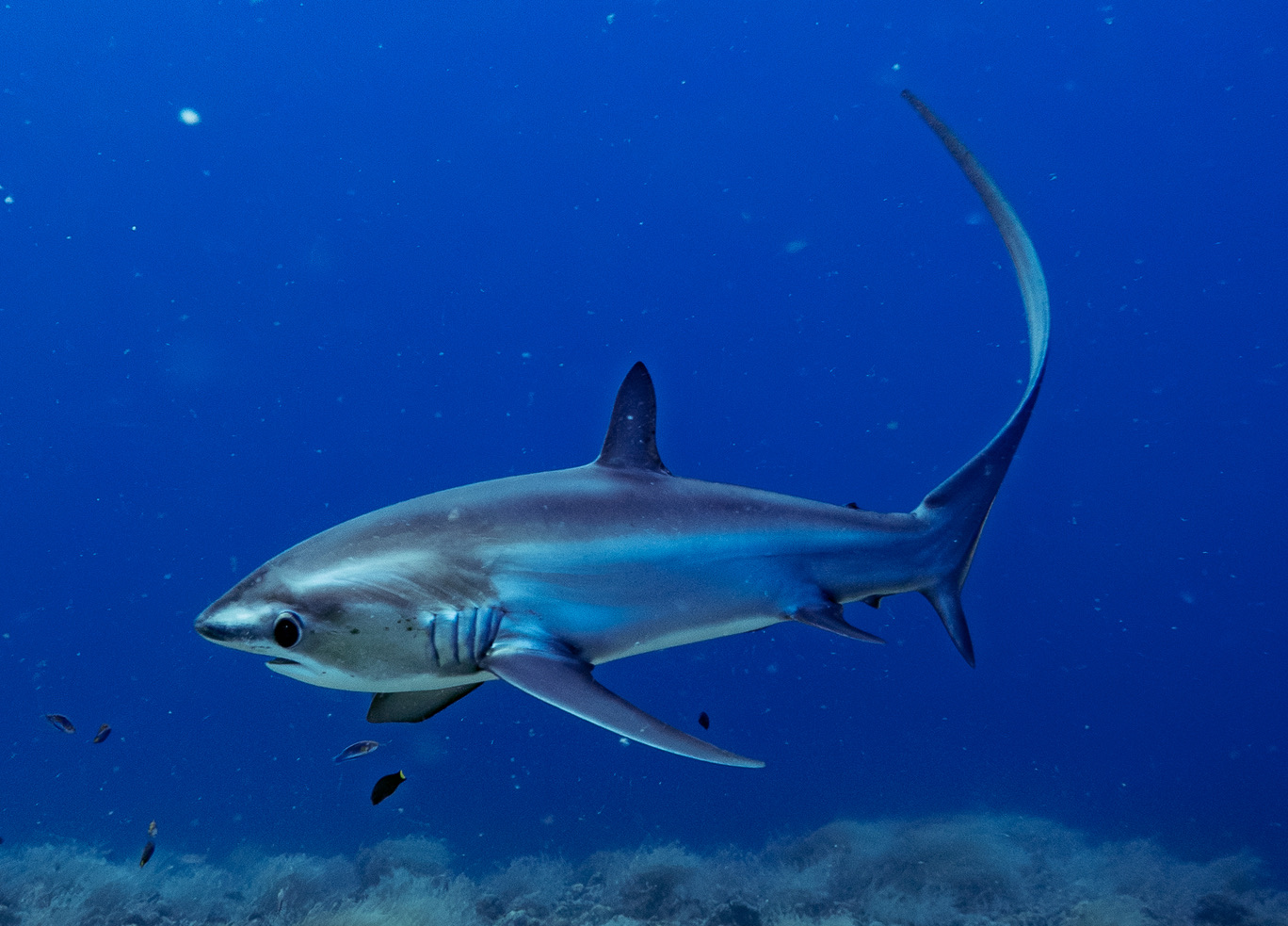
The pelagic thresher looks like a shark designed by a calligrapher: huge liquid eyes, a small mouth, metallic lavender-gray flanks, and a tail that streams behind it in an impossible ribbon. At dawn over Monad Shoal, divers kneel behind rope lines in blue half-light until one rises from the deep and begins its slow carousel around a cleaning station, tail arcing with every turn. It is among diving's most graceful sights and one of its best-managed: local rules on distance and lights have kept the sharks coming for two decades. Elsewhere the species exists mostly as bycatch statistics, which the Endangered listing reflects.
Wo und wann man eines sieht
„Resident" bedeutet, dass die meisten Tauchgänge am jeweiligen Tauchziel eine Begegnung erwarten lassen; „saisonal" bedeutet, dass die Art in den genannten Monaten zuverlässig anzutreffen ist; alles andere ist ein Bonus, keine Planungsgrundlage.
| Ziel | Zuverlässigkeit | Monate | Hinweise |
|---|---|---|---|
| MalapascuaPhilippines | Resident: seen on most dives | Ganzjährig | |
| Brothers, Daedalus & St John'sEgypt | Occasional | Ganzjährig | |
| Marsa Alam & the Deep SouthEgypt | Occasional | Ganzjährig |
Bester Monat auf einen Blick
Sie verstehen
Lebensraum: Open ocean and deep seamount flanks; rises to shallow cleaning stations at dawn, one of the few predictable windows into its world
Verbreitung: Indo-Pacific pelagic waters from the Red Sea and East Africa to Mexico; the reliable diver encounters are at Philippine seamounts
Verhalten: A shy, wide-eyed deep-water hunter that visits cleaning stations in the dim early morning, circling patiently while cleaner wrasses work its skin and gills. The tail-slap hunting technique, confirmed on video off Cebu, is unique theater: the shark lunges, brakes, and snaps its caudal fin overhead like a whip.
Ernährung: Small schooling fish and squid, stunned with whip-cracks of the enormous tail before being picked off
Größe: typischerweise rund 3.0 m; dokumentiert bis zu 3.8 m (total length; the scythe-shaped upper tail lobe accounts for roughly half of it).
Wie man sich in ihrer Nähe verhält
Follow the Malapascua protocol that made these dives sustainable: stay behind the viewing lines, no flash where prohibited, minimal movement and noise, and let the shark control its circuit of the cleaning station.
Naturschutz
Endangered: slow reproduction (usually two pups) collides with heavy longline and gillnet mortality across the Indo-Pacific. The Philippines' protection of its cleaning stations is a working model of encounter-based conservation.
Bekannte Tauchplätze dafür
Hervorgehobene Tauchplätze wurden von unseren Redakteuren für diese Art kartiert; die Zahlen sind GBIF-Vorkommensdatensätze, die seit 1990 im Umkreis von etwa 5 km um einen Tauchplatz protokolliert wurden.
Ansehen
Aus den offiziellen Kanälen

Wildlife of Monterey | New film in our auditorium

Live Aviary Cam | Monterey Bay Aquarium

Live Aviary Cam | Monterey Bay Aquarium
Videos sind eingebettete Links zu den Kanälen der jeweiligen Ersteller – wir hosten nichts und geben für alles die Quelle an.