Sharks
Pelagic Thresher Shark
Alopias pelagicus · Cartilaginous fish, family Alopiidae
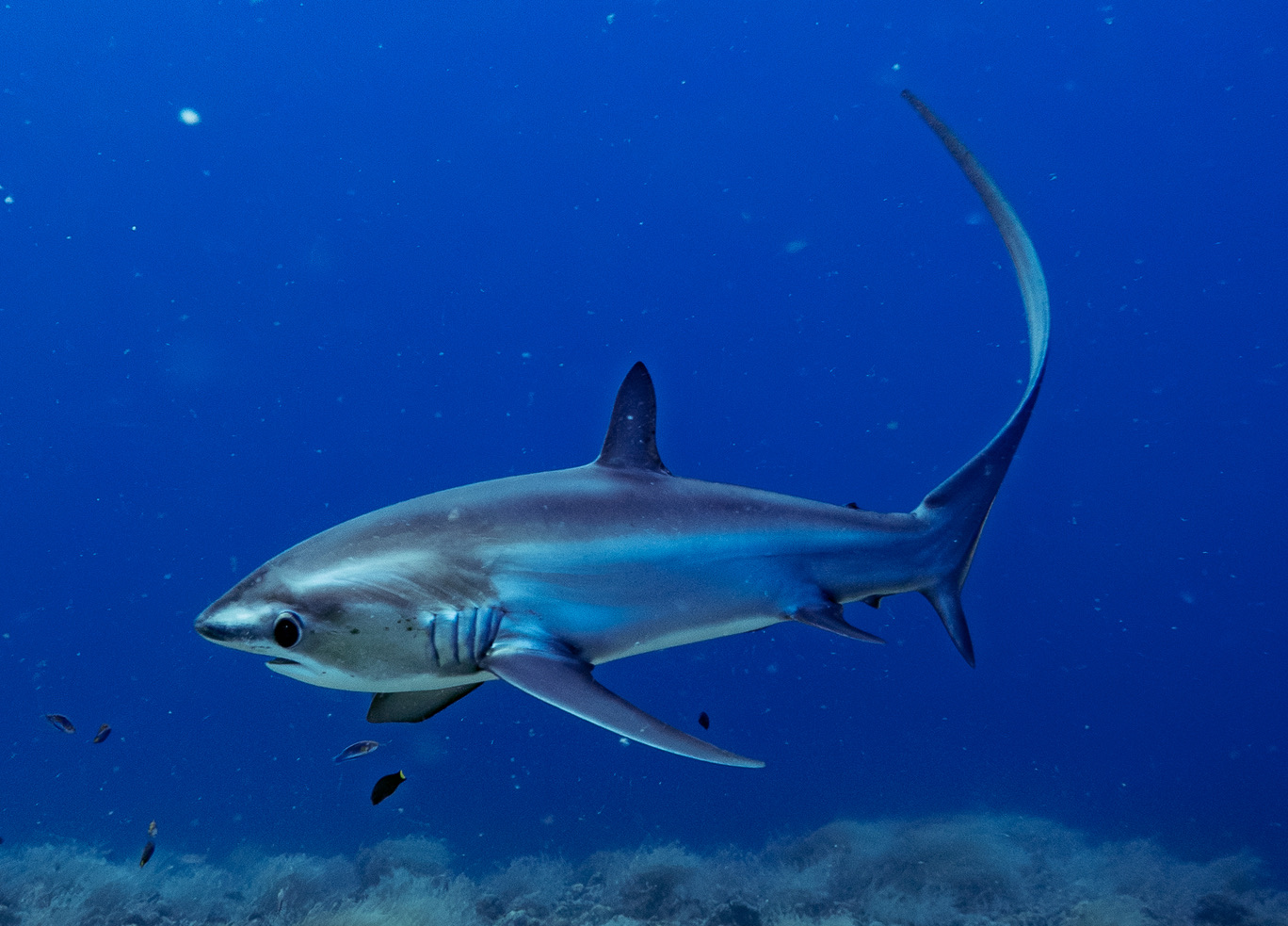
The pelagic thresher looks like a shark designed by a calligrapher: huge liquid eyes, a small mouth, metallic lavender-gray flanks, and a tail that streams behind it in an impossible ribbon. At dawn over Monad Shoal, divers kneel behind rope lines in blue half-light until one rises from the deep and begins its slow carousel around a cleaning station, tail arcing with every turn. It is among diving's most graceful sights and one of its best-managed: local rules on distance and lights have kept the sharks coming for two decades. Elsewhere the species exists mostly as bycatch statistics, which the Endangered listing reflects.
Où et quand en observer un
« Résident » signifie que la plupart des plongées sur ce site permettent de les observer ; « saisonnier » signifie qu'ils sont présents de manière fiable durant les mois indiqués ; tout le reste est un bonus, pas une certitude.
| Destination | Fiabilité | Mois | Notes |
|---|---|---|---|
| MalapascuaPhilippines | Resident: seen on most dives | Toute l'année | |
| Brothers, Daedalus & St John'sEgypt | Occasional | Toute l'année | |
| Marsa Alam & the Deep SouthEgypt | Occasional | Toute l'année |
Meilleur mois, en un coup d'œil
Les comprendre
Habitat: Open ocean and deep seamount flanks; rises to shallow cleaning stations at dawn, one of the few predictable windows into its world
Aire de répartition: Indo-Pacific pelagic waters from the Red Sea and East Africa to Mexico; the reliable diver encounters are at Philippine seamounts
Comportement: A shy, wide-eyed deep-water hunter that visits cleaning stations in the dim early morning, circling patiently while cleaner wrasses work its skin and gills. The tail-slap hunting technique, confirmed on video off Cebu, is unique theater: the shark lunges, brakes, and snaps its caudal fin overhead like a whip.
Régime alimentaire: Small schooling fish and squid, stunned with whip-cracks of the enormous tail before being picked off
Taille: généralement autour de 3.0 m; documenté jusqu'à 3.8 m (total length; the scythe-shaped upper tail lobe accounts for roughly half of it).
Comment se comporter avec lui
Follow the Malapascua protocol that made these dives sustainable: stay behind the viewing lines, no flash where prohibited, minimal movement and noise, and let the shark control its circuit of the cleaning station.
Conservation
Endangered: slow reproduction (usually two pups) collides with heavy longline and gillnet mortality across the Indo-Pacific. The Philippines' protection of its cleaning stations is a working model of encounter-based conservation.
Sites répertoriés connus pour leur présence
Les sites mis en évidence ont été cartographiés pour cette espèce par nos éditeurs ; les chiffres correspondent aux occurrences GBIF enregistrées dans un rayon d'environ 5 km d'un site depuis 1990.
Regarder
Depuis les canaux officiels

Wildlife of Monterey | New film in our auditorium

Live Aviary Cam | Monterey Bay Aquarium

Live Aviary Cam | Monterey Bay Aquarium
Les vidéos sont des liens intégrés vers les chaînes de leurs créateurs. Nous n'hébergeons rien et créditons tout.