Sharks
Pelagic Thresher Shark
Alopias pelagicus · Cartilaginous fish, family Alopiidae
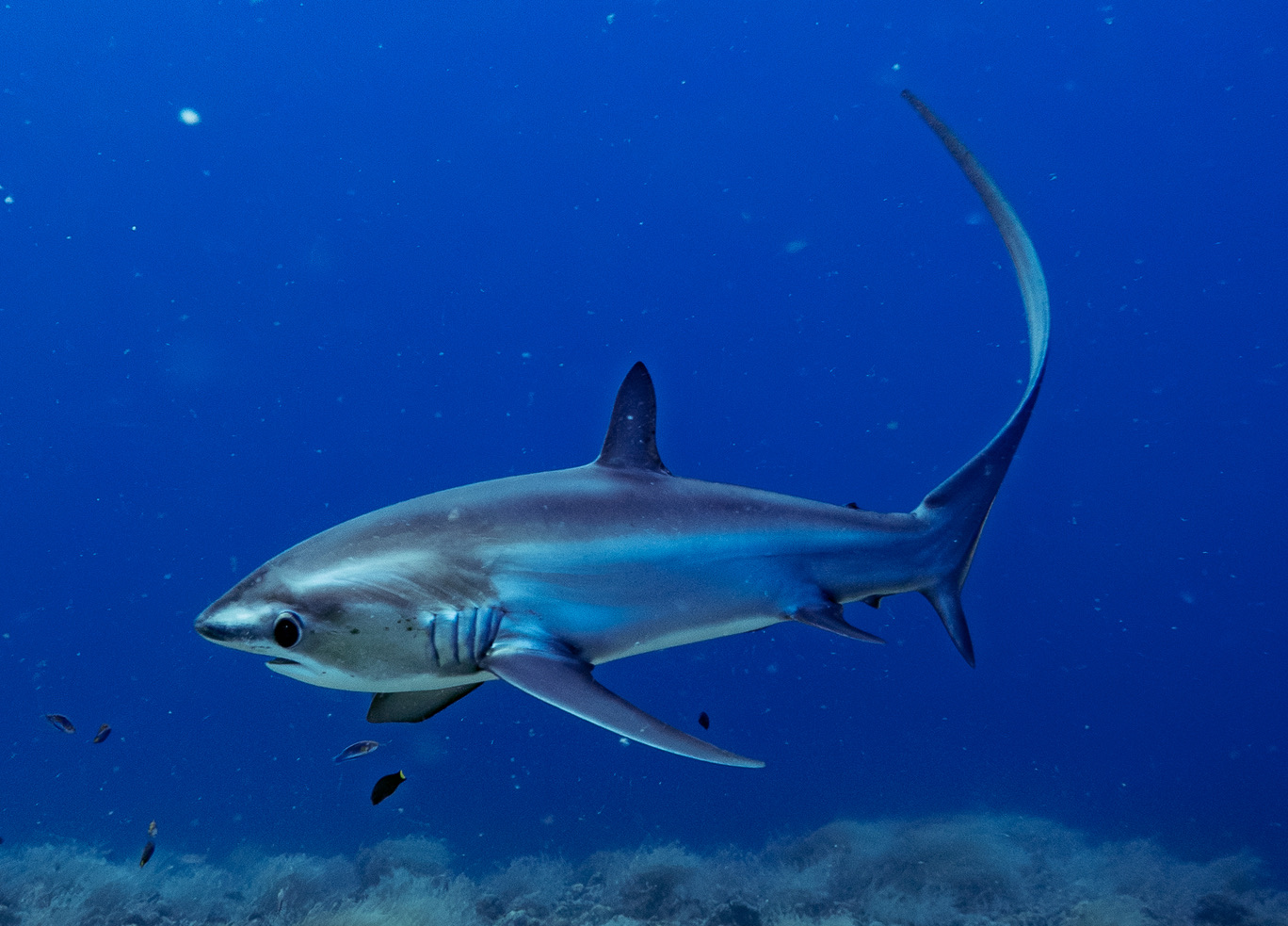
The pelagic thresher looks like a shark designed by a calligrapher: huge liquid eyes, a small mouth, metallic lavender-gray flanks, and a tail that streams behind it in an impossible ribbon. At dawn over Monad Shoal, divers kneel behind rope lines in blue half-light until one rises from the deep and begins its slow carousel around a cleaning station, tail arcing with every turn. It is among diving's most graceful sights and one of its best-managed: local rules on distance and lights have kept the sharks coming for two decades. Elsewhere the species exists mostly as bycatch statistics, which the Endangered listing reflects.
Waar en wanneer je er een kunt zien
"Resident" betekent dat je ze bij de meeste duiken op die bestemming tegenkomt; "seizoensgebonden" betekent betrouwbaar aanwezig in de vermelde maanden; al het andere is een bonus, geen garantie.
| Bestemming | Betrouwbaarheid | Maanden | Notities |
|---|---|---|---|
| MalapascuaPhilippines | Resident: seen on most dives | Het hele jaar door | |
| Brothers, Daedalus & St John'sEgypt | Occasional | Het hele jaar door | |
| Marsa Alam & the Deep SouthEgypt | Occasional | Het hele jaar door |
Beste maand, in één oogopslag
Ze begrijpen
Habitat: Open ocean and deep seamount flanks; rises to shallow cleaning stations at dawn, one of the few predictable windows into its world
Verspreidingsgebied: Indo-Pacific pelagic waters from the Red Sea and East Africa to Mexico; the reliable diver encounters are at Philippine seamounts
Gedrag: A shy, wide-eyed deep-water hunter that visits cleaning stations in the dim early morning, circling patiently while cleaner wrasses work its skin and gills. The tail-slap hunting technique, confirmed on video off Cebu, is unique theater: the shark lunges, brakes, and snaps its caudal fin overhead like a whip.
Dieet: Small schooling fish and squid, stunned with whip-cracks of the enormous tail before being picked off
Grootte: doorgaans rond 3.0 m; gedocumenteerd tot 3.8 m (total length; the scythe-shaped upper tail lobe accounts for roughly half of it).
Hoe je je ertegenover gedraagt
Follow the Malapascua protocol that made these dives sustainable: stay behind the viewing lines, no flash where prohibited, minimal movement and noise, and let the shark control its circuit of the cleaning station.
Behoud
Endangered: slow reproduction (usually two pups) collides with heavy longline and gillnet mortality across the Indo-Pacific. The Philippines' protection of its cleaning stations is a working model of encounter-based conservation.
Gekende duiksites waar je ze tegenkomt
Gemarkeerde locaties zijn voor deze soort in kaart gebracht door onze redacteurs; de getallen zijn GBIF-waarnemingsrecords vastgelegd binnen ongeveer 5 km van een locatie sinds 1990.
Bekijk
Via de officiële kanalen

Wildlife of Monterey | New film in our auditorium

Live Aviary Cam | Monterey Bay Aquarium

Live Aviary Cam | Monterey Bay Aquarium
Video's zijn ingesloten links naar de eigen kanalen van de makers. We hosten niets en vermelden altijd de bron.