Sharks
Pelagic Thresher Shark
Alopias pelagicus · Cartilaginous fish, family Alopiidae
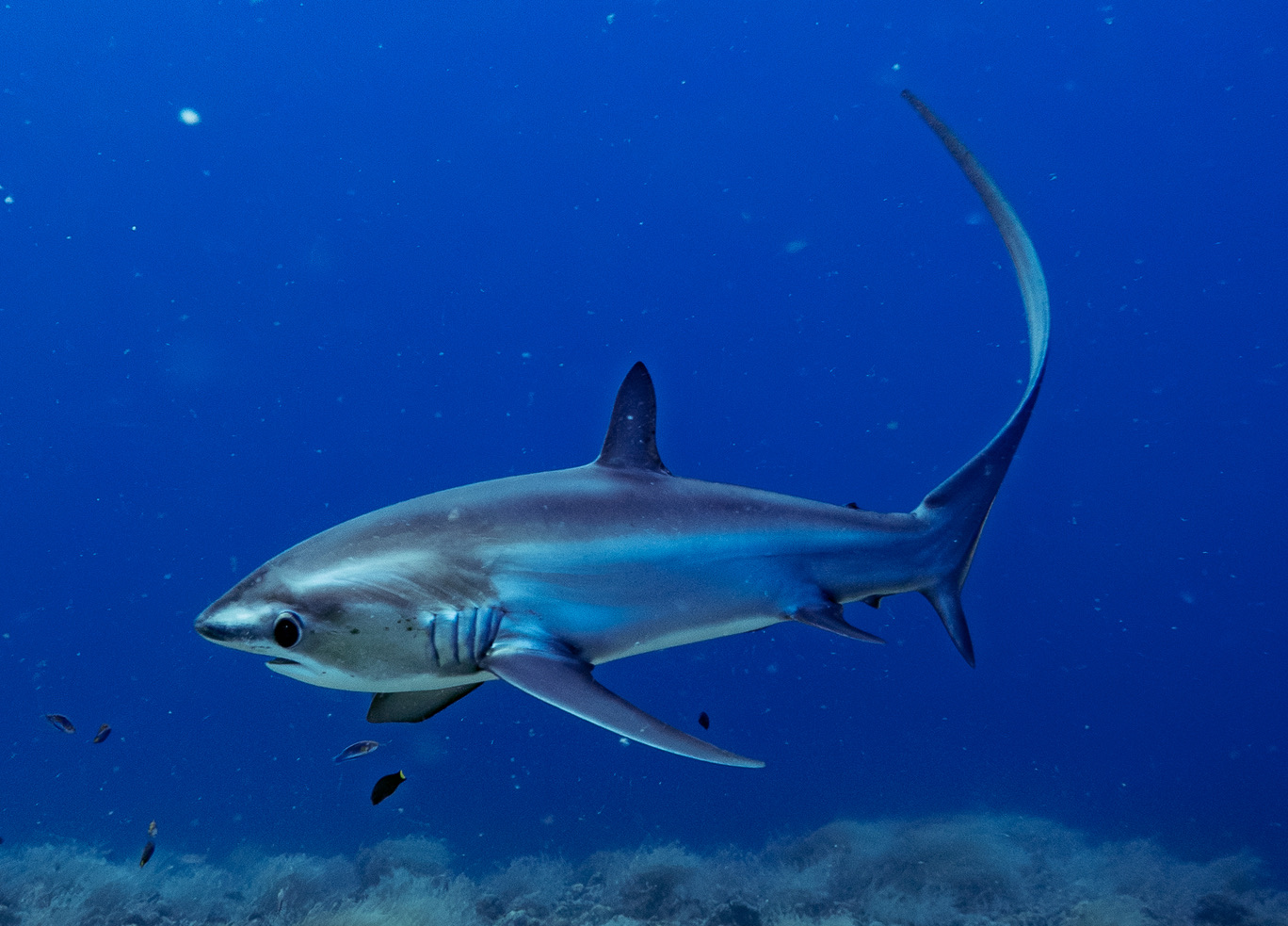
The pelagic thresher looks like a shark designed by a calligrapher: huge liquid eyes, a small mouth, metallic lavender-gray flanks, and a tail that streams behind it in an impossible ribbon. At dawn over Monad Shoal, divers kneel behind rope lines in blue half-light until one rises from the deep and begins its slow carousel around a cleaning station, tail arcing with every turn. It is among diving's most graceful sights and one of its best-managed: local rules on distance and lights have kept the sharks coming for two decades. Elsewhere the species exists mostly as bycatch statistics, which the Endangered listing reflects.
Onde e quando ver um
"Residente" significa que a maioria dos mergulhos naquele destino os encontra; "sazonal" significa presença confiável nos meses listados; qualquer outra coisa é um bônus, não um plano.
| Destino | Fiabilidade | Meses | Notas |
|---|---|---|---|
| MalapascuaPhilippines | Resident: seen on most dives | Todo o ano | |
| Brothers, Daedalus & St John'sEgypt | Occasional | Todo o ano | |
| Marsa Alam & the Deep SouthEgypt | Occasional | Todo o ano |
Melhor mês, em resumo
Entendendo-os
Habitat: Open ocean and deep seamount flanks; rises to shallow cleaning stations at dawn, one of the few predictable windows into its world
Distribuição: Indo-Pacific pelagic waters from the Red Sea and East Africa to Mexico; the reliable diver encounters are at Philippine seamounts
Comportamento: A shy, wide-eyed deep-water hunter that visits cleaning stations in the dim early morning, circling patiently while cleaner wrasses work its skin and gills. The tail-slap hunting technique, confirmed on video off Cebu, is unique theater: the shark lunges, brakes, and snaps its caudal fin overhead like a whip.
Dieta: Small schooling fish and squid, stunned with whip-cracks of the enormous tail before being picked off
Tamanho: normalmente cerca de 3.0 m; documentado até 3.8 m (total length; the scythe-shaped upper tail lobe accounts for roughly half of it).
Como se comportar perto de um
Follow the Malapascua protocol that made these dives sustainable: stay behind the viewing lines, no flash where prohibited, minimal movement and noise, and let the shark control its circuit of the cleaning station.
Conservação
Endangered: slow reproduction (usually two pups) collides with heavy longline and gillnet mortality across the Indo-Pacific. The Philippines' protection of its cleaning stations is a working model of encounter-based conservation.
Pontos mapeados conhecidos por eles
Os locais destacados foram cartografados para esta espécie pelos nossos editores; os números são registos de ocorrência do GBIF num raio de cerca de 5 km do local desde 1990.
Assista
Dos canais oficiais

Wildlife of Monterey | New film in our auditorium

Live Aviary Cam | Monterey Bay Aquarium

Live Aviary Cam | Monterey Bay Aquarium
Os vídeos são ligações incorporadas para os canais dos próprios criadores. Não alojamos nada e creditamos tudo.