Cold Water
Weedy Seadragon
Phyllopteryx taeniolatus · Bony fish, family Syngnathidae; also called the common seadragon, an Australian endemic
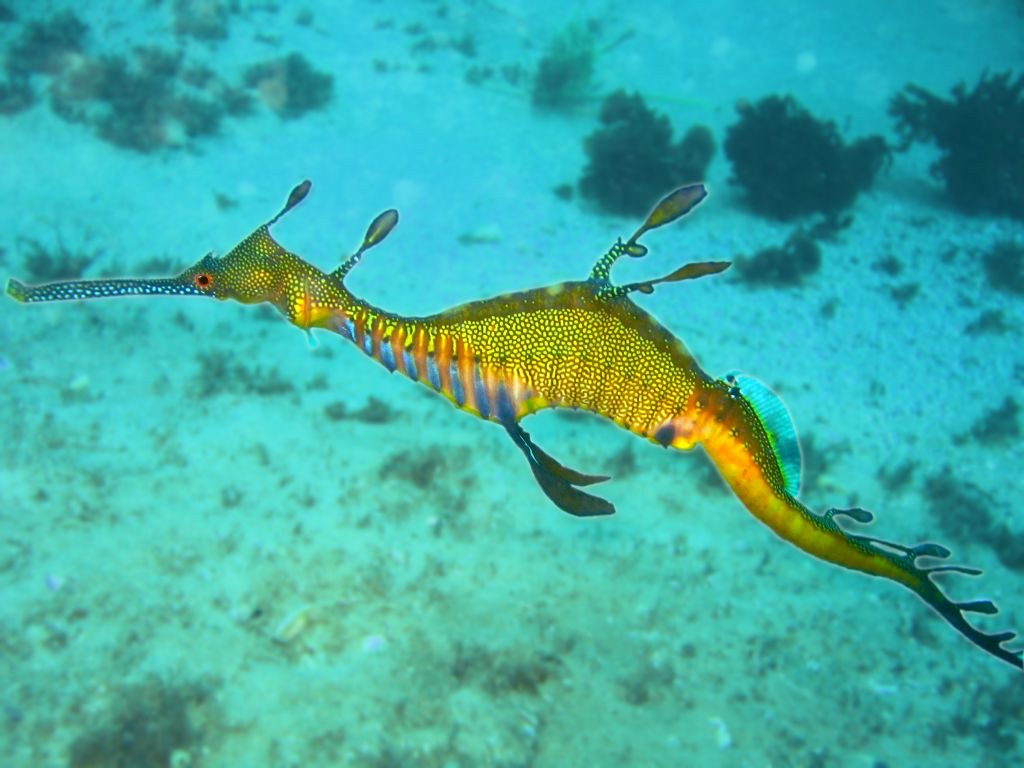
A weedy seadragon trades the leafy's full costume for jewelry: a slimmer, kelp-red body scattered with yellow spots and violet-blue bars, trailing a few weed-like appendages as it drifts along sponge gardens and kelp lines across Australia's temperate south. It is the more widespread and more often met seadragon, turning up on shore dives and jetty pilings as well as offshore reefs, always slightly farther away than it looks and always mid-meal, vacuuming mysids by the thousand. Males carry the brood (around 250 eggs pressed onto the underside of the tail each breeding season), and site-faithful adults let researchers identify individuals from spot patterns year after year. Give the animal right of way and resist guiding it with a hand or fin wash; a displaced dragon burns energy it budgets tightly.
Wo und wann man eines sieht
„Resident" bedeutet, dass die meisten Tauchgänge am jeweiligen Tauchziel eine Begegnung erwarten lassen; „saisonal" bedeutet, dass die Art in den genannten Monaten zuverlässig anzutreffen ist; alles andere ist ein Bonus, keine Planungsgrundlage.
| Ziel | Zuverlässigkeit | Monate | Hinweise |
|---|---|---|---|
| South AustraliaAustralia | Resident: seen on most dives | Ganzjährig |
Bester Monat auf einen Blick
| Monat | Zuverlässige Reiseziele |
|---|---|
| January | South Australia |
| February | South Australia |
| March | South Australia |
| April | South Australia |
| May | South Australia |
| June | South Australia |
| July | South Australia |
| August | South Australia |
| September | South Australia |
| October | South Australia |
| November | South Australia |
| December | South Australia |
Sie verstehen
Lebensraum: Kelp lines, sponge gardens, seagrass margins, and jetty piles over sand across Australia's temperate south.
Verbreitung: Southern Australia from New South Wales around to southern Western Australia, including Tasmania.
Verhalten: Drifts singly or in loose pairs along habitat edges; males brood around 250 eggs pressed onto the underside of the tail each breeding season, and individuals can be photo-identified by their spot patterns.
Ernährung: Mysid shrimp and other small crustaceans vacuumed continuously through the tubular snout.
Größe: typischerweise rund 0.3 m; dokumentiert bis zu 0.46 m (total length).
Wie man sich in ihrer Nähe verhält
Protected in Australian waters: no touching or shepherding with hands or fins, and photo-identification projects welcome clear, unharassed side-on images.
Naturschutz
Least Concern under its current assessment and protected in Australian waters; kelp decline along the southeast is the pressure researchers watch most closely.
Bekannte Tauchplätze dafür
Hervorgehobene Tauchplätze wurden von unseren Redakteuren für diese Art kartiert; die Zahlen sind GBIF-Vorkommensdatensätze, die seit 1990 im Umkreis von etwa 5 km um einen Tauchplatz protokolliert wurden.
Ansehen
Aus den offiziellen Kanälen

Wildlife of Monterey | New film in our auditorium

Live Aviary Cam | Monterey Bay Aquarium

Live Aviary Cam | Monterey Bay Aquarium
Videos sind eingebettete Links zu den Kanälen der jeweiligen Ersteller – wir hosten nichts und geben für alles die Quelle an.