Cold Water
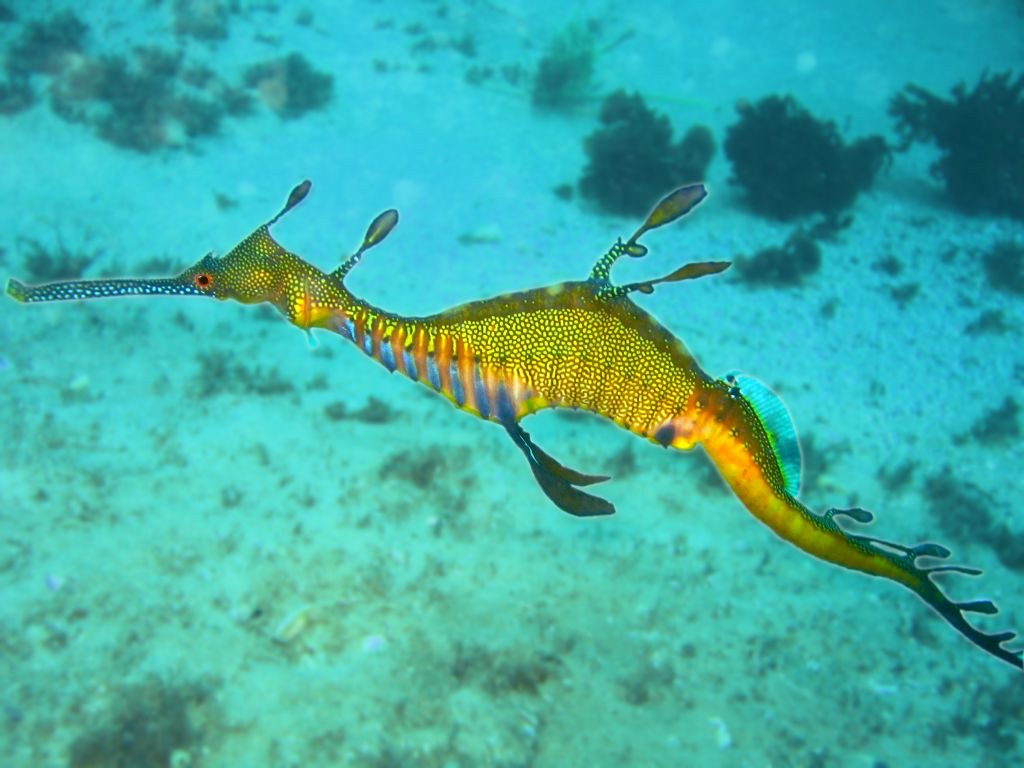
Weedy Seadragon
Phyllopteryx taeniolatus · Bony fish, family Syngnathidae; also called the common seadragon, an Australian endemic
A weedy seadragon trades the leafy's full costume for jewelry: a slimmer, kelp-red body scattered with yellow spots and violet-blue bars, trailing a few weed-like appendages as it drifts along sponge gardens and kelp lines across Australia's temperate south. It is the more widespread and more often met seadragon, turning up on shore dives and jetty pilings as well as offshore reefs, always slightly farther away than it looks and always mid-meal, vacuuming mysids by the thousand. Males carry the brood (around 250 eggs pressed onto the underside of the tail each breeding season), and site-faithful adults let researchers identify individuals from spot patterns year after year. Give the animal right of way and resist guiding it with a hand or fin wash; a displaced dragon burns energy it budgets tightly.
Di mana dan kapan melihatnya
"Resident" berarti sebagian besar penyelaman di destinasi tersebut akan menjumpai mereka; "seasonal" berarti kehadirannya dapat diandalkan pada bulan-bulan yang tercantum; selain itu adalah bonus, bukan rencana.
| Destinasi | Keandalan | Bulan | Catatan |
|---|---|---|---|
| South AustraliaAustralia | Resident: seen on most dives | Sepanjang tahun |
Bulan terbaik, sekilas pandang
| Bulan | Destinasi yang dapat diandalkan |
|---|---|
| January | South Australia |
| February | South Australia |
| March | South Australia |
| April | South Australia |
| May | South Australia |
| June | South Australia |
| July | South Australia |
| August | South Australia |
| September | South Australia |
| October | South Australia |
| November | South Australia |
| December | South Australia |
Memahaminya
Habitat: Kelp lines, sponge gardens, seagrass margins, and jetty piles over sand across Australia's temperate south.
Sebaran: Southern Australia from New South Wales around to southern Western Australia, including Tasmania.
Perilaku: Drifts singly or in loose pairs along habitat edges; males brood around 250 eggs pressed onto the underside of the tail each breeding season, and individuals can be photo-identified by their spot patterns.
Diet: Mysid shrimp and other small crustaceans vacuumed continuously through the tubular snout.
Ukuran: biasanya sekitar 0.3 m; terdokumentasi hingga 0.46 m (total length).
Cara berperilaku di sekitarnya
Protected in Australian waters: no touching or shepherding with hands or fins, and photo-identification projects welcome clear, unharassed side-on images.
Konservasi
Least Concern under its current assessment and protected in Australian waters; kelp decline along the southeast is the pressure researchers watch most closely.
Situs-situs terdata yang dikenal dengan hal itu
Lokasi yang disorot dipetakan untuk spesies ini oleh editor kami; angka-angkanya adalah catatan kemunculan GBIF yang dicatat dalam radius sekitar 5 km dari suatu lokasi sejak 1990.
Tonton
Dari saluran resmi

Wildlife of Monterey | New film in our auditorium

Live Aviary Cam | Monterey Bay Aquarium

Live Aviary Cam | Monterey Bay Aquarium
Video adalah tautan tertanam ke saluran milik kreatornya sendiri. Kami tidak meng-host apa pun dan selalu mencantumkan kredit.