Cold Water
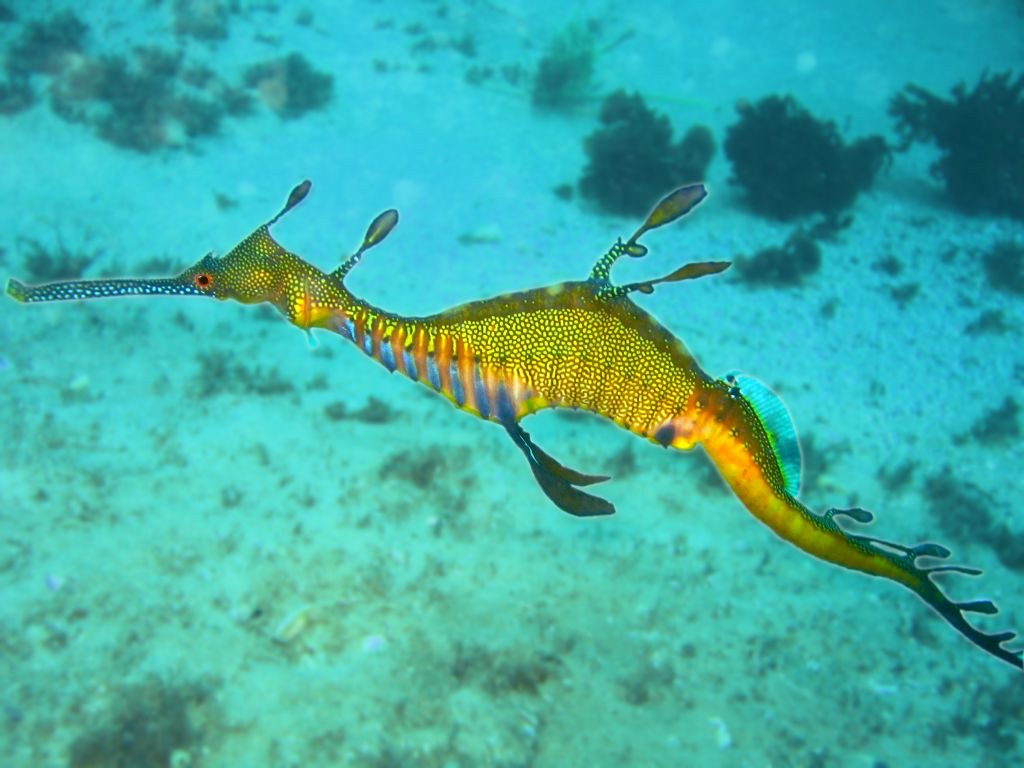
Weedy Seadragon
Phyllopteryx taeniolatus · Bony fish, family Syngnathidae; also called the common seadragon, an Australian endemic
A weedy seadragon trades the leafy's full costume for jewelry: a slimmer, kelp-red body scattered with yellow spots and violet-blue bars, trailing a few weed-like appendages as it drifts along sponge gardens and kelp lines across Australia's temperate south. It is the more widespread and more often met seadragon, turning up on shore dives and jetty pilings as well as offshore reefs, always slightly farther away than it looks and always mid-meal, vacuuming mysids by the thousand. Males carry the brood (around 250 eggs pressed onto the underside of the tail each breeding season), and site-faithful adults let researchers identify individuals from spot patterns year after year. Give the animal right of way and resist guiding it with a hand or fin wash; a displaced dragon burns energy it budgets tightly.
Dove e quando avvistarne uno
"Residente" significa che la maggior parte delle immersioni in quella destinazione li incontra; "stagionale" significa che sono presenti in modo affidabile nei mesi indicati; qualsiasi altra cosa è un bonus, non un piano.
| Destinazione | Affidabilità | Mesi | Note |
|---|---|---|---|
| South AustraliaAustralia | Resident: seen on most dives | Tutto l'anno |
Il mese migliore, a colpo d'occhio
| Mese | Destinazioni affidabili |
|---|---|
| January | South Australia |
| February | South Australia |
| March | South Australia |
| April | South Australia |
| May | South Australia |
| June | South Australia |
| July | South Australia |
| August | South Australia |
| September | South Australia |
| October | South Australia |
| November | South Australia |
| December | South Australia |
Capirle
Habitat: Kelp lines, sponge gardens, seagrass margins, and jetty piles over sand across Australia's temperate south.
Distribuzione: Southern Australia from New South Wales around to southern Western Australia, including Tasmania.
Comportamento: Drifts singly or in loose pairs along habitat edges; males brood around 250 eggs pressed onto the underside of the tail each breeding season, and individuals can be photo-identified by their spot patterns.
Dieta: Mysid shrimp and other small crustaceans vacuumed continuously through the tubular snout.
Dimensioni: tipicamente intorno a 0.3 m; documentato fino a 0.46 m (total length).
Come comportarsi in sua presenza
Protected in Australian waters: no touching or shepherding with hands or fins, and photo-identification projects welcome clear, unharassed side-on images.
Conservazione
Least Concern under its current assessment and protected in Australian waters; kelp decline along the southeast is the pressure researchers watch most closely.
Siti mappati noti per avvistamenti
I siti evidenziati sono stati schedati per questa specie dai nostri redattori; i numeri sono record di occorrenza GBIF registrati entro circa 5 km dal sito a partire dal 1990.
Guarda
Dai canali ufficiali

Wildlife of Monterey | New film in our auditorium

Live Aviary Cam | Monterey Bay Aquarium

Live Aviary Cam | Monterey Bay Aquarium
I video sono link incorporati ai canali dei rispettivi autori. Non ospitiamo nulla e accreditiamo tutto.