Cold Water
Weedy Seadragon
Phyllopteryx taeniolatus · Bony fish, family Syngnathidae; also called the common seadragon, an Australian endemic
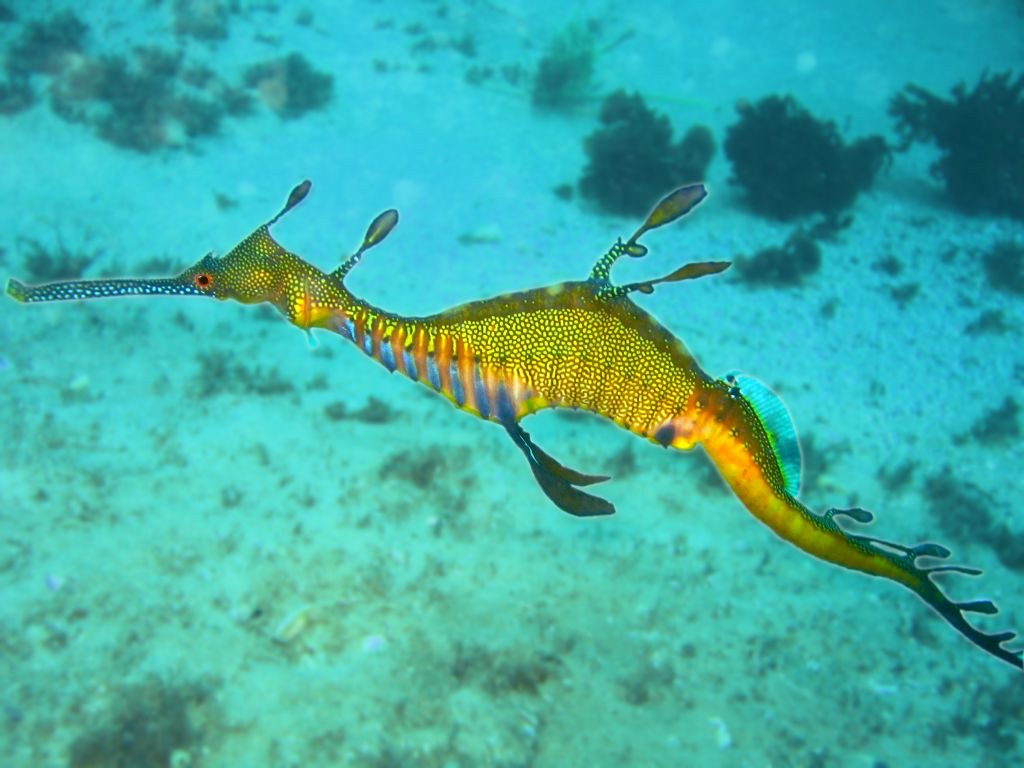
A weedy seadragon trades the leafy's full costume for jewelry: a slimmer, kelp-red body scattered with yellow spots and violet-blue bars, trailing a few weed-like appendages as it drifts along sponge gardens and kelp lines across Australia's temperate south. It is the more widespread and more often met seadragon, turning up on shore dives and jetty pilings as well as offshore reefs, always slightly farther away than it looks and always mid-meal, vacuuming mysids by the thousand. Males carry the brood (around 250 eggs pressed onto the underside of the tail each breeding season), and site-faithful adults let researchers identify individuals from spot patterns year after year. Give the animal right of way and resist guiding it with a hand or fin wash; a displaced dragon burns energy it budgets tightly.
Waar en wanneer je er een kunt zien
"Resident" betekent dat je ze bij de meeste duiken op die bestemming tegenkomt; "seizoensgebonden" betekent betrouwbaar aanwezig in de vermelde maanden; al het andere is een bonus, geen garantie.
| Bestemming | Betrouwbaarheid | Maanden | Notities |
|---|---|---|---|
| South AustraliaAustralia | Resident: seen on most dives | Het hele jaar door |
Beste maand, in één oogopslag
| Maand | Betrouwbare bestemmingen |
|---|---|
| January | South Australia |
| February | South Australia |
| March | South Australia |
| April | South Australia |
| May | South Australia |
| June | South Australia |
| July | South Australia |
| August | South Australia |
| September | South Australia |
| October | South Australia |
| November | South Australia |
| December | South Australia |
Ze begrijpen
Habitat: Kelp lines, sponge gardens, seagrass margins, and jetty piles over sand across Australia's temperate south.
Verspreidingsgebied: Southern Australia from New South Wales around to southern Western Australia, including Tasmania.
Gedrag: Drifts singly or in loose pairs along habitat edges; males brood around 250 eggs pressed onto the underside of the tail each breeding season, and individuals can be photo-identified by their spot patterns.
Dieet: Mysid shrimp and other small crustaceans vacuumed continuously through the tubular snout.
Grootte: doorgaans rond 0.3 m; gedocumenteerd tot 0.46 m (total length).
Hoe je je ertegenover gedraagt
Protected in Australian waters: no touching or shepherding with hands or fins, and photo-identification projects welcome clear, unharassed side-on images.
Behoud
Least Concern under its current assessment and protected in Australian waters; kelp decline along the southeast is the pressure researchers watch most closely.
Gekende duiksites waar je ze tegenkomt
Gemarkeerde locaties zijn voor deze soort in kaart gebracht door onze redacteurs; de getallen zijn GBIF-waarnemingsrecords vastgelegd binnen ongeveer 5 km van een locatie sinds 1990.
Bekijk
Via de officiële kanalen

Wildlife of Monterey | New film in our auditorium

Live Aviary Cam | Monterey Bay Aquarium

Live Aviary Cam | Monterey Bay Aquarium
Video's zijn ingesloten links naar de eigen kanalen van de makers. We hosten niets en vermelden altijd de bron.