Cold Water
Weedy Seadragon
Phyllopteryx taeniolatus · Bony fish, family Syngnathidae; also called the common seadragon, an Australian endemic
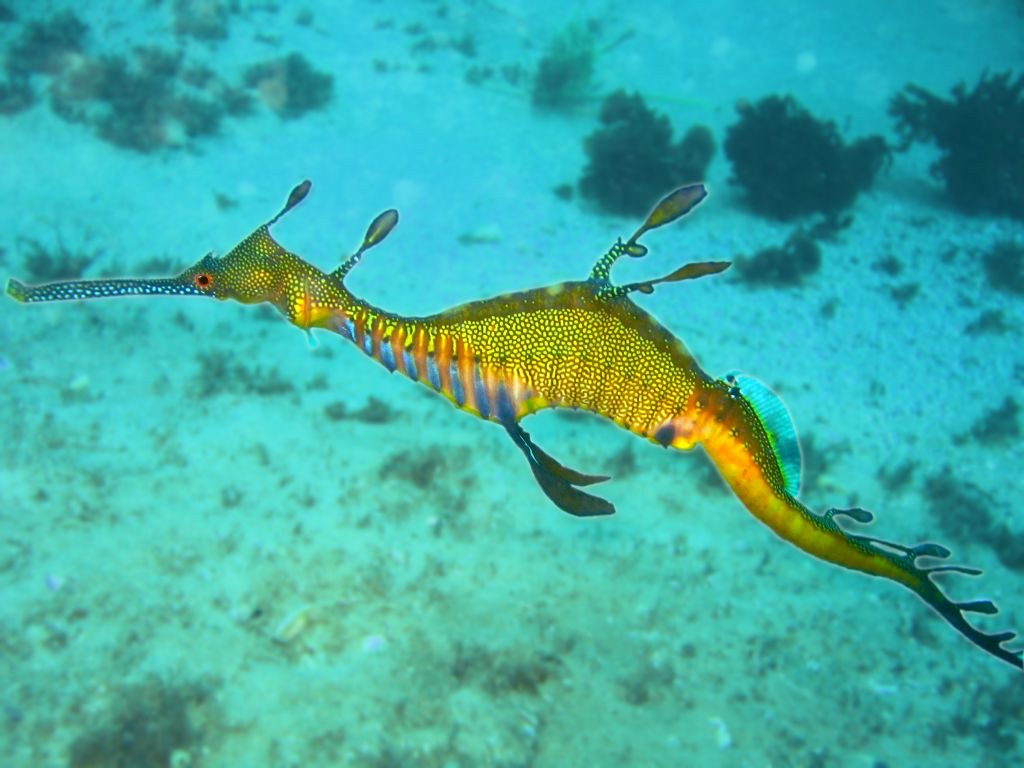
A weedy seadragon trades the leafy's full costume for jewelry: a slimmer, kelp-red body scattered with yellow spots and violet-blue bars, trailing a few weed-like appendages as it drifts along sponge gardens and kelp lines across Australia's temperate south. It is the more widespread and more often met seadragon, turning up on shore dives and jetty pilings as well as offshore reefs, always slightly farther away than it looks and always mid-meal, vacuuming mysids by the thousand. Males carry the brood (around 250 eggs pressed onto the underside of the tail each breeding season), and site-faithful adults let researchers identify individuals from spot patterns year after year. Give the animal right of way and resist guiding it with a hand or fin wash; a displaced dragon burns energy it budgets tightly.
Nơi và thời điểm có thể gặp
"Thường trú" nghĩa là hầu hết các lần lặn tại điểm đó đều gặp được chúng; "theo mùa" nghĩa là chúng xuất hiện đáng tin cậy trong các tháng được liệt kê; bất kỳ điều gì ngoài ra là điểm thưởng, không phải kế hoạch.
| Điểm đến | Độ tin cậy | Các tháng | Ghi chú |
|---|---|---|---|
| South AustraliaAustralia | Resident: seen on most dives | Quanh năm |
Tháng tốt nhất, nhìn tổng quan
| Tháng | Điểm đến đáng tin cậy |
|---|---|
| January | South Australia |
| February | South Australia |
| March | South Australia |
| April | South Australia |
| May | South Australia |
| June | South Australia |
| July | South Australia |
| August | South Australia |
| September | South Australia |
| October | South Australia |
| November | South Australia |
| December | South Australia |
Tìm hiểu về chúng
Môi trường sống: Kelp lines, sponge gardens, seagrass margins, and jetty piles over sand across Australia's temperate south.
Phạm vi phân bố: Southern Australia from New South Wales around to southern Western Australia, including Tasmania.
Hành vi: Drifts singly or in loose pairs along habitat edges; males brood around 250 eggs pressed onto the underside of the tail each breeding season, and individuals can be photo-identified by their spot patterns.
Chế độ ăn: Mysid shrimp and other small crustaceans vacuumed continuously through the tubular snout.
Kích thước: thường vào khoảng 0.3 m; ghi nhận đến độ sâu 0.46 m (total length).
Cách ứng xử khi ở gần loài này
Protected in Australian waters: no touching or shepherding with hands or fins, and photo-identification projects welcome clear, unharassed side-on images.
Bảo tồn
Least Concern under its current assessment and protected in Australian waters; kelp decline along the southeast is the pressure researchers watch most closely.
Các điểm lặn đã ghi nhận có loài này
Các điểm được làm nổi bật là những điểm đã được ban biên tập ghi chép cho loài này; các con số là bản ghi xuất hiện từ GBIF được ghi nhận trong phạm vi khoảng 5 km của điểm lặn kể từ năm 1990.
Xem
Từ kênh chính thức

Wildlife of Monterey | New film in our auditorium

Live Aviary Cam | Monterey Bay Aquarium

Live Aviary Cam | Monterey Bay Aquarium
Video là các liên kết nhúng dẫn đến kênh của chính tác giả. Chúng tôi không lưu trữ gì và ghi công đầy đủ.