Sharks
Whitetip Reef Shark
Triaenodon obesus · Cartilaginous fish, family Carcharhinidae
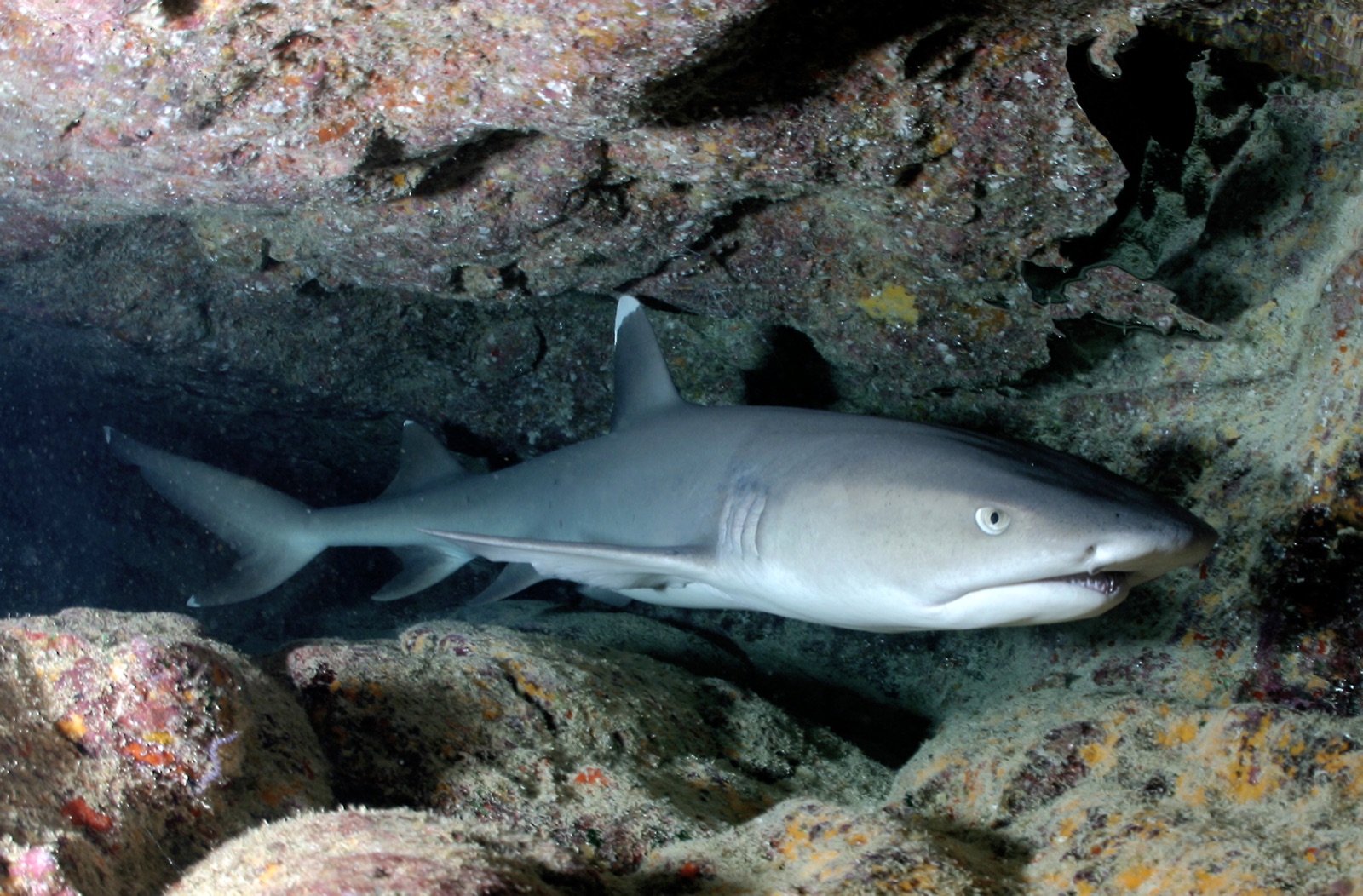
The whitetip reef shark is the reef's off-duty predator: slim, gray-brown, white-flagged on dorsal and tail tips, draped over a sand patch beneath a ledge in groups of three or six, gills sighing. Divers step over them, almost literally, on a thousand Indo-Pacific reefs. Come back after dark and the same animals hunt like ferrets, jamming into coral heads until fish panic into open water. At Cocos's Manuelita the night shift numbers in the hundreds and ranks among diving's great spectacles. Long-lived, small-littered, and reef-bound, whitetips have quietly declined across much of Southeast Asia even as protected populations thrive.
Où et quand en observer un
« Résident » signifie que la plupart des plongées sur ce site permettent de les observer ; « saisonnier » signifie qu'ils sont présents de manière fiable durant les mois indiqués ; tout le reste est un bonus, pas une certitude.
| Destination | Fiabilité | Mois | Notes |
|---|---|---|---|
| Galápagos IslandsEcuador | Resident: seen on most dives | Toute l'année | |
| Sipadan & MabulMalaysia | Resident: seen on most dives | Toute l'année | |
| PalauPalau | Resident: seen on most dives | Toute l'année | |
| Cocos IslandCosta Rica | Resident: seen on most dives | Toute l'année | |
| Tubbataha ReefsPhilippines | Resident: seen on most dives | Mar–Jun | |
| Sea of Cortez & Cabo PulmoMexico | Resident: seen on most dives | Toute l'année |
Meilleur mois, en un coup d'œil
Les comprendre
Habitat: Coral reefs with caves, ledges, and swim-throughs; rests by day on sand patches and inside overhangs
Aire de répartition: Indo-Pacific and Eastern Pacific: Red Sea to Hawaii and French Polynesia, plus Cocos, Malpelo, the Galápagos, and Central American coasts
Comportement: One of the few sharks that can pump water over its gills at rest, so days are spent stacked in caves or piled on sand, dozing in loose heaps. At night the species transforms into a relentless pack hunter, writhing into crevices after sleeping fish, the basis of Cocos Island's famous night dive.
Régime alimentaire: Reef fish, octopus, crabs, and lobster extracted from holes at night with a slender, flexible body built for the job
Taille: généralement autour de 1.2 m; documenté jusqu'à 1.7 m (total length).
Comment se comporter avec lui
Never block a cave mouth where sharks are resting, don't touch or prod dozing animals, and on night hunts hold your light steady off to the side rather than pinning fish for the pack.
Conservation
Assessed Vulnerable in 2020; heavy inshore fishing across the Coral Triangle drives the decline, while reserves such as Cocos and Tubbataha show how quickly protected populations stabilize.
Sites répertoriés connus pour leur présence
Les sites mis en évidence ont été cartographiés pour cette espèce par nos éditeurs ; les chiffres correspondent aux occurrences GBIF enregistrées dans un rayon d'environ 5 km d'un site depuis 1990.
Regarder
Depuis les canaux officiels

Wildlife of Monterey | New film in our auditorium

Live Aviary Cam | Monterey Bay Aquarium

Live Aviary Cam | Monterey Bay Aquarium
Les vidéos sont des liens intégrés vers les chaînes de leurs créateurs. Nous n'hébergeons rien et créditons tout.