Discover where to dive, when to go, and what you could see.

Discover where to dive, when to go, and what you could see.
★
Menu
Destinations Dive Sites Marine Life Wrecks News
Plan a trip Trip planner When to dive Cost calculator Comparisons Marine-life calendar Water temperature Liveaboards Operators & resorts Marine parks Hyperbaric chambers World map
Cave Diving All cave diving Destinations & Dive Sites Cave Systems & Maps Training & Qualifications Dive Centers & Guides Equipment & Technology Safety & Incident Research Science, History & Conservation Resources & Updates
Regions Australia, New Zealand & East AsiaCaribbean & Western AtlanticEurope, Atlantic & MediterraneanIndian Ocean & East AfricaPacific Islands & MicronesiaRed Sea & Middle EastSoutheast Asia & Coral TriangleThe Americas & Eastern Pacific Countries
Learn & Tools All guides Certifications Gear guides Videos Ask the Data AI Agents API
About About us Methodology Disclaimer Contact
Your view
★ Saved

Your starred destinations, sites and species, stored in this browser.

API GATEWAY

Free read-only JSON access to the atlas's cached data.

Dark mode

Guided View
New to diving? Depths, currents, certification levels? We explain every term as you browse, in plain English. Same data, with the help built in.

Expert View
You already know the difference between a wall and a drift. Just the data: clean, fast and compact. This is the default view.

Interface language
Cristóbal Colón

Cristóbal Colón

Spanish transatlantic passenger liner Sunk 1936 5–17 m Bermuda
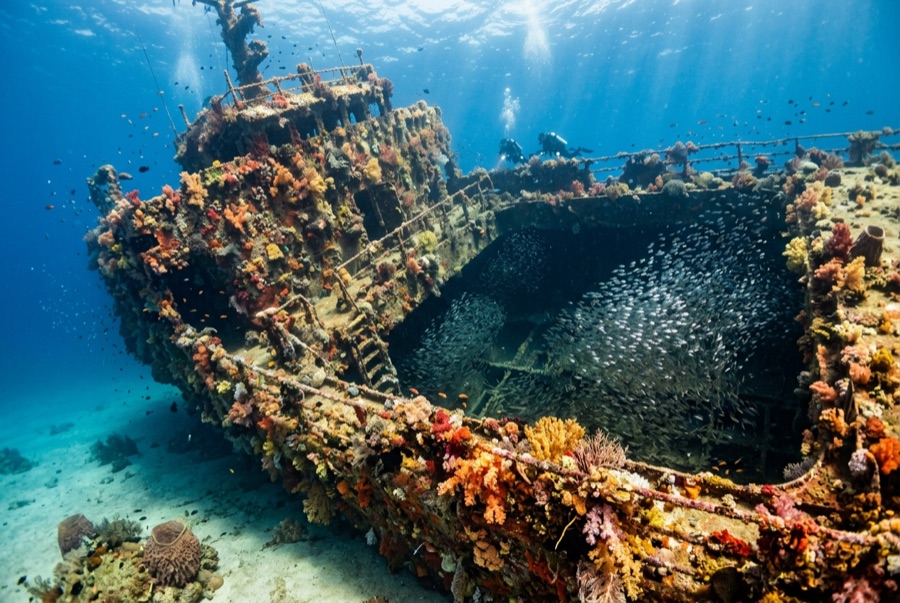
AI-generated illustration
No lives were lost hereNone: all aboard were taken off.
Well documented
Depth to deck
5 m / 16 ft
Maximum depth
17 m / 56 ft
Built / sunk
1923 / 1936
Length
152 m
Tonnage
10,833 GRT
Orientation
Broken And Scattered Across The Reef
Level
Beginner
Best months
May–Oct

The story

Bermuda's largest shipwreck died of misread lights and a civil war. The Cristóbal Colón, a 152-meter luxury liner of the Compañía Transatlántica Española, was steaming from Cardiff toward Mexico in October 1936 (with a skeleton complement and no paying passengers, in the opening months of the Spanish Civil War) when she drove onto the northern barrier reef at nearly full speed, apparently having mistaken her position off the low island. Everyone aboard got off safely, and for a while the stranded liner sat upright on the reef crest, so temptingly intact that Bermudians salvaged her fittings with enthusiasm; furniture from the Colón still surfaces in island houses. During the Second World War the hulk served as a bombing target, which finished the job of spreading her across the seabed. Today her remains sprawl over an enormous area on both sides of the reef in 5 to 17 meters: boilers, propellers, driveshafts, gears and acres of plating in gin-clear water. She is less a ship than a steel reef system, ideal for long, shallow wandering dives and even snorkeling on calm days.

How she sank: Ran onto Bermuda's northern barrier reef at speed on 25 October 1936.

Diving her today

Condition: Fully broken and dispersed: boilers, shafts and props recognizable amid vast plating fields

Penetration: None. Nothing enclosed remains; the site is an open debris field.

Recommended certification: Open Water

Current: Mild · Visibility: 15–30 m

Marine life: Parrotfish and blue angelfish graze the plates, gray snapper school in the boiler shadows, barracuda hover over the machinery, and hard corals grow straight from the steel.

Hazards: Surge over the shallow reef and sharp coral-crusted steel

Protection & law

Protected historic wreck of Bermuda: nothing may be lifted or disturbed

Bermuda's wrecks fall under the island's historic-wreck legislation; artifact recovery without license is illegal.

Watch

From the official channels

All videos →

Videos are embedded links to their creators' own channels. We host nothing and credit everything.

Sources: Bermuda Tourism Authority ↗Government of Bermuda (Department of Environment and Natural Resources) ↗University of California San Diego ↗ · Facts verified against the sources above; fields without support are labeled not yet verified.

Australia, New Zealand & East Asia

Cairns & the Ribbon ReefsNingaloo ReefCoral Sea & Osprey ReefOkinawa & the Kerama IslandsPoor Knights IslandsTownsville & the YongalaGreen IslandIzu Peninsula

Caribbean & Western Atlantic

BonaireCozumelRiviera Maya & the CenotesBelize Barrier ReefGrand CaymanIsla Mujeres & CancúnRoatánTiger Beach & Grand Bahama

Europe, Atlantic & Mediterranean

Malta & GozoSilfra & IcelandThe AzoresCanary IslandsLarnaca & the ZenobiaScapa FlowArctic NorwayMadeira

Indian Ocean & East Africa

North & South Malé AtollsAri AtollBaa Atoll & Hanifaru BayAliwal Shoal & UmkomaasMafia IslandMauritiusSeychellesSodwana Bay

Pacific Islands & Micronesia

PalauChuuk (Truk) LagoonFakaravaKona, HawaiʻiRangiroaTaveuni & Rainbow ReefBeqa Lagoon & Pacific HarbourEspiritu Santo

Red Sea & Middle East

Sharm El Sheikh & Ras MohammedBrothers, Daedalus & St John'sDahabHurghada & El GounaMarsa Alam & the Deep SouthAqabaDaymaniyat IslandsMusandam Peninsula

Southeast Asia & Coral Triangle

Bali & Nusa PenidaKomodoRaja AmpatSipadan & MabulAnilaoCoronKoh TaoLembeh Strait

The Americas & Eastern Pacific

Galápagos IslandsCocos IslandFlorida KeysSea of Cortez & Cabo PulmoSocorro & the RevillagigedosBritish ColumbiaCalifornia Channel IslandsCosta Rica Pacific Coast