Giannis D
Het verhaal
Launched in Japan in 1969 as Shoyo Maru, this mid-sized freighter passed through several owners before a Greek company renamed her Giannis D, painting the funnel with the D of the Dumarc line. In April 1983 she loaded sawn softwood at Rijeka on the Adriatic, bound for Jeddah and Hodeidah. Crossing the Strait of Gubal on 19 April, she ran at full sea speed onto the northwest corner of Sha'ab Abu Nuhas, the low reef that has collected more ships than any other in the northern Red Sea. The crew abandoned safely, and after weeks of pounding the hull broke into three. Her stern settled almost intact on its port side, engine room enclosed and inviting, while the midships collapsed into scattered plate. Within a decade she had become the signature wreck of Abu Nuhas, dived daily from Hurghada and El Gouna boats.
Hoe ze zonk: Ran onto Sha'ab Abu Nuhas reef at speed, 19 April 1983.
Duik er vandaag in
Conditie: The stern remains remarkably whole and is corroding slowly; the bow sits separately and the middle third is flattened wreckage.
Penetratieduiken: Full With Training. The tilted engine room is the famous swim: its slanted decks scramble the inner ear, so it belongs to trained wreck divers with a guide; the open midships is easy. Het betreden van een omgeving met overhead vereist specifieke training: minimaal een wrakbrevet, technische wraktraining voor volledige penetratie.
Aanbevolen certificering: Advanced Open Water
Stroming: Mild · Zicht: 10–25 m
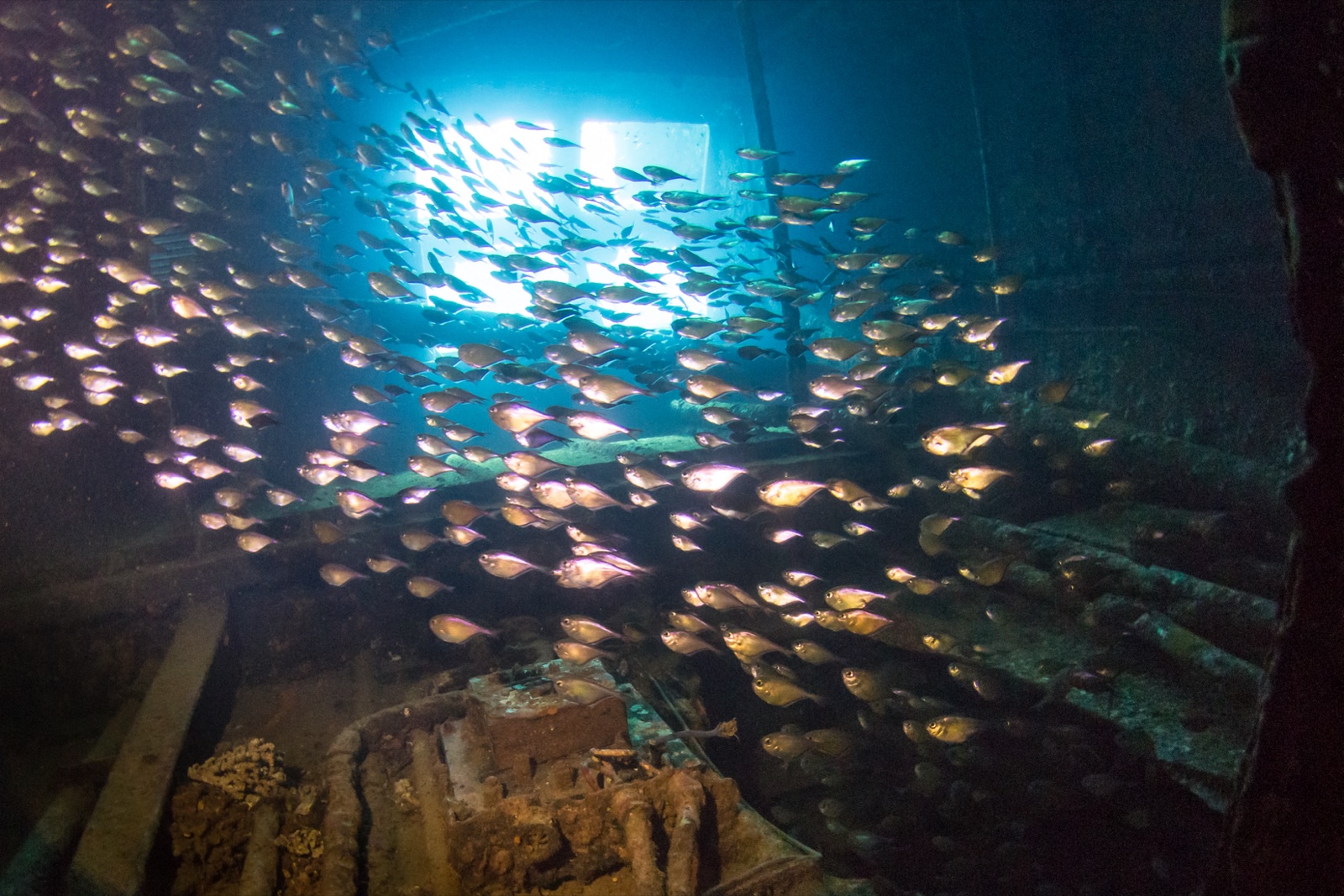
Zeeleven: Glassfish pack the engine room, anthias shimmer over the masts and A-frame, and lionfish, groupers, and batfish work the broken midships.
Gevaren: Disorienting angles inside the hull; surge over the shallow reef top; occasional swell makes boarding boats lively.
Bescherming & wetgeving
Leave fittings where they lie; Egyptian authorities prohibit removal.
Bekijk
Via de officiële kanalen

Deep-Sea Coral Fireworks

Camera 2: 2026 American Samoa ROV + Mapping Exploration (EX2606)
Video's zijn ingesloten links naar de eigen kanalen van de makers. We hosten niets en vermelden altijd de bron.