Dive sites, seasons and marine life — researched, mapped, planned.
Menu
Destinations Dive Sites Marine Life Wrecks News
Plan a trip Trip planner When to dive Cost calculator Comparisons Marine-life calendar Water temperature Liveaboards Operators & resorts Marine parks Hyperbaric chambers World map
Regions Australia, New Zealand & East AsiaCaribbean & Western AtlanticEurope, Atlantic & MediterraneanIndian Ocean & East AfricaPacific Islands & MicronesiaRed Sea & Middle EastSoutheast Asia & Coral TriangleThe Americas & Eastern Pacific Countries
Learn & Tools All guides Certifications Gear guides Videos Ask the Data AI Agents API
About About us Methodology Disclaimer Contact
Your view
★ Saved

Your starred destinations, sites and species — stored in this browser.

API GATEWAY

Free read-only JSON access to the atlas's cached data.

Dark mode

🧭 Guided View
New to diving — depths, currents, certification levels? We explain every term as you browse, in plain English. Same data, with the help built in.

⚡ Expert View
You already know the difference between a wall and a drift. Just the data — clean, fast and compact. This is the default view.

Interface language
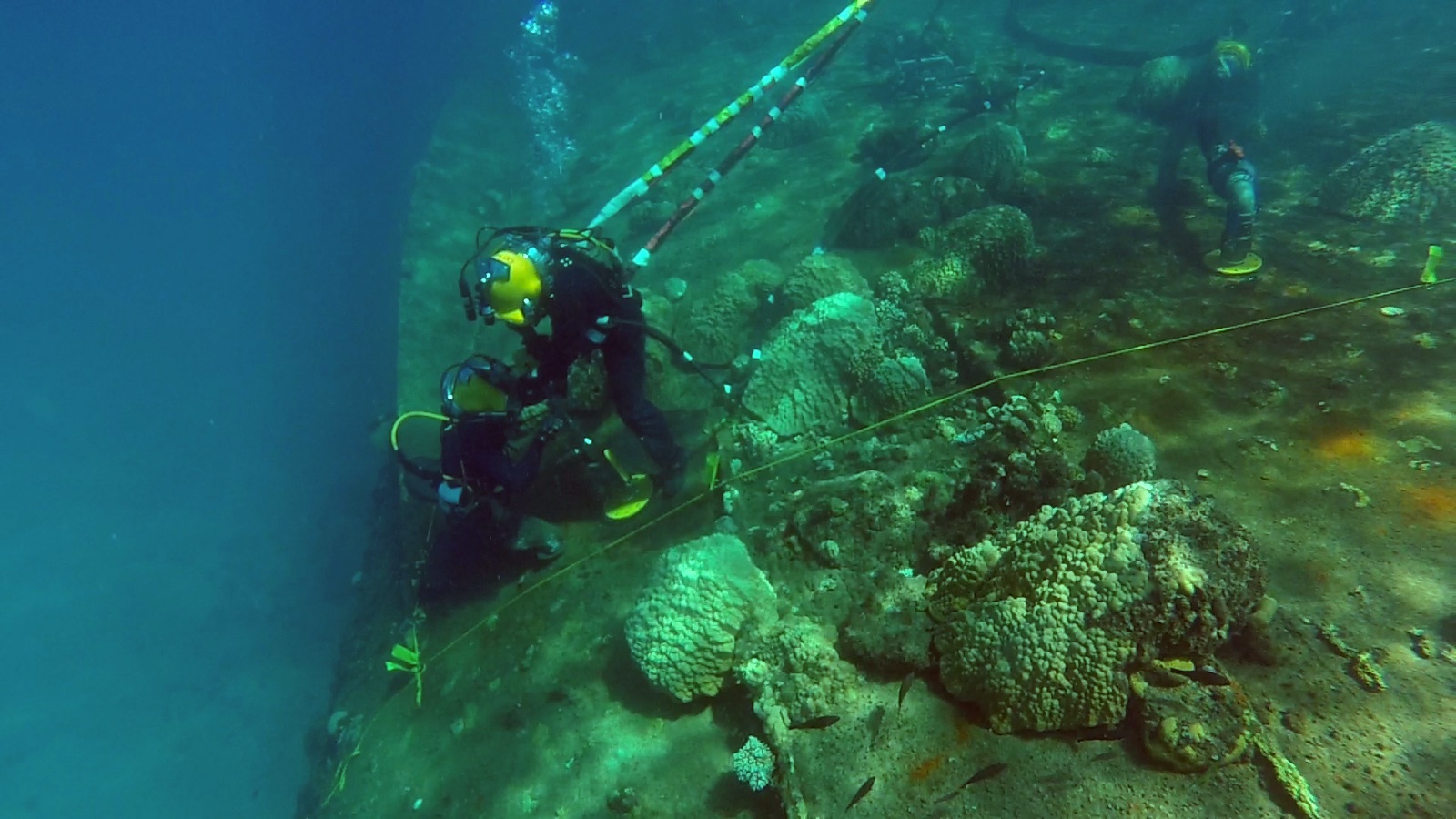
Prinz Eugen — illustrative image

Prinz Eugen

German Admiral Hipper-class heavy cruiser Sunk 1946 0–35 m Bikini Atoll
AI-generated illustration
Lives were lost hereNone in the capsizing. Local operators ask that the wreck be dived with corresponding respect.
Well documented
Depth to deck
0 m / 0 ft
Maximum depth
35 m / 115 ft
Built / sunk
1940 / 1946
Length
213 m
Orientation
Capsized, Stern Shallowest
Level
Intermediate
Best months
May–Oct

The story

Prinz Eugen led a charmed war. Commissioned in 1940, she sailed with Bismarck into the Denmark Strait action, ran the Channel Dash, and finished the war afloat — the only major German warship to do so in fighting condition. Handed to the US Navy as a prize, she was assigned to Operation Crossroads and survived both the Able and Baker blasts of July 1946 at Bikini with her hull essentially sound. Her end was quieter and stranger: towed to Kwajalein Atoll with a radiologically contaminated hull that crews could not safely maintain, she took on water through minor leaks no one could stop, heeled over through the autumn, and capsized onto a reef off Enubuj on 22 December 1946. She lies there today, upside down with her stern works near the surface — one propeller was raised in 1978 and stands at the Laboe Naval Memorial in Germany — and in 2018 a US–NOAA operation drained roughly 250,000 gallons of oil from her bunkers. The Scuba Atlas lists her with the Bikini fleet she belonged to; the dive itself happens at Kwajalein, subject to US Army and Marshallese access arrangements.

How she sank: Survived both Bikini atomic tests, was towed to Kwajalein Atoll, and capsized there from uncontrolled leaks on 22 December 1946.

Diving her today

Condition: Whole but inverted, gradually settling; the 2018 defueling removed the main pollution threat. Her Bikini radiation exposure has long since ceased to be a practical concern for external diving.

Penetration: Limited. An inverted warship is a maze turned wrong way up; interior forays belong to technical divers with lines, and casual entry has no place here. Entering any overhead environment requires specific training — a wreck certification at minimum, technical wreck training for full penetration.

Recommended certification: Advanced Open Water for the exterior

Current: Mild · Visibility: 15–30 m

Marine life: Corals and clams stud the upturned hull plates, reef fish crowd the shallow rudders, and turtles graze along the torpedo-tube sponsons.

Hazards: Entanglement on wartime fittings, overhead geometry everywhere, and access rules that change — arrange permissions before travel.

Protection & law

She remains US government property inside a controlled atoll; diving is arranged locally at Kwajalein rather than freely bookable.

War-prize or not, she is a protected historic hull — take nothing.

Watch

From the official channels

All videos →

Videos are embedded links to their creators' own channels — we host nothing and credit everything.

Sources: U.S. Navy ↗Wikipedia ↗ · Facts verified against the sources above; fields without support are labeled not yet verified.

Australia, New Zealand & East Asia

Cairns & the Ribbon ReefsNingaloo ReefCoral Sea & Osprey ReefOkinawa & the Kerama IslandsPoor Knights IslandsTownsville & the YongalaGreen IslandIzu Peninsula

Caribbean & Western Atlantic

BonaireCozumelRiviera Maya & the CenotesBelize Barrier ReefGrand CaymanIsla Mujeres & CancúnRoatánTiger Beach & Grand Bahama

Europe, Atlantic & Mediterranean

Malta & GozoSilfra & IcelandThe AzoresCanary IslandsLarnaca & the ZenobiaScapa FlowArctic NorwayMadeira

Indian Ocean & East Africa

North & South Malé AtollsAri AtollBaa Atoll & Hanifaru BayAliwal Shoal & UmkomaasMafia IslandMauritiusSeychellesSodwana Bay

Pacific Islands & Micronesia

PalauChuuk (Truk) LagoonFakaravaKona, HawaiʻiRangiroaTaveuni & Rainbow ReefBeqa Lagoon & Pacific HarbourEspiritu Santo

Red Sea & Middle East

Sharm El Sheikh & Ras MohammedBrothers, Daedalus & St John'sDahabHurghada & El GounaMarsa Alam & the Deep SouthAqabaDaymaniyat IslandsMusandam Peninsula

Southeast Asia & Coral Triangle

Bali & Nusa PenidaKomodoRaja AmpatSipadan & MabulAnilaoCoronKoh TaoLembeh Strait

The Americas & Eastern Pacific

Galápagos IslandsCocos IslandFlorida KeysSea of Cortez & Cabo PulmoSocorro & the RevillagigedosBritish ColumbiaCalifornia Channel IslandsCosta Rica Pacific Coast