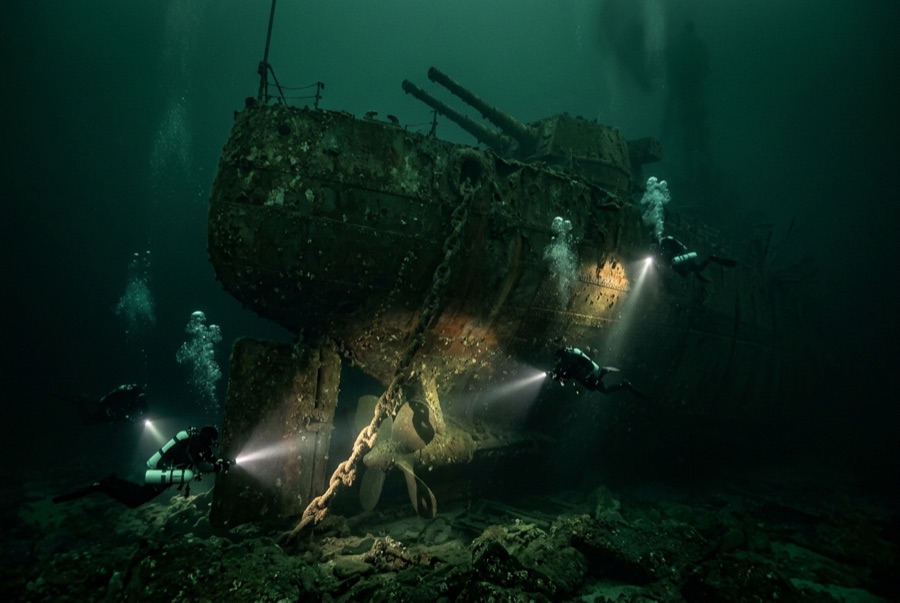
SMS Cöln
我们的故事
Launched in 1916 as lead ship of the Imperial Navy's final light-cruiser class, the Cöln arrived too late to shape the war she was built for; her career amounted to North Sea routine, the fleet's 1918 collapse, and the long gray internment at Scapa Flow. When von Reuter's signal came on 21 June 1919 she flooded and rolled under with the rest, and, lying in deeper water than the salvors cared to work, she was left where she fell. That neglect made her the connoisseur's wreck of the Flow. Resting on her starboard side in about 35 meters, the Cöln is the most intact of the surviving cruisers: her graceful clipper bow sweeps up off the seabed, anchor still housed, guns reach out over the sand, and along the port hull divers pass davits, bollards and the aft control position in something close to launch-day arrangement. Her near-sister Dresden lies a short boat ride away, and dive skippers enjoy pairing them (one preserved, one slowly folding) as a study in how a century underwater treats identical ships differently.
她是如何沉没的: Scuttled with the interned German High Seas Fleet on Admiral von Reuter's order, 21 June 1919.
今日潜水中
环境条件: The best-preserved cruiser of the German fleet; hull coherent with collapse beginning along the upper port side
穿越式潜水: Limited. Openings exist along the collapsing port side, but her very intactness means enclosed, silty spaces: trained wreck teams only. 进入任何封闭式环境都需要专项培训:至少需要沉船潜水认证,完整穿越则需要技术级沉船培训。
建议持有证书: Advanced Open Water with deep and drysuit experience
水流: Mild · 能见度: 4–12 m
海洋生物: Anemones and soft growth on rails and guns, saithe schooling along the hull, congers and lobsters inside, and the occasional seal buzzing decompression stops.
危险因素: Depth, cold, low ambient light, and entanglement on degraded fittings
保护与法规
Scheduled monument under UK law: diving permitted, disturbance and recovery prohibited
观看
来自官方渠道

Deep-Sea Coral Fireworks

Camera 2: 2026 American Samoa ROV + Mapping Exploration (EX2606)
视频均为创作者自有频道的嵌入链接。我们不托管任何内容,所有来源均注明出处。