Dive sites, seasons and marine life — researched, mapped, planned.
Menu
Destinations Dive Sites Marine Life Wrecks News
Plan a trip Trip planner When to dive Cost calculator Comparisons Marine-life calendar Water temperature Liveaboards Operators & resorts Marine parks Hyperbaric chambers World map
Regions Australia, New Zealand & East AsiaCaribbean & Western AtlanticEurope, Atlantic & MediterraneanIndian Ocean & East AfricaPacific Islands & MicronesiaRed Sea & Middle EastSoutheast Asia & Coral TriangleThe Americas & Eastern Pacific Countries
Learn & Tools All guides Certifications Gear guides Videos Ask the Data AI Agents API
About About us Methodology Disclaimer Contact
Your view
★ Saved

Your starred destinations, sites and species — stored in this browser.

API GATEWAY

Free read-only JSON access to the atlas's cached data.

Dark mode

🧭 Guided View
New to diving — depths, currents, certification levels? We explain every term as you browse, in plain English. Same data, with the help built in.

⚡ Expert View
You already know the difference between a wall and a drift. Just the data — clean, fast and compact. This is the default view.

Interface language
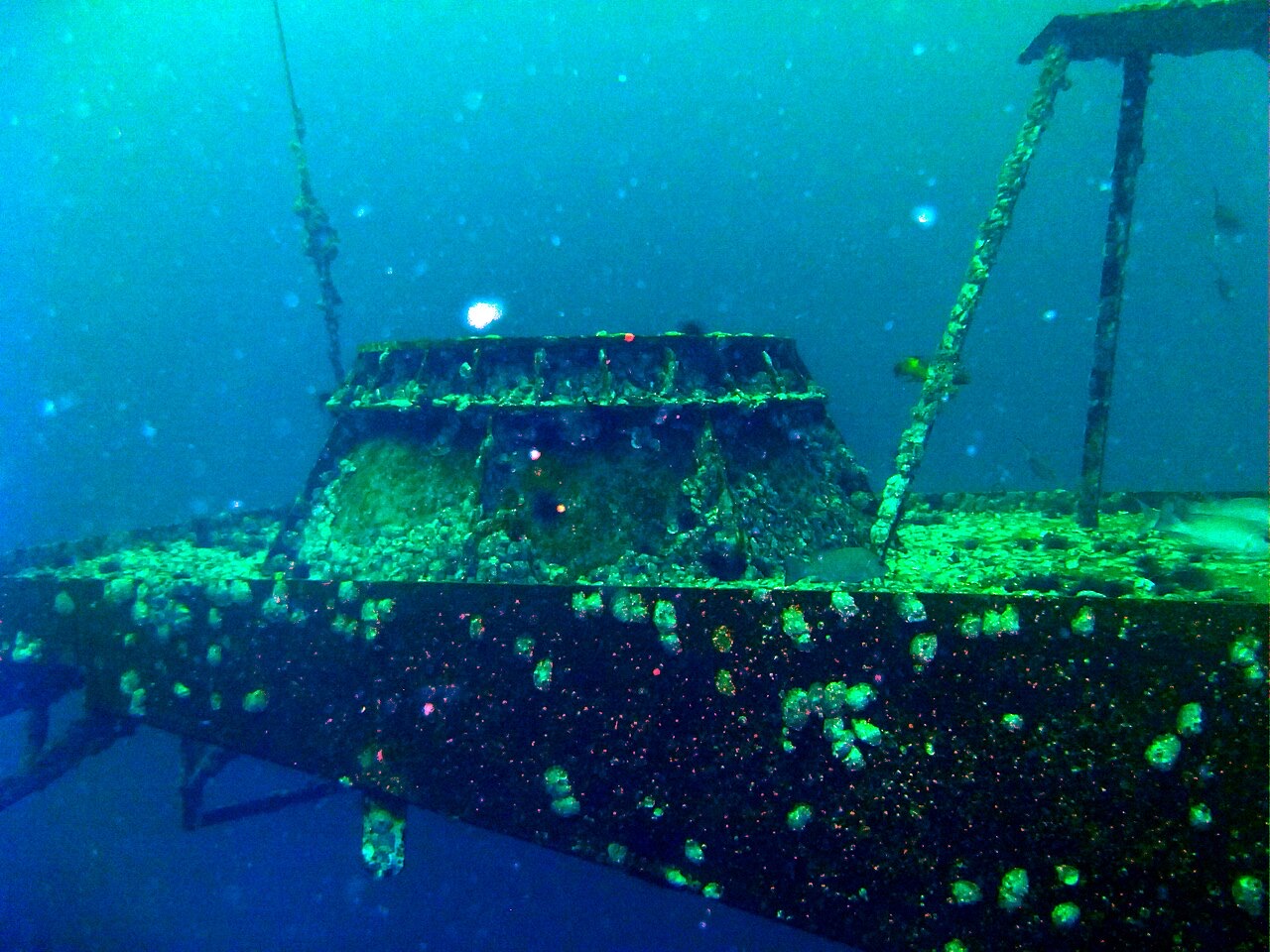
USS Oriskany — illustrative image

USS Oriskany

Essex-class aircraft carrier (CV-34) Sunk 2006 24–65 m Pensacola, Florida (Gulf of Mexico)
AI-generated illustration
Lives were lost hereNone in the scuttling; 44 men died in her 1966 shipboard fire, remembered by veterans who visit the wreck. Local operators ask that the wreck be dived with corresponding respect.
Well documented
Depth to deck
24 m / 79 ft
Maximum depth
65 m / 213 ft
Built / sunk
1945 / 2006
Length
271 m
Orientation
Upright
Level
Technical
Best months
May–Oct

The story

The 'Mighty O' fought two wars before becoming the largest ship ever deliberately sunk as an artificial reef. Completed after the Second World War to an improved Essex-class design, the Oriskany launched strikes through Korea and Vietnam; a magnesium-flare fire in 1966 killed 44 of her crew, and among her aviators was John McCain, shot down over Hanoi in 1967. Decommissioned in 1976 and slated for scrap, she was instead handed to Florida, cleaned of contaminants over years, and scuttled 22.5 miles southeast of Pensacola in May 2006 — the 'Great Carrier Reef.' She sits upright on sand at roughly 64 meters, and hurricanes have since settled her deeper into the bottom: the flight deck now lies near 44 meters, so recreational divers work only the island superstructure, which rises to about 24 meters, while the deck and hangar bays are the province of technical teams. Charters run from Pensacola and Destin, and on a clear day the tower emerging from blue Gulf water below a descent line is one of American diving's genuinely humbling sights.

How she sank: Deliberately scuttled as an artificial reef in the Gulf of Mexico off Pensacola, Florida, 17 May 2006.

Diving her today

Condition: Upright and structurally sound, settling gradually into the sand; lighter island fittings are corroding away

Penetration: Full With Training. Openings exist throughout the island and hull, but every enclosed space starts deep; interior work is technical diving, full stop, and the ship has claimed unprepared divers. Entering any overhead environment requires specific training — a wreck certification at minimum, technical wreck training for full penetration.

Recommended certification: Deep specialty for the island; technical training for the flight deck and below

Current: Moderate · Visibility: 10–30 m

Marine life: Amberjack and almaco jack swarm the tower, red snapper crowd the flight deck, sandbar sharks and the occasional whale shark cruise past, and baitballs sheet across the island in summer.

Hazards: Serious depth, open-water current, monofilament from fishing boats, and an interior far beyond recreational limits

Protection & law

Florida state artificial reef; removing anything from the former warship is prohibited

Watch

From the official channels

All videos →

Videos are embedded links to their creators' own channels — we host nothing and credit everything.

Sources: Florida Fish and Wildlife Conservation Commission ↗Wikipedia ↗ · Facts verified against the sources above; fields without support are labeled not yet verified.

Australia, New Zealand & East Asia

Cairns & the Ribbon ReefsNingaloo ReefCoral Sea & Osprey ReefOkinawa & the Kerama IslandsPoor Knights IslandsTownsville & the YongalaGreen IslandIzu Peninsula

Caribbean & Western Atlantic

BonaireCozumelRiviera Maya & the CenotesBelize Barrier ReefGrand CaymanIsla Mujeres & CancúnRoatánTiger Beach & Grand Bahama

Europe, Atlantic & Mediterranean

Malta & GozoSilfra & IcelandThe AzoresCanary IslandsLarnaca & the ZenobiaScapa FlowArctic NorwayMadeira

Indian Ocean & East Africa

North & South Malé AtollsAri AtollBaa Atoll & Hanifaru BayAliwal Shoal & UmkomaasMafia IslandMauritiusSeychellesSodwana Bay

Pacific Islands & Micronesia

PalauChuuk (Truk) LagoonFakaravaKona, HawaiʻiRangiroaTaveuni & Rainbow ReefBeqa Lagoon & Pacific HarbourEspiritu Santo

Red Sea & Middle East

Sharm El Sheikh & Ras MohammedBrothers, Daedalus & St John'sDahabHurghada & El GounaMarsa Alam & the Deep SouthAqabaDaymaniyat IslandsMusandam Peninsula

Southeast Asia & Coral Triangle

Bali & Nusa PenidaKomodoRaja AmpatSipadan & MabulAnilaoCoronKoh TaoLembeh Strait

The Americas & Eastern Pacific

Galápagos IslandsCocos IslandFlorida KeysSea of Cortez & Cabo PulmoSocorro & the RevillagigedosBritish ColumbiaCalifornia Channel IslandsCosta Rica Pacific Coast