安全性と事故から学べること
ケーブがなぜ専門的な準備を必要とするのか、どのような危険があるのか、そして公表されている調査や事故分析から何がわかったのかを解説します。
4 ガイド
リスクを理解する
Emergency resources and their limits
Environmental hazards in underwater caves
What accident analyses have found
Why overhead environments demand specialist preparation
8 事故件数
記録された事故とその調査結果
公式調査、査読済みまたは団体による分析、あるいは当事者による公表された記録がある事故のみを対象に、誰かを批判するためではなく学びを得るために要約しています。
| 年 | 事故 | 掲載元 |
|---|---|---|
| 2023 | Solo rebreather fatality, Cow Springs, Florida, 2023 | Organisation analysis |
| 2023 | Deep exploration fatality, Phantom Lake Spring, Texas, 2023 | Organisation analysis |
| 2022 | Cave traverse fatality, Manatee Springs, Florida, 2022 | Organisation analysis |
| 2022 | Deep rebreather fatality, Roaring River Spring, Missouri, 2022 | Organisation analysis |
| 2021 | Solo rebreather fatality, Devil's Eye cave system, Florida, 2021 | Organisation analysis |
| 2018 | Flooded cave rescue, Tham Luang, Thailand, 2018 | Peer reviewed |
| 2014 | Deep cave diving fatalities and recovery, Plura, Norway, 2014 | Organisation analysis |
| 2005 | Deep sinkhole fatality, Boesmansgat, 2005 | Peer reviewed |
Solo rebreather fatality, Cow Springs, Florida, 2023
In January 2023 a trained and experienced rebreather cave diver, diving solo, died close to the entrance of Cow Springs, Florida, a site owned by the NSS-CDS. The committee's analysis pointed to an improvised repair to damaged equipment and bailout regulators that could not be reached in time.
確認された調査結果。 According to the NSS-CDS Accident Analysis Committee, the diver had cut and taped over a damaged electronics cable on his rebreather after it was dropped, leaving only a head-up display to monitor his breathing gas; after recovery, water was found to have entered the improvised seal. IUCRR divers found him at the start of the upstream cave. His bailout cylinders and diluent were full; the valve that switches the mouthpiece from the loop was half closed with its lever detached on the cave floor; his unfinished guideline was wrapped around his body and tangled with a deployed bailout regulator; and his computer showed no movement after about ten minutes. The Medical Examiner recorded accidental drowning.
報告はされていますが、確認は取れていません。 The committee's best-guess sequence, in the absence of witnesses, is that water at the cut cable caused false oxygen readings, the diver tried to bail out, could not fully close the loop, and could not reach either bailout regulator before losing consciousness. A second pathologist, reviewing the autopsy without the incident details, found indications that the diver may have had immersion pulmonary oedema (fluid in the lungs during immersion), which could also explain an attempt to bail out.
不明。 There were no witnesses; the committee describes its reconstruction as the best available scenario from the scene evidence. Whether immersion pulmonary oedema occurred is not established.
公表された教訓。 The NSS-CDS committee called the field repair unsafe and ineffective, noted that bailout gas would have been immediately available had at least one bailout regulator been kept within easy reach, and concluded that a buddy would probably have turned the event into an incident or near miss, since the diver was in shallow water within about a three-minute swim of the entrance.
情報源: NSS Cave Diving Section ↗ · NSS Cave Diving Section ↗ · 確認済み 2026-10-14
Deep exploration fatality, Phantom Lake Spring, Texas, 2023
In October 2023 one of two divers on a deep exploration and survey dive in Phantom Lake Spring, west Texas, did not return. The project team recovered him over several days. The NSS-CDS analysis concluded that a sudden medical event, most likely cardiac, was the probable cause.
確認された調査結果。 According to the NSS-CDS Accident Analysis Committee, the two divers were extending exploration beyond a previous limit, reaching about 174 metres; the survivor last saw his partner in a chamber at about 140 metres, more than 2 km from the entrance, while surveying. On returning he found the chamber filled with dense silt and, with his own rebreather giving erratic readings, judged a search at that depth to be futile and dangerous; he developed symptoms of decompression illness on the ascent, extended his decompression and surfaced after 16.5 hours. Support divers searched as deep as their gas allowed without finding his partner. The missing diver was found two days later with his equipment functioning and no entanglement. Rebreather data showed repeated manual oxygen additions that the committee considered deliberate. After ruling out the usual diving explanations, the committee concluded that a significant non-diving medical problem, almost certainly cardiac and probably an abnormal heart rhythm, was the most likely cause, supported by post-mortem findings.
報告はされていますが、確認は取れていません。 The committee suggested the diver may have raised his oxygen level deliberately in response to symptoms he thought were cardiac.
不明。 The post-mortem examination was compromised by the time taken to bring the diver out, and some possible causes could not be excluded definitively.
公表された教訓。 The NSS-CDS committee advised that all divers, particularly those diving deep or in overhead environments, should seriously consider annual medical examinations, ideally by a physician trained in diving or hyperbaric medicine. It also suggested considering protocols that improve team cohesion and communication during highly focused tasks such as survey, while noting that closer proximity at that depth might have resulted in a double fatality.
情報源: NSS Cave Diving Section ↗ · NSS Cave Diving Section ↗ · 確認済み 2026-10-14
Cave traverse fatality, Manatee Springs, Florida, 2022
In May 2022 a team of four divers trained to introductory cave level attempted a traverse at Manatee Springs State Park that none had dived before. Turning back against strong flow, the team became separated and one diver ran out of breathing gas and died.
確認された調査結果。 According to the NSS-CDS Accident Analysis Committee, the four divers held Intro to Cave certification with about 100 dives at that level and planned a downstream traverse from Friedman's Sink to Catfish Hotel after watching an online video of the dive. At the end of the guideline they could not see daylight, doubted where they were and turned back toward a known exit, swimming against strong flow. They split into pairs; two divers exited at Sue Sink, a third exited at Friedman's Sink thinking the fourth was following, and the fourth diver was found by IUCRR divers in a dome near Friedman's Sink with both cylinders empty. The committee identified the decisive error as attempting a blind traverse into a siphon (a passage where water flows into the cave, away from the entry) in a system none of them knew. It noted that Intro to Cave divers are taught that traverses and siphons are beyond their training, that the park requires full cave training and a companion who has dived there before for dives at Friedman's Sink, and that the dive would be risky even for experienced full-cave divers.
報告はされていますが、確認は取れていません。 The committee listed contributing factors that may have changed the outcome: not extending the line a short distance to look for daylight, continued use of a wide-angle video light that reduced visibility and may have misled a teammate, and loss of team cohesion at both exits.
不明。 What happened to the fourth diver after the last pair separated near Friedman's Sink is not known in detail.
公表された教訓。 The NSS-CDS committee's central lesson is that regardless of training level, divers who had never dived the system did not know what they did not know, in particular the strength of the flow they would face if they had to turn back; it also drew attention to an online video that presented the dive as acceptable despite acknowledging it went against cave training.
情報源: NSS Cave Diving Section ↗ · NSS Cave Diving Section ↗ · 確認済み 2026-10-14
Deep rebreather fatality, Roaring River Spring, Missouri, 2022
In October 2022 a member of an exploration team placing safety cylinders at about 58 metres in Roaring River Spring, Missouri, had a seizure and died. The NSS-CDS analysis concluded that unsuitable gas for the depth led to oxygen toxicity.
確認された調査結果。 According to the NSS-CDS Accident Analysis Committee, the diver was setting stage cylinders at about 58 metres for a deeper exploration dive the following day when he suddenly swam upward, appeared to struggle with his rebreather and began convulsing; a teammate tried to help but was dragged to the bottom and had to break off when visibility, the guideline and his own exertion made it too dangerous. A second diver who descended to help also had to abandon the attempt. The committee concluded that the diluent and bailout gas the diver carried, which on analysis also differed from its label, was unsuitable for the planned depth, and that together with manual oxygen additions on the descent this produced a critically high oxygen level in the breathing loop for several minutes, leading to an oxygen-toxicity seizure. His equipment was intact and malfunction was not suspected.
報告はされていますが、確認は取れていません。 The committee suggested, as hypotheses, that nitrogen narcosis from a diluent without helium may have slowed his response, and that dense breathing gas and carbon dioxide build-up could have worsened both effects.
不明。 Whether any underlying medical condition or medication made the diver more susceptible is unknown; none was disclosed on his medical form.
公表された教訓。 The committee noted that individual susceptibility to oxygen toxicity varies widely and that divers should be conservative in planning their oxygen exposure. The report also records that a rescuer's own gas was set up for decompression rather than depth when he descended to help, illustrating how quickly a rescue attempt can endanger the rescuer.
情報源: NSS Cave Diving Section ↗ · NSS Cave Diving Section ↗ · 確認済み 2026-10-14
Solo rebreather fatality, Devil's Eye cave system, Florida, 2021
In January 2021 a trained rebreather diver died while diving solo on a survey project in the Devil's Eye system, Florida. The NSS-CDS analysis found his rebreather's oxygen supply had been shut off, probably by accident near a restriction.
確認された調査結果。 The Medical Examiner recorded accidental drowning. According to the NSS-CDS Accident Analysis Committee, the diver was found about 1,870 metres into the cave at a depth of about 44 metres, apparently in the middle of joining two sections of guideline, with his equipment in place and his bailout cylinders full. An in-line slider valve on his rebreather's oxygen feed was found closed. His dive computer showed no oxygen added to the breathing loop after about 85 minutes and an oxygen reading of zero by about 110 minutes. The committee concluded that the valve was accidentally shut, probably while he passed a tight rock-on-rock restriction, and that he continued breathing from the loop until there was too little oxygen to remain conscious.
報告はされていますが、確認は取れていません。 The committee presents the timing and cause of the valve closure as the likely explanation rather than as directly observed.
不明。 Exactly how and when the valve was closed is not known. According to the sheriff's office records cited by the committee, no further equipment examination was carried out after the death was ruled accidental.
公表された教訓。 The NSS-CDS committee identified three measures that may have prevented the death: diving with a buddy, who can spot an anomaly before it becomes a problem; a secondary head-up oxygen display in the diver's line of sight, especially during task-heavy work such as survey; and careful consideration of the risk that in-line shut-off valves can be closed inadvertently.
情報源: NSS Cave Diving Section ↗ · NSS Cave Diving Section ↗ · 確認済み 2026-10-14
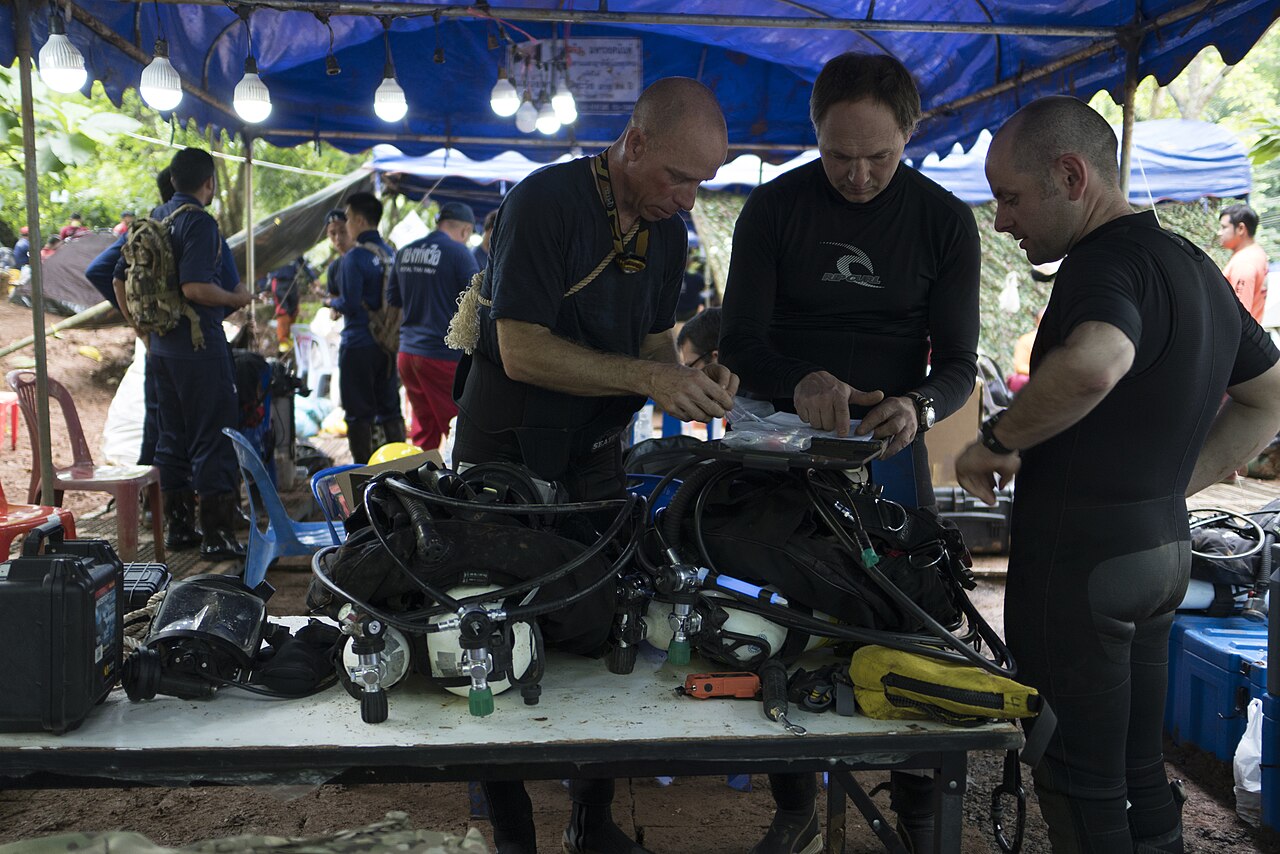
Flooded cave rescue, Tham Luang, Thailand, 2018
In mid-2018 floodwater trapped twelve boys and their football coach in Tham Luang cave, Thailand. After British cave divers found them, an international team brought all thirteen out through flooded passages on 8-10 July. Former Thai Navy SEAL Saman Kunan died supporting the operation.
確認された調査結果。 The British Cave Rescue Council states that two members of its cave diving team found the group alive on a ledge about 2,300 metres from the entrance, that Thai authorities concluded diving them out was their only hope, and that the last of the boys was brought out on 10 July, about eighteen days after the group entered the cave. A peer-reviewed description by van Waart and colleagues (2020) records that the route out was about 2.6 km long, of which about 1.1 km was fully flooded in six sumps (fully water-filled sections between air spaces), with depths up to 4.5 metres, water at 23 degrees C, near-zero visibility, moderate flow and tight restrictions. The children were anaesthetised and carried out face-down in full-face masks supplied with oxygen-enriched gas on open circuit, each towed by a rescue diver. None drowned; three showed chest X-ray changes consistent with minor aspiration or infection and one was severely hypothermic and was rewarmed without lasting harm. The Cave Diving Group records that Saman Kunan died while supporting the operation.
報告はされていますが、確認は取れていません。 Contemporary press accounts differed on distances, timings and the daily sequence of the rescue; this record relies on the BCRC statement and the peer-reviewed description rather than press reports.
不明。 The peer-reviewed paper's daily breakdown of rescues does not add up to thirteen as printed. The circumstances of Saman Kunan's death are not described in the sources opened for this record, and no official Thai government report was opened.
公表された教訓。 Van Waart and colleagues cautioned against generalising the success to other diving scenarios: the positive-pressure function of the full-face mask was shown to work on open circuit but not on a rebreather with back-mounted counterlungs, ketamine anaesthesia differs from unconsciousness caused by a diving emergency, and the safest place for an unconscious diver remains the surface. They suggested the methods might apply to bringing an injured caver through a sump. An ethics paper by Irwin (2022) discussed how informed consent was justifiably waived in the disaster setting and the role of virtue ethics for the rescue team.
情報源: Diving and Hyperbaric Medicine (via PubMed Central) ↗ · British Cave Rescue Council ↗ · Cave Diving Group ↗ · Journal of Bioethical Inquiry (via PubMed) ↗ · 確認済み 2026-10-14
Deep cave diving fatalities and recovery, Plura, Norway, 2014
In February 2014 two members of a five-person Finnish team died during a deep rebreather traverse of the Plura cave system in Plurdalen, Nordland. Norwegian authorities judged a recovery too dangerous; in March 2014 the survivors and other divers recovered both bodies themselves.
確認された調査結果。 No official investigation findings were available to this record. Yle reported in February 2014 that the three survivors gave their account to the Finnish Divers' Association's accident investigation committee and that, at their request, the report was published on the association's website; that report was not located for this edition, so its conclusions are not summarised here.
報告はされていますが、確認は取れていません。 According to the survivors' account as reported by Yle and the Norwegian newspaper VG, the team dived in two groups about two hours apart on a planned five-hour dive with a deepest point of roughly 130 metres. At about 110 metres one diver of the first pair became stuck in a narrow passage, entangled in the guideline, and died despite his partner's efforts to free him. In the second group, one diver had an equipment problem, switched to his backup breathing apparatus and also died despite help from a teammate. The three survivors spent many hours underwater on the exit and were treated for decompression sickness in Tromsø. Police deemed a recovery operation too dangerous and banned entry to the cave; in March 2014 a privately organised team recovered both bodies (Yle reported 17 divers; VG described 17 Finns and 10 Norwegians taking part), and Norwegian police said they were questioning the recovery divers.
不明。 Press sources give the date as 6 or 7 February 2014 and differ on depths (110 or 112 metres for the first incident; 129 or 132 metres for the deepest point) and on time underwater. The nature of the second diver's equipment problem, the content of the Finnish association's report and the outcome of the Norwegian police inquiry are not established in sources opened for this record. A separate fatality at Plura in April 2024 is listed by the NSS-CDS as an analysis in progress.
公表された教訓。 No lessons attributed to an investigating body could be verified for this record.
情報源: Yle ↗ · Yle ↗ · VG ↗ · Wikipedia ↗ · NSS Cave Diving Section ↗ · 確認済み 2026-10-14
Deep sinkhole fatality, Boesmansgat, 2005
In January 2005 an experienced rebreather diver died at extreme depth in Boesmansgat, a flooded sinkhole in South Africa, while trying to recover the remains of a diver lost there in 1994. A peer-reviewed paper later analysed video from the dive.
確認された調査結果。 A peer-reviewed case report by Mitchell and colleagues (2007) analysed underwater video recorded by a diver who died at 264 metres in fresh water. The authors concluded that the very high density of breathing gas at that pressure progressively raised resistance to breathing, both in the diver's airways and in the rebreather's breathing circuit. Faced with physical work at the bottom, the diver could not breathe enough to clear carbon dioxide; breathlessness, rising carbon dioxide and wasted breathing effort fed each other until he lost consciousness. The paper does not name the diver or the site; reference sources identify it as this dive.
報告はされていますが、確認は取れていません。 Popular and reference accounts, which are not an investigation, report that the remains being recovered were unexpectedly buoyant and that the diver became entangled in lines and a light cable while handling them. The same accounts report that both bodies rose and were recovered near the surface a few days later, during the retrieval of equipment.
不明。 This record found no official investigation report. How the entanglement described in popular accounts interacted with the respiratory crisis described in the paper has not been set out in an official finding. Reference sources differ slightly on the recovery date (three days later, or 12 January 2005).
公表された教訓。 Mitchell and colleagues wrote that the case confirmed predictions made by early researchers about breathing at extreme pressure, and that the growing number of deep technical divers needs to understand that there are physiological limits to consider when planning extreme dives.
情報源: Aviation, Space, and Environmental Medicine (via PubMed) ↗ · Wikipedia ↗ · Wikipedia ↗ · 確認済み 2026-10-14
6 団体数
安全・レスキュー関連団体
British Cave Rescue Council
DAN Europe
Divers Alert Network
European Cave Rescue Association
International Underwater Cave Rescue and Recovery
Spéléo-secours français
独自の調査とガイダンス
| タイトル | 著者または出版社 | 年 |
|---|---|---|
| Basic Cave Diving: A Blueprint for Survival ↗The founding text of accident-analysis-based cave diving safety. Each chapter opens with a real accident and draws out a... | Sheck Exley | 1979 |
| BCRC Incident Reports ↗Annual summaries, from 2004 onwards, of the underground and surface incidents that British volunteer cave rescue teams... | British Cave Rescue Council | — |
| DAN Publication Library (Annual Diving Reports and workshop proceedings) ↗DAN's library of annual reports analysing incidents and fatalities reported to it since 1988, along with risk guides and... | Divers Alert Network | — |
| A 10-year estimate of the incidence of decompression illness in a discrete group of recreational cave divers in Australia ↗A retrospective study of cave divers treated for decompression illness after diving in the Mount Gambier karst of South... | R. J. Harris; G. Frawley; B. C. Devaney; A. Fock; A. B. Jones | 2015 |
| American Cave Diving Fatalities 1969-2007 ↗An analysis of 368 American cave diving deaths over almost four decades, comparing trained and untrained divers. Useful for... | Peter L. Buzzacott; Erin Zeigler; Petar Denoble; Richard Vann | 2009 |
| Deep anaesthesia: The Thailand cave rescue and its implications for management of the unconscious diver underwater ↗The peer-reviewed medical account of the 2018 Tham Luang rescue, describing the anaesthetic approach and testing the full-face... | Hanna van Waart, Richard J. Harris, Nicholas Gant, Xavier C. E. Vrijdag, Craig J. Challen, Chanrit Lawthaweesawat, Simon J. Mitchell | 2020 |
| Fatal respiratory failure during a 'technical' rebreather dive at extreme pressure ↗A physiological interpretation of video recorded during a fatal rebreather dive to 264 metres, explaining how dense breathing... | Simon J. Mitchell, Frans J. Cronjé, W. A. Jack Meintjes, Hermie C. Britz | 2007 |
| Is more complex safer in the case of bail-out rebreathers for extended range cave diving? ↗A discussion of redundancy in long-range cave diving and of the growing practice of carrying a second rebreather instead of... | Derek B. Covington, Charlotte Sadler, Anthony Bielawski, Gareth Lock, Andrew Pitkin | 2022 |
| Recovery of deceased scuba divers from within flooded subterranean caves ↗Describes, stage by stage, how IUCRR divers carry out body recoveries with law enforcement and medical examiners, with five... | Peter Buzzacott, Craig Nelson, Ken Hill, Lamar Hires | 2017 |
| Thirty years of American cave diving fatalities ↗A review of 161 cave diving deaths reported to DAN between July 1985 and June 2015, covering training status, safety rules... | Leah Potts, Peter Buzzacott, Petar Denoble | 2016 |
| Underwater cave diving fatalities in Florida: a review and analysis ↗An early forensic review of Florida cave diving deaths from 1962 to 1991 and 1995-1996, written when no formal accident data... | J. H. Byrd, W. F. Hamilton | 1997 |
| NSS-CDS Accident Analysis ↗A running list of North American cave diving incidents with downloadable committee reports (recent cases from 2021 onwards,... | NSS-CDS Accident Analysis Committee | — |
| Report an Incident ↗DAN's voluntary reporting route for diving injuries, near misses and witnessed accidents, feeding a database kept since 1989;... | Divers Alert Network | — |
| Where's the Nearest Chamber? ↗DAN Europe's explanation of why the nearest hyperbaric chamber may be closed, unstaffed or unwilling to treat divers, and why... | DAN Europe Staff | 2015 |
| Why Does DAN Not Share Chamber Availability ↗A short explanation of why an injured diver should be assessed at a hospital or emergency clinic before anyone thinks about a... | Divers Alert Network | — |