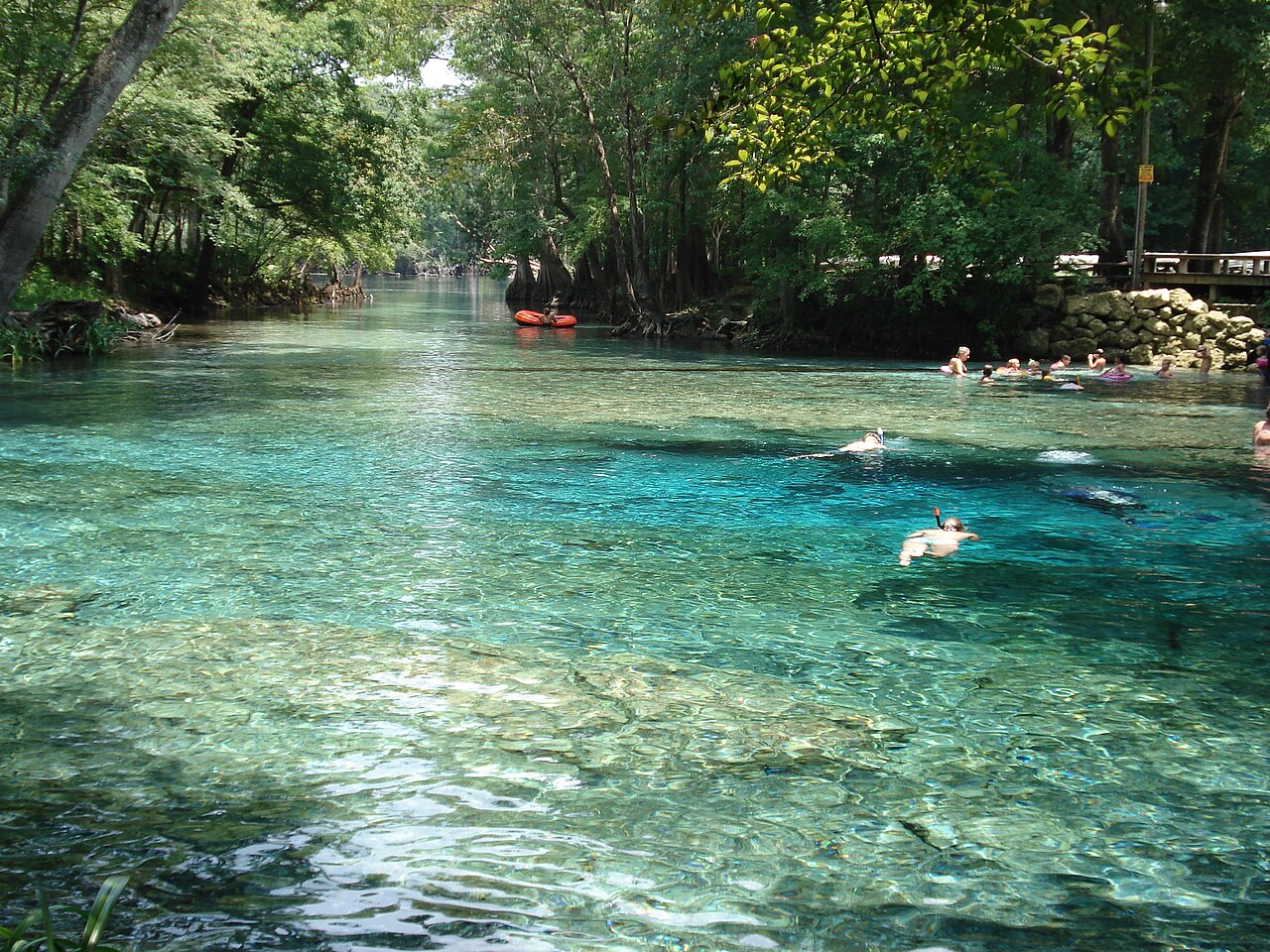
Ginnie Spring (Ginnie Ballroom)
Cavern only (cave gated): Ginnie Springs operator rule [1] (Certified divers of all levels may carry lights; the cave beyond is closed by a grate.). Ces catégories sont propres au système de certification mentionné ; elles décrivent la formation requise pour le site.
The main spring at Ginnie Springs: a broad, shallow basin leading to a large cavern room (the Ballroom) about 15 metres deep, with a welded grate at the back that keeps divers out of the cave beyond.
Ginnie Spring is a bowl-shaped basin more than 30 metres across and about 4.5 metres deep, connected by a short run to the Santa Fe River. From the basin, divers drop into the Ballroom, an amphitheatre-sized cavern room that reaches about 15 metres at its very back.
A large welded grate at the back of the Ballroom blocks entry to the silty, maze-like cave system that lies beyond, so this is a cavern dive only. A heavy guideline runs from the back of the room to the entrance to show the way out (a guideline is a fixed line that divers follow in an overhead environment). Ginnie Springs allows certified divers of all experience levels to carry lights here, unlike at the Devil's springs.
L'environnement
Clear spring water flowing through a large cavern room; about 35 million gallons a day pass through the opening near the grate, according to the park.
Conditions
DAN reports the cavern at 20 to 50 feet (6 to 15 m), and notes the park is crowded on weekends from Memorial Day to Labor Day. Flow through the grate area is strong.
Fourchettes indicatives issues de sources publiées, pas les conditions actuelles.
Installations
Decks and stairs with railings into the spring; bathhouses with hot showers; park store with an open water dive centre, air fill station and rental department; camping.
Pour s'orienter, pas pour naviguer. Les points creux sont approximatifs.
Chaque information de cette page, avec sa source (13)
| Information | Statut | Source |
|---|---|---|
| The Ginnie Springs basin is bowl-shaped, over 100 feet across and 15 feet deep.15 ft is about 4.6 m; landowner figure. | Vérifié | [1] |
| The Ballroom reaches a maximum depth of 50 feet at its very back.DAN gives the cavern as 20 to 50 feet (6 to 15 m). | Vérifié | [1] [4] |
| A large welded grate at the back of the Ballroom keeps divers out of the cave system beyond, and certified divers of all experience levels may bring lights. | Vérifié | [1] [4] |
| About 35 million gallons of water a day pass through the opening near the grate.Landowner figure. | Vérifié | [1] |
| Florida spring water runs 72°F (22°C) year-round.General Florida figure. | Signalé | [4] |
| Ginnie Springs is crowded on weekends from Memorial Day to Labor Day. | Signalé | [4] |
| Divers must register before diving. | Vérifié | [2] |
| Daily scuba admission is $28 for certified full cave divers or equivalent and $36 for all other certified divers.Read 2026-10-14. | Vérifié | [3] |
| Park hours are Monday to Thursday 8AM-5PM, Friday and Saturday 8AM-7PM, Sunday 8AM-6PM. | Vérifié | [3] |
| The park store includes a country store and dive centre selling open water gear, an air fill station and a rental department; bathhouses have hot showers. | Vérifié | [5] |
| USGS lists Ginnie Springs (site 295010082420101) at latitude 29.83622222. | Vérifié | [6] |
| USGS lists Ginnie Springs at longitude -82.70027778. | Vérifié | [6] |
| Ginnie Springs requires divers to register prior to diving and links a waiver for visitors to sign.Landowner rules page read 2026-10-14. | Vérifié | [2] |
Vérifié : indiqué par une source officielle ou primaire que nous avons consultée. Signalé : issu d'une source secondaire uniquement. Sources contradictoires : la note présente les deux versions. Peut être obsolète : la source la plus récente que nous avons trouvée est ancienne.
Rédigé dans nos propres mots à partir des sources ci-dessus. Signaler une correction