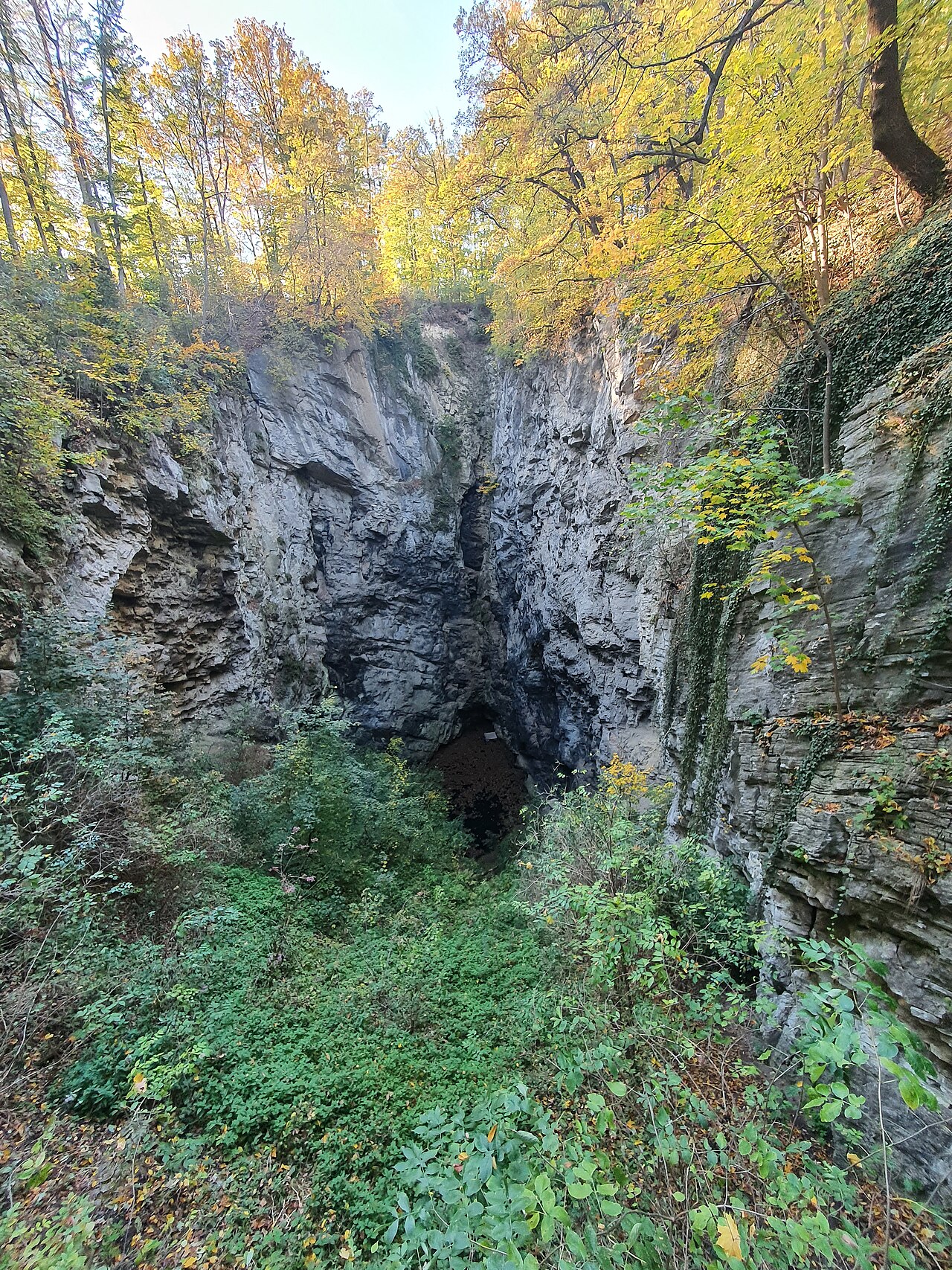
Hranice Abyss – shaft and lake
The single entrance to Hranice Abyss: a 69.5 m deep dry shaft ending at a small green lake that drops to more than 450 m. Viewable from a public platform; the water is a research-only dive site.
The rim of the abyss lies at about 315 m above sea level in the Hůrka u Hranic National Nature Reserve. The dry shaft descends 69.5 m to a small lake that appears to be the floor of the shaft but is in fact the surface of a flooded chasm more than 450 m deep.
Visitors can reach a viewing platform on foot from Teplice nad Bečvou railway station along a nature trail, or from the Hranice campsite on marked trails. The water itself is reached only by the research team of ZO 7-02 Hranický kras, which works under a legal exemption and maintains equipment such as a winch for its dives.
L'environnement
Lukewarm, CO2-saturated mineral water in a vertical chasm cut in limestone; a 2022 trap survey found no amphipods and researchers judged the deep water unsuitable for life.
Installations
Viewing platform over the shaft; marked trails from Teplice nad Bečvou railway station and the Hranice campsite.
Chaque information de cette page, avec sa source (6)
| Information | Statut | Source |
|---|---|---|
| The dry entrance shaft is 69.5 m deep, 104 m long and 34 m wide. | Vérifié | [2] [3] |
| The flooded part was measured at 450.6 m deep in 2022 without reaching the bottom.Older figure of 404 m (2016) is still shown elsewhere on the site. | Vérifié | [2] |
| Research is carried out by ZO 7-02 Hranický kras under an exemption from Act No. 114/1992 Coll.; the reserve is managed by the Nature Conservation Agency of the Czech Republic, Olomouc office.No public diving rules were found. | Vérifié | [1] [2] |
| A viewing platform overlooks the shaft, reached on foot from Teplice nad Bečvou station or the Hranice campsite. | Vérifié | [1] [3] |
| The rim of the abyss is at 315 m above sea level. | Vérifié | [2] |
| Diving is done by the research group under an exemption from Act No. 114/1992 Coll. | Vérifié | [1] |
Vérifié : indiqué par une source officielle ou primaire que nous avons consultée. Signalé : issu d'une source secondaire uniquement. Sources contradictoires : la note présente les deux versions. Peut être obsolète : la source la plus récente que nous avons trouvée est ancienne.
Rédigé dans nos propres mots à partir des sources ci-dessus. Signaler une correction