Descubre dónde bucear, cuándo ir y qué podrías ver.

Descubre dónde bucear, cuándo ir y qué podrías ver.
★
Menú
Destinos Puntos de buceo Vida marina Pecios Noticias
Planifica un viaje Planificador de viajes Cuándo bucear Calculadora de costes Comparativas Calendario de fauna marina Temperatura del agua Liveaboards Operadores y resorts Parques marinos Cámaras hiperbáricas Mapa mundial
Buceo en cuevas Todo sobre el buceo en cueva Destinos y sitios de buceo Sistemas de Cuevas y Mapas Formación y titulaciones Centros de buceo y guías Equipamiento y tecnología Seguridad e investigación de incidentes Ciencia, historia y conservación Recursos y actualizaciones
Regiones Australia, Nueva Zelanda y Asia OrientalCaribe y Atlántico occidentalEuropa, Atlántico y MediterráneoOcéano Índico y África OrientalIslas del Pacífico y MicronesiaMar Rojo y Oriente MedioSudeste Asiático y el Triángulo del CoralLas Américas y el Pacífico Oriental Países
Aprender y herramientas Todas las guías Certificaciones Guías de equipo Vídeos Consulta los datos Agentes de IA API
Acerca de Quiénes somos Metodología Aviso legal Contacto
Tu vista
★ Guardado

Tus destinos, puntos de buceo y especies marcados como favoritos, guardados en este navegador.

API GATEWAY

Acceso JSON gratuito de solo lectura a los datos en caché del atlas.

Modo oscuro

Vista guiada
¿Nuevo en el buceo? ¿Profundidades, corrientes, niveles de certificación? Explicamos cada término mientras navegas, en un lenguaje claro. Los mismos datos, con la ayuda integrada.

Vista experta
Ya conoces la diferencia entre una pared y un drift dive. Solo los datos: claros, rápidos y concisos. Esta es la vista predeterminada.

Idioma de la interfaz
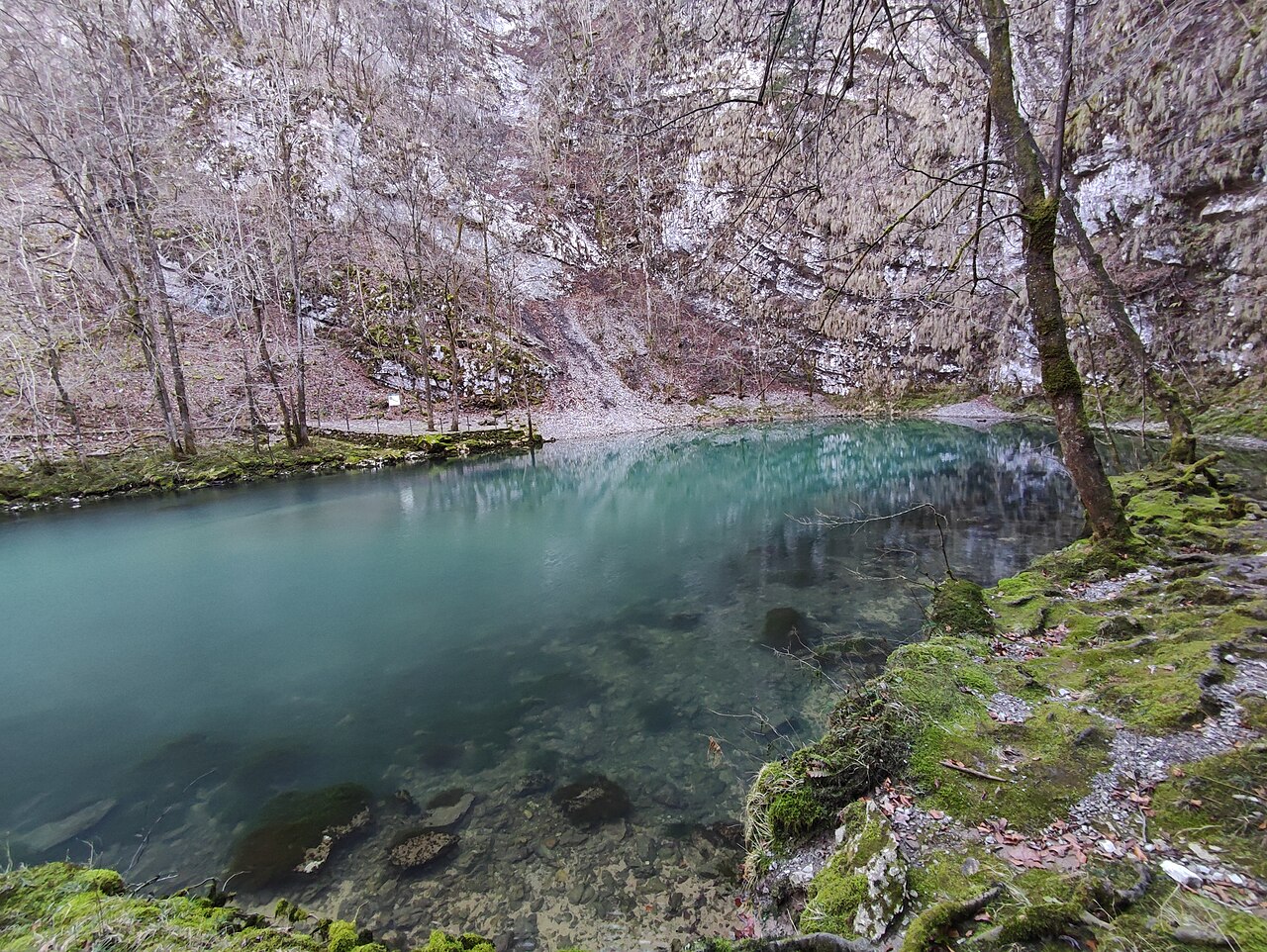
Divje jezero

Divje jezero

Sistema de surgencias160 m profundoSlovenia, Idrija
Foto: Ajznponar · CC0
Cerrado para buceo The FFS fiche states that, after fatal accidents in recent years, dives in the spring are prohibited; the lake itself is a protected natural site with free public access. The authority and date of the ban are not given. Las normas de acceso cambian: confírmalo con el propietario del terreno o la autoridad gestora antes de viajar.
Documentado También conocido como: Wild Lake, Lac sauvage, Divje jezero (Idrija), Divjak
Longitud relevada
No publicado
Profundidad documentada
160 m (525 ft)
Entradas listadas
1
Temperatura del agua
6–7 °C
Cartografía y exploración
D.Z.R.J.S. (Ljubljana cave exploration society, as named on the FFS fiche)

Depth reached by Luigi Casati, about 450 m from the entrance, as reported on the FFS fiche (date of the dive not given).

A karst spring lake in a steep rock amphitheatre in the Idrijca valley near Idrija whose flooded shaft has been explored to 160 m. After several fatal accidents, diving in the spring is reported to be prohibited.

Divje jezero, the 'Wild Lake', is a deep spring pool about 60 by 30 m set in a dark, cliff-walled cirque in the Idrijca valley south of Idrija. The FFS fiche describes it as a protected natural site that remains freely accessible to visitors.

At the bottom of a cobble slope cluttered with tree trunks, the flooded gallery begins at about 15 m. The conduit, of tectonic origin, descends through a chaotic gallery to about 60 m, where a terminal shaft bends into an inclined tube that divers have followed to 160 m.

Slovenian divers explored the cave in stages from 1957, reaching 38 m in 1969, 50 m in 1972 and 83 m in 1981. Tomo Vrhovec passed 100 m in 1995 and reached about 135 m in 2000; Olivier Isler reached 122 m in 1996; and the Italian diver Luigi Casati reached 160 m about 450 m from the entrance, with eight hours of decompression in very cold water. Three divers have died in the spring according to a report quoted on the fiche.

The fiche states that, following these fatal accidents, dives in the spring are now prohibited. Water temperature is given as about 6 to 7 °C, and divers have reported poor visibility.

Agua, flujo e inundaciones

A powerful spring draining depressions on the higher massifs to the south; the FFS fiche mentions a reported hydrological link with the Postojna region.

Por qué es importante

One of Slovenia's best-known deep karst springs and a site of deep exploration dives since 1957.

Condiciones

Very cold water; poor visibility reported by explorers (about 3 m on one 1996 dive).

Rangos típicos de fuentes publicadas, no condiciones actuales.

Historia de topografía y exploración

1957B. Rupnik and M. Straus make the first dive and find a flooded gallery at the bottom of the lake. [1]
1981P. Krivic and A. Praprotnik reach 200 m from the entrance at 83 m depth. [1]
1996-02Olivier Isler reaches 122 m depth, 335 m from the entrance. [1]
2000Tomo Vrhovec reaches about 135 m. [1]

Entradas y sitios de buceo

One entrance, the spring lake.
Fuentes: [1] plongeesout.ffspeleo.fr ↗ · comprobado 2026-10-14
Cada dato de esta página, con su fuente (6)
DatoEstadoFuente
Luigi Casati reached 160 m depth about 450 m from the entrance.Quoted report on the fiche; dive date not given. Reportado [1]
The lake measures about 60 x 30 m and the gallery starts at 15 m at the base of a cobble slope. Verificado [1]
Exploration reached 38 m (1969), 50 m (1972), 83 m (1981), 112 m (1995), 122 m (1996) and about 135 m (2000). Verificado [1]
Water temperature is given as 7 °C on the fiche and 6 °C in a quoted report. Verificado [1]
Following fatal accidents, dives in the spring are prohibited; the site is protected but freely accessible.Fiche undated; the legal basis and current status were not confirmed with Slovenian authorities. Puede estar desactualizado [1]
Diving is prohibited according to the fiche. Puede estar desactualizado [1]

Verificado: declarado por una fuente oficial o primaria que consultamos directamente. Reportado: basado únicamente en una fuente secundaria. Fuentes en conflicto: la nota recoge ambas versiones. Puede estar desactualizado: la fuente más reciente que encontramos es antigua.

Redactado con nuestras propias palabras a partir de las fuentes anteriores. Reportar una corrección

Australia, Nueva Zelanda y Asia Oriental

Cairns & the Ribbon ReefsNingaloo ReefCoral Sea & Osprey ReefOkinawa & the Kerama IslandsPoor Knights IslandsTownsville & the YongalaGreen IslandIzu Peninsula

Caribe y Atlántico occidental

BonaireCozumelRiviera Maya & the CenotesBelize Barrier ReefGrand CaymanIsla Mujeres & CancúnRoatánTiger Beach & Grand Bahama

Europa, Atlántico y Mediterráneo

Malta & GozoSilfra & IcelandThe AzoresCanary IslandsLarnaca & the ZenobiaScapa FlowArctic NorwayMadeira

Océano Índico y África Oriental

North & South Malé AtollsAri AtollBaa Atoll & Hanifaru BayAliwal Shoal & UmkomaasMafia IslandMauritiusSeychellesSodwana Bay

Islas del Pacífico y Micronesia

PalauChuuk (Truk) LagoonFakaravaKona, HawaiʻiRangiroaTaveuni & Rainbow ReefBeqa Lagoon & Pacific HarbourEspiritu Santo

Mar Rojo y Oriente Medio

Sharm El Sheikh & Ras MohammedBrothers, Daedalus & St John'sDahabHurghada & El GounaMarsa Alam & the Deep SouthAqabaDaymaniyat IslandsMusandam Peninsula

Sudeste Asiático y el Triángulo del Coral

Bali & Nusa PenidaKomodoRaja AmpatSipadan & MabulAnilaoCoronKoh TaoLembeh Strait

Las Américas y el Pacífico Oriental

Galápagos IslandsCocos IslandFlorida KeysSea of Cortez & Cabo PulmoSocorro & the RevillagigedosBritish ColumbiaCalifornia Channel IslandsCosta Rica Pacific Coast