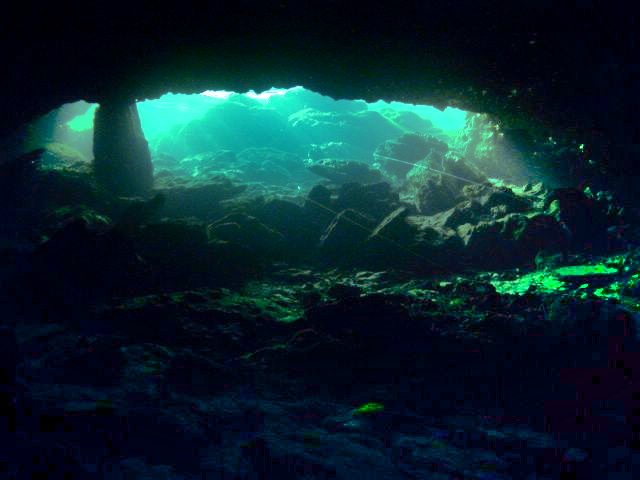
Peacock Springs cave system
About 33,000 feet of surveyed passage, as cited by Florida State Parks and by DAN's Alert Diver (March 2026). Another Florida State Parks page gives 'around 10 miles' mapped, so treat the figure as approximate. NSS-CDS members had surveyed 20,293 feet by the end of the 1970s.
A long, mapped underwater cave beneath Wes Skiles Peacock Springs State Park in north Florida, entered by certified divers at Peacock Springs and Orange Grove Sink under state park rules.
The Peacock Springs cave system lies under Wes Skiles Peacock Springs State Park, a small, quiet park near Luraville in north Florida. The park holds two major springs, a spring run and six sinkholes, and the water-filled passages that link them run beneath a mature hardwood and pine forest. Florida State Parks describes the system as one of the longest underwater caves in the continental United States.
The first recorded cave dive here was in 1956, and divers have been mapping the passages ever since. By the end of the 1970s, members of the NSS Cave Diving Section had surveyed about 20,000 feet, then the longest known system of its kind. The park now cites roughly 33,000 feet of surveyed passage and says new discoveries are still being made.
Divers know the system by its landmarks: the Breakdown Room, a passage whose floor is piled with rock fallen from the ceiling; the Peanut Restriction, where passages narrow (a restriction is a tight spot that a diver must pass carefully); the Crypt, named for turtle bones found there in 1975; and Olsen Sink, a karst window where daylight reaches the water through a collapsed sinkhole. Diving is allowed only from Peacock Springs and Orange Grove Sink, and only within the limits of each diver's training.
Above ground, a 1.2-mile interpretive trail traces the route of the caves below, with displays showing maps and photographs of the passages. The caves are also home to cave-adapted animals such as the pallid cave crayfish and the Florida cave amphipod.
지질학
The cave formed in limestone laid down when Florida lay beneath a shallow sea during the Eocene; slightly acidic rainwater dissolved fissures and hollows in the rock that grew into the present passages. Florida State Parks counts five second-magnitude springs in the park: Peacock Springs I, II and III, Bonnet Spring and Orange Grove Sink.
수질, 유속 및 침수
The park's springs are second-magnitude, which Florida State Parks defines as discharging roughly 10 to 100 cubic feet (about 0.3 to 2.8 cubic metres) of water per second. The park notes that water levels in the springs vary, and swimming and snorkelling depend on seasonal water levels.
왜 중요한가
The system has been explored since 1956 and was the world's longest known system of its type at the end of the 1970s, according to the NSS Cave Diving Section. The park was renamed in 2011 to honour Wes Skiles, a cave diver, explorer and filmmaker who campaigned to protect it and Florida's springs.
서베이 및 탐사 역사
| 1956 | First recorded cave dive into the Peacock system. [4] |
| 1975 | Sheck Exley discovered the Crypt, a collapsed section of tunnel named for the remains of a large turtle found there. [3] |
| 1979 | By the end of the 1970s NSS-CDS members had surveyed the system to 20,293 feet, then the longest known system of its kind. [7] |
| 1985 | The Nature Conservancy bought 250 acres around the springs to protect the forest and caves. [4] |
| 1993 | The state of Florida, having acquired the land, opened Peacock Springs State Park to the public. [4] |
| 2011 | The park was renamed Wes Skiles Peacock Springs State Park. [4] |
입구 및 다이브 사이트
Florida State Parks names three main entrances to the cave system, and also mentions the Pothole and Olsen Sink as openings into it. Park rules allow divers to enter and surface only at Peacock Springs and Orange Grove Sink, except where necessary for safety.
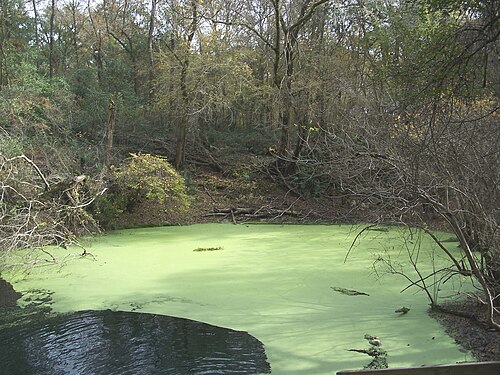
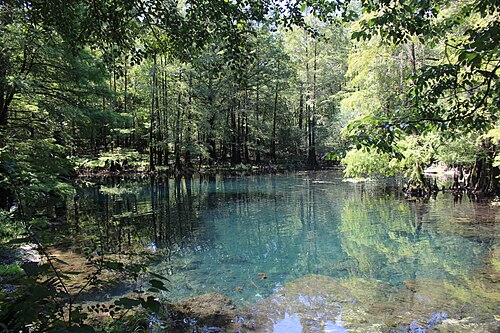
방향 파악용이며 내비게이션용이 아닙니다. 빈 점은 대략적인 위치입니다.
추가 읽을거리
A short history of underwater cave exploration: dated milestones
Archaeology and palaeontology in underwater caves
Conservation, landowners and responsible access
Groundwater, haloclines and water quality in flooded caves
How underwater caves form: karst, dissolution and drowned passages
Life in flooded caves: stygofauna, remipedes and the diver's footprint
Threats to underwater caves today, and how they are protected
Karst Underwater Research (KUR) ↗
이 페이지의 모든 정보와 출처 (15)
| 정보 항목 | 상태 | 출처 |
|---|---|---|
| Florida State Parks says cave divers can explore nearly 33,000 feet of surveyed underwater passages at Peacock Springs.DAN (2026-03) repeats 33,000 feet (10 km). The park's 'Springs of Peacock Springs' page instead says divers have mapped around 10 miles (about 16 km); its cave diving page says over 30,000 feet. Sources s1 and s6 agree on about 33,000 feet. | 출처 간 내용 불일치 | [1] [6] |
| Another Florida State Parks page says divers have mapped around 10 miles of caves and tunnels at Peacock Springs.Disagrees with the 33,000-foot figure on the park's main page. | 출처 간 내용 불일치 | [5] |
| NSS-CDS members surveyed the Peacock Springs system to 20,293 feet, the world's longest known system at the end of the 1970s.Historical figure, superseded by later survey. | 확인됨 | [7] |
| The first recorded cave dive into the Peacock system was made in 1956. | 확인됨 | [4] |
| Sheck Exley discovered the Crypt in 1975 and named it for the skeletal remains of a large turtle. | 확인됨 | [3] |
| The Nature Conservancy bought 250 acres in 1985; the state later acquired the land and opened the park in 1993; it was renamed for Wes Skiles in 2011. | 확인됨 | [4] |
| Three main entrances give access to the cave system, and the Pothole is described as another entrance. | 확인됨 | [3] |
| The park contains five second-magnitude springs: Peacock Springs I, II and III, Bonnet Spring and Orange Grove Sink. | 확인됨 | [5] |
| Second-magnitude springs discharge between about 10 and 100 cubic feet of water per second, and water levels in the park's springs vary. | 확인됨 | [5] |
| Cavern and cave diving is available to certified dive teams in Orange Grove Sink and Peacock Springs; open water divers are allowed only in Orange Grove Sink and may not carry lights.Park pages undated; read 2026-10-14. | 확인됨 | [2] [3] |
| Divers must show proof of certification or leave it visible on the dashboard, sign in, dive in parties of at least two, stay within their certification, and may not use scooters (DPVs). | 확인됨 | [2] [3] |
| Student divers must sign in under an instructor's permit, and instructors teaching a class need a current Commercial Dive Permit. | 확인됨 | [2] |
| Entering or surfacing anywhere other than Peacock Springs or Orange Grove Sink is prohibited unless necessary for diver safety, and dives must end one hour before sundown. | 확인됨 | [2] |
| USGS lists Peacock Springs (site 300718083075701) at latitude 30.1218901, longitude -83.1323569 (NAD83).Public state park spring. | 확인됨 | [8] |
| USGS lists Peacock Springs at longitude -83.1323569. | 확인됨 | [8] |
확인됨: 직접 열람한 공식 또는 1차 출처에서 명시된 정보입니다. 보고됨: 2차 출처에서만 확인된 정보입니다. 출처 간 상충: 비고에 두 가지 내용이 모두 기재되어 있습니다. 최신 정보가 아닐 수 있음: 확인된 가장 최근 출처가 오래된 경우입니다.
위의 출처를 바탕으로 자체적으로 작성했습니다. 수정 사항 제보