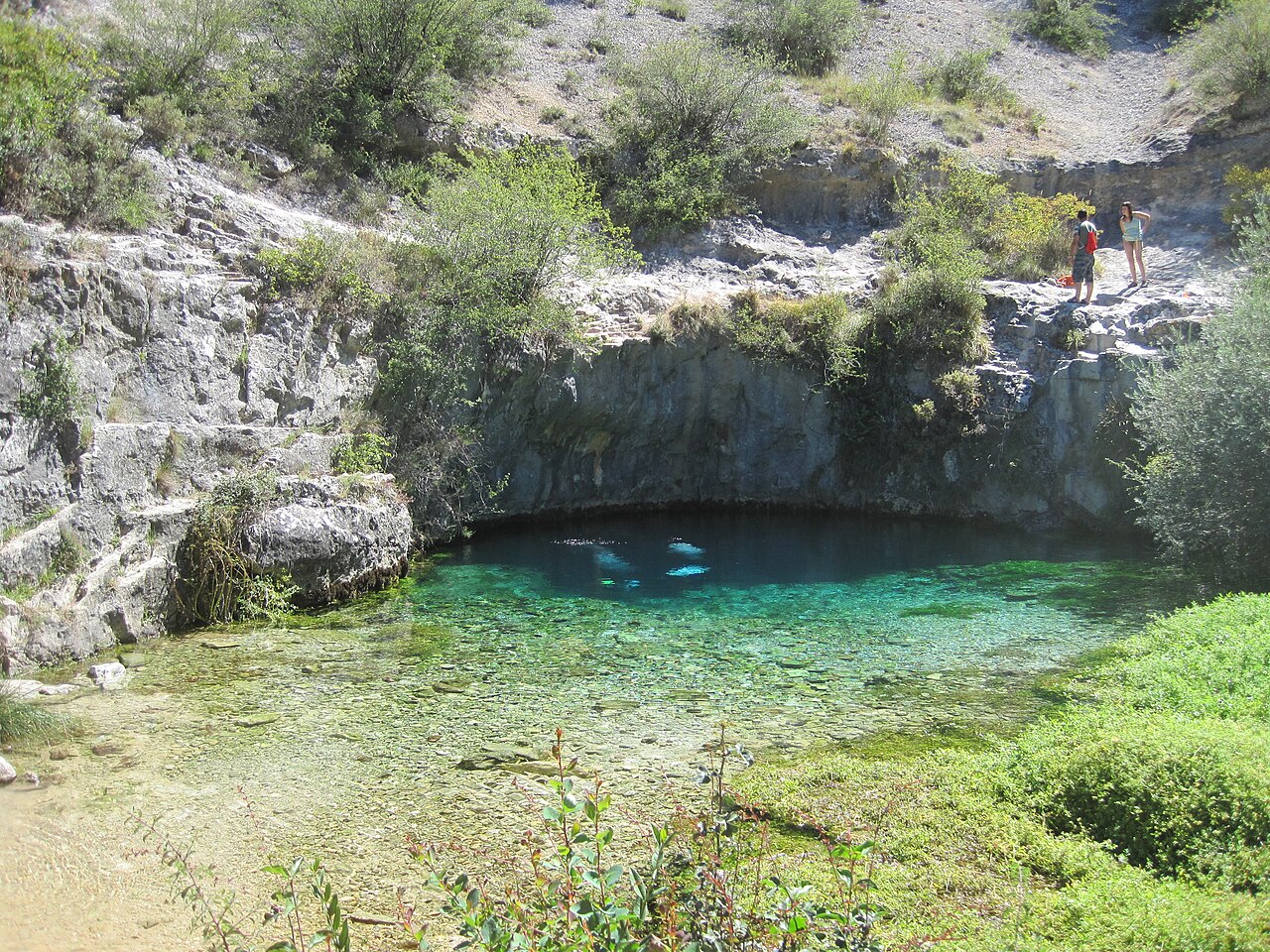
Pozo Azul
Grupo Espeleológico Edelweiss gives more than 13,700 m after the August 2015 campaign; Showcaves lists 13,755 m with dimension data dated 2019. Showcaves lists sump 2 as 5,160 m long and 71 m deep (2019 data); the 2019 expedition report mentions a turnaround at about 60 m in sump 2.
A blue spring pool in the Rudrón valley at Covanera, Burgos, that opens into a chain of six sumps. Expeditions led by British and Spanish divers had raised the cave's development to more than 13.7 km by 2015.
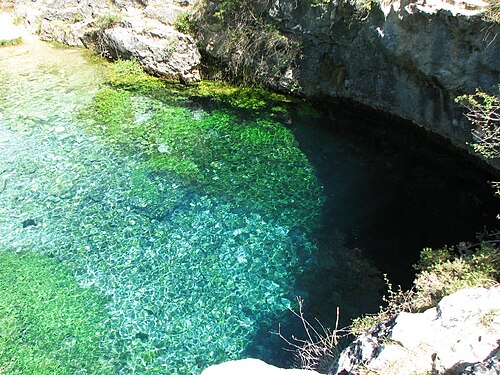
The Pozo Azul is a small, intensely blue spring pool a short walk up a side valley from the village of Covanera, beside the Rudrón river. Beneath it lies a long resurgence cave made up of six sumps separated by air-filled galleries; the first sump is about 700 m long and is followed by a 300 m deep-water canal, according to a 2019 expedition report.
Divers of the Grupo Espeleológico Edelweiss of Burgos began exploring it in 1964 with home-built and early commercial equipment. Later Spanish groups pushed the first and second sumps, and from 2002 British diver Jason Mallinson extended the second sump far beyond 1.9 km at depths of 60 to 70 m.
International expeditions, many coordinated with Spanish cavers, continued into a third, fourth, fifth and in 2015 a sixth sump, reached only after many hours underwater. The 2019 Pegasus Caving Club report describes dives of several kilometres with a temporary underwater habitat for decompression, and attempts to radio-locate the far reaches.
Showcaves notes that the water-filled cave behind the spring is accessible only to cave divers; its far reaches are expedition territory.
水况、水流与洪水
A resurgence feeding the Rudrón. Sump 2 is reported to reach depths of about 60 to 71 m, and divers have used scooters and long staged dives to reach the far sumps.
为何重要
In 1966 the Edelweiss divers' 200 m penetration was described as a world record for underwater caving; by 2010 the cave hosted one of the longest cave-diving penetrations then made, and it remains Spain's best-known long sump system.
环境条件
Typical only. Reaching the far sumps requires long staged dives with decompression support.
典型范围来自已发表资料,不代表当前实际状况。
测量与探索历史
| 1964 | Joaquim and Pere Plana of the Grupo Espeleológico Edelweiss make the first dives. [4] |
| 2002-09 | Jason Mallinson extends sump 2 to about 1,950 m at 60 m depth. [3] |
| 2015-08 | Mallinson finds and dives a sixth sump, raising the cave's development above 13,700 m. [1] |
| 2019-08 | A Pegasus Caving Club team uses an underwater habitat and radio beacons to support dives towards the far end of sump 2 (Tipperary). [2] |
入口与潜点
One entrance, the Pozo Azul spring pool.
仅供方位参考,不可用于导航。空心圆点为大致位置。
本页所有信息及其来源 (12)
| 信息条目 | 状态 | 来源 |
|---|---|---|
| After the August 2015 campaign the cave's development rose by about 700 m to more than 13,700 m. | 已核实 | [1] |
| The 13,700 m figure follows the campaign of the second half of August 2015. | 已核实 | [1] |
| Showcaves lists a total length of 13,755 m with dimensions dated 2019. | 已报告 | [3] |
| Sump 2 is listed as 5,160 m long and -71 m deep.Secondary source; the 2019 expedition report mentions depths around 60 m in sump 2. | 已报告 | [3] |
| Divers of the GE Edelweiss began diving in the Pozo Azul in 1964. | 已核实 | [4] |
| In 2015 Jason Mallinson dived a sixth sump, swimming 60 m at 12 m depth; sumps 5 and 6 are separated by 600 m of air-filled gallery. | 已核实 | [1] |
| Sump 1 is 700 m long followed by a 300 m deep-water canal. | 已核实 | [2] |
| Showcaves states that Joaquín Plana's 200 m penetration in 1966 was a world record for underwater caving and that a 2010 expedition achieved 8.8 km of underwater travel. | 已报告 | [3] |
| Water temperature is listed as 11 °C. | 已报告 | [3] |
| The site is listed as open with no restrictions and free of charge (2022 data).No official access source found; this concerns visiting the spring, not diving. | 已报告 | [3] |
| Coordinates of the spring are listed as 42.735772, -3.795994. | 已报告 | [3] |
| Coordinates of the spring are listed as 42.735772, -3.795994. | 已报告 | [3] |
已核实:来自我们直接查阅的官方或主要来源。已报告:仅来自二手来源。来源存在冲突:注释中列出两种版本。可能已过时:我们找到的最新来源已有一定年代。
由我们根据上述来源以自己的文字整理撰写。 提交更正