Basics · 4 min read
Discover Scuba vs. Full Certification
The difference between a supervised try-dive and an actual certification course: what each permits, what each costs in time and money, and how to decide which fits your trip.
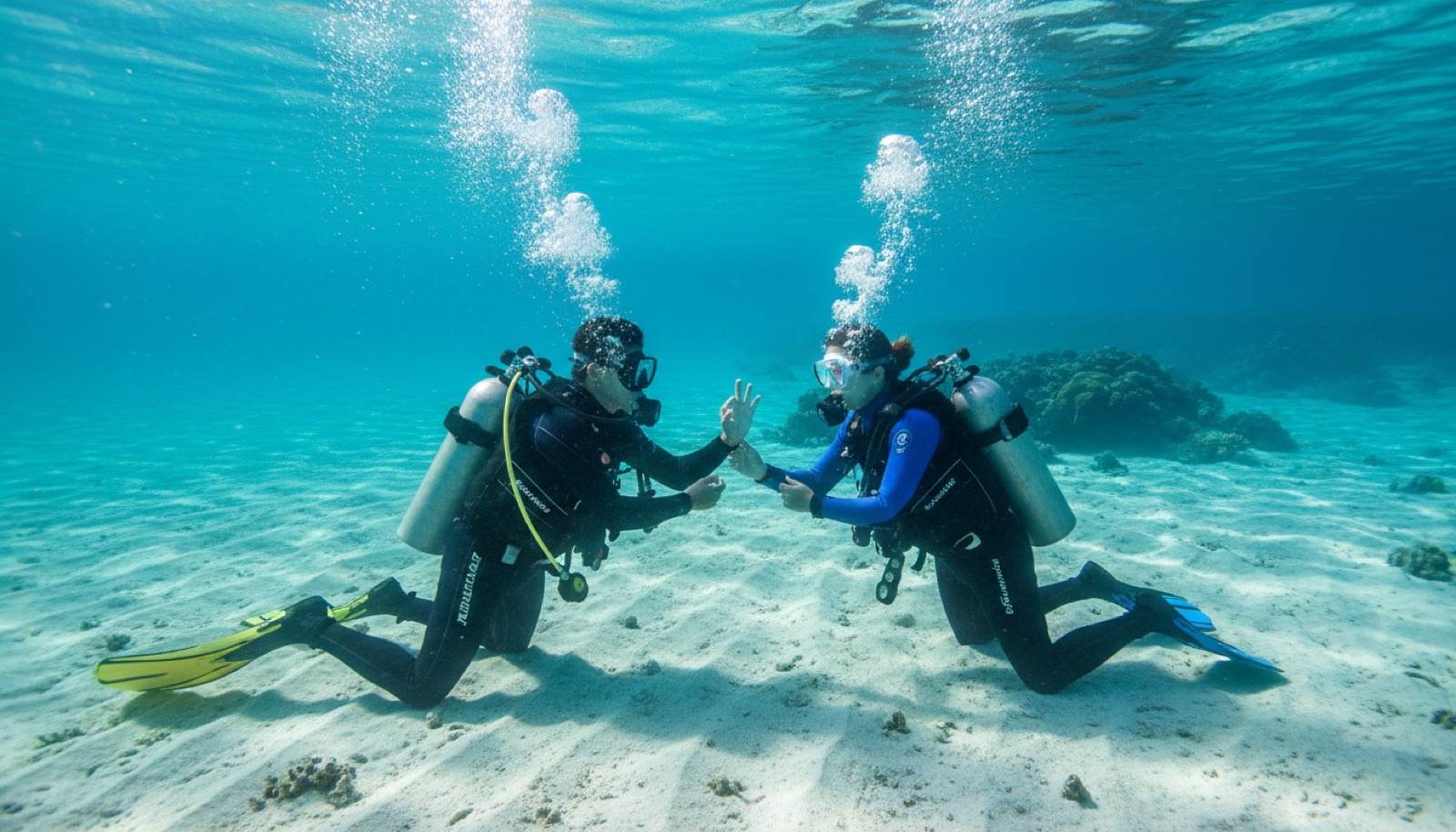
Every resort dive desk offers two very different products that beginners routinely confuse. One is a try-dive experience: PADI calls it Discover Scuba Diving, SSI calls it Try Scuba, and boat crews everywhere call it an intro dive. The other is the Open Water certification course. They answer different questions: the first asks whether you like breathing underwater, the second makes you a diver.
What a try-dive is
An intro experience compresses the essentials into a single session: a short briefing, a few minutes of skills practice in shallow or confined water, then a guided dive under the direct, in-water supervision of an instructor, to a maximum of 12 meters. There is no exam, no autonomy and no certification at the end: you cannot rent tanks or join a boat as a diver on the strength of it. What you get is the experience itself, often on a genuinely good reef, for roughly 80–200 USD and half a day. Ratios are deliberately tight, and the instructor manages your buoyancy and safety throughout.
Two details are worth knowing. Many operators let you repeat try-dives on subsequent days of the same trip after a shorter re-briefing, so a non-certified traveler can still log several supervised reef dives in a week. And with most agencies, a try-dive conducted to full standards can credit toward the certification course if you continue promptly with the same shop; ask before you book, not after.
What certification adds
The Open Water course takes three to four days and produces a credential recognized worldwide that never expires: you may then dive independently with a buddy to 18 meters, rent equipment, join any dive boat, fill tanks and continue to advanced training. The course covers what the intro dive deliberately skips: dive theory, planning, problem management, rescue-adjacent self-help skills, and enough repetition that emergencies become procedures instead of surprises.
Choosing between them
- Curious but unsure, or short on time: take the try-dive. It is the cheapest honest answer to the question of whether diving is for you, and losing 80–200 USD to discover you hate it beats losing 500 USD and three vacation days.
- Already sure, with three-plus days available: go straight to the course. Nothing in the intro dive is prerequisite, and course confined-water sessions cover the same ground more thoroughly.
- Sure, but short on vacation days: do the theory online at home and a referral course on the trip, which compresses the on-site commitment to about two days.
- Traveling with a mixed group: intro divers and certified divers often ride the same boat but dive separately, a workable compromise families use constantly.
One caution applies to both paths: the medical questionnaire is identical, so conditions that require a physician's clearance apply to a 12 meter intro dive just as they do to a course. And one caution applies to try-dives specifically: the 12 meter supervised format is safe precisely because of its restrictions, so treat any operator offering to take uncertified guests deeper or without an instructor's hands-on attention as a signal to walk away. The product is a taste of diving, and a good operator serves it exactly that way.