Keselamatan · 4 menit baca
Nitrogen Narcosis
The reversible fog that breathing nitrogen under pressure puts on the mind: what it feels like, why it varies day to day, and the simple management every agency teaches.
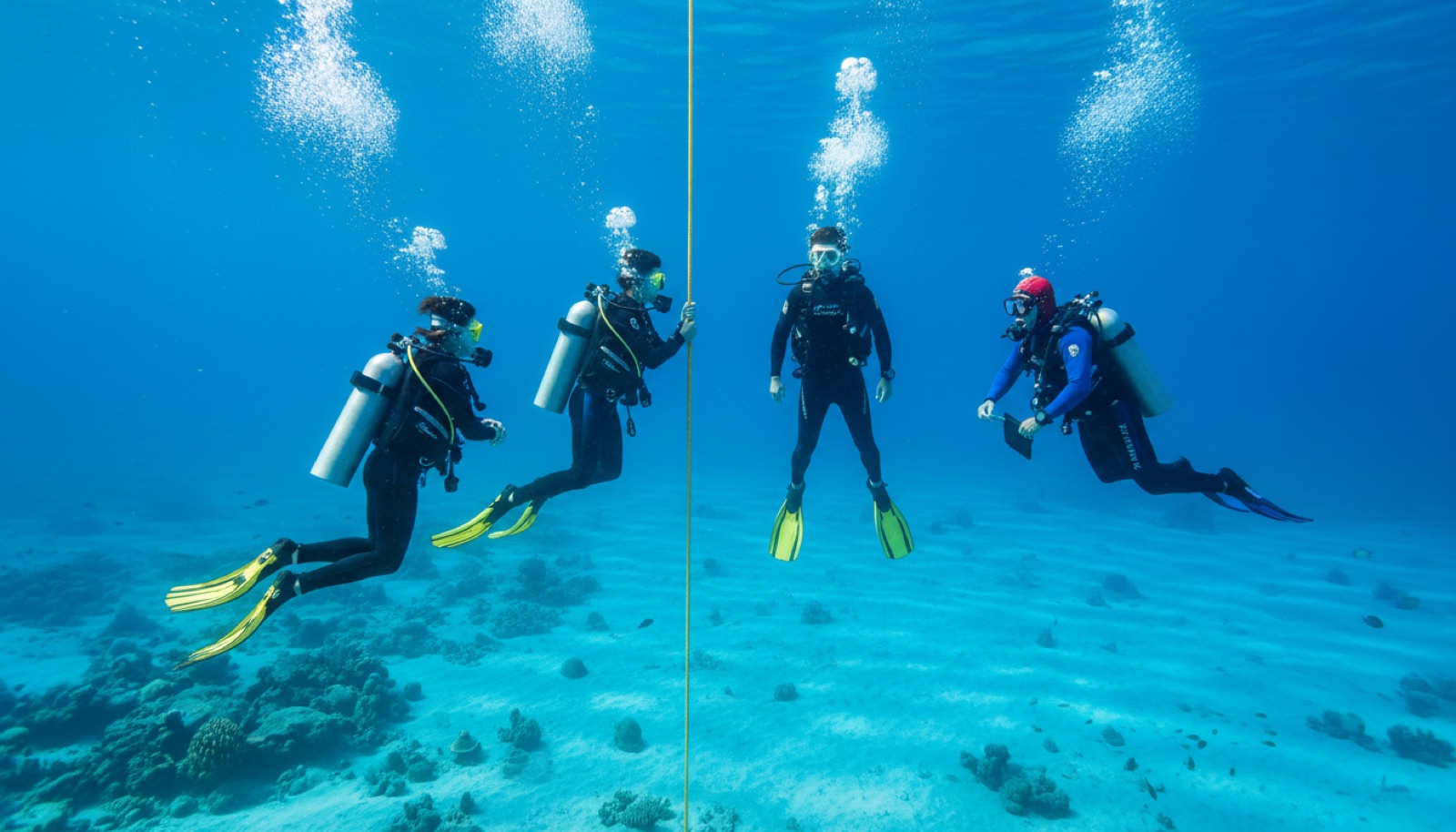
Somewhere past 30 meters, many divers meet a strange companion: a warm, slightly detached fuzziness, as if the dive had acquired a soundtrack and the gauges had become mildly amusing. Nitrogen narcosis (raptures of the deep in the old literature) is a normal, predictable effect of breathing nitrogen at elevated partial pressure, and unlike most things in dive safety it is completely reversible in minutes. The danger is never the sensation; it is what an impaired diver does while having it.
What it is and how it feels
Under pressure, nitrogen dissolved in nerve tissue produces an anesthetic-like effect on signaling, mechanistically related to what anesthetic gases do, just far milder at recreational depths. Divers describe it along two axes. The euphoric version: overconfidence, fixation, giggling at nothing, a loosened grip on the plan. The dark version: anxiety, foreboding, tunnel vision, a sudden conviction that something is wrong. Both degrade the same underlying things (reasoning speed, short-term memory, multitasking), which is why classic narcosis stories involve misread gauges, forgotten turn pressures and tasks done in the wrong order rather than dramatic collapse. Old folklore compares each 10–15 meters of depth to a drink; treat that as a memorable exaggeration with a true core, not arithmetic.
The variables that matter
- Depth is the master variable: effects commonly become noticeable around 30 meters for many divers on air, strengthening with every meter beyond. This is one of the reasons 40 meters stands as the recreational limit.
- Day-to-day variation is real and taught: the same diver at the same depth can be sharp on Tuesday and foggy on Thursday. Cold, fatigue, anxiety, task loading, carbon dioxide buildup from exertion and poor visibility all deepen impairment.
- Adaptation is mostly subjective: divers report feeling less narced with experience, but measured performance still declines, which makes I do not get narced one of the least safe sentences in diving.
- Enriched-air nitrox does not meaningfully help; oxygen is similarly narcotic in mainstream teaching, so a nitrox blend at equal depth is not a clearer head. Genuinely reducing narcosis means adding helium to the mix (trimix), which is technical-diving territory with its own training.
Management: the shallow cure
Agency teaching is refreshingly simple. Recognize it: in yourself by noticing fixation, slowness, uneasiness or inappropriate mood, and in your buddy by watching for odd behavior, missed signals and sluggish responses. Then ascend a few meters and reassess: impairment lightens almost immediately as partial pressure falls, with no lasting effect. That is the entire cure. Around it sit the habits that make deep dives resilient: plan the dive shallow-of-limits when conditions are poor, keep tasks at depth few and rehearsed, agree on conservative signals so aborting deeper legs is a routine call rather than a debate, and monitor each other more actively below 25–30 meters. Deep-diving training formalizes all of this, including a look at your own performance at depth under controlled conditions.
Perspective helps: narcosis is not an accident waiting to happen, it is a known property of the gas you breathe, present to some degree on every deeper dive and fully manageable by depth discipline. Respecting it is what lets divers enjoy the 30-meter world (the wrecks, the walls, the big fish) with judgment intact enough to get back from it.

