Fotografia · 5 min de leitura
Photographing Sharks: Protocol First, Pictures Second
Shark photography is mostly discipline: follow the operator's protocol, hold your position, and let the animal close the distance. Settings for fast subjects in blue water, and etiquette by species.
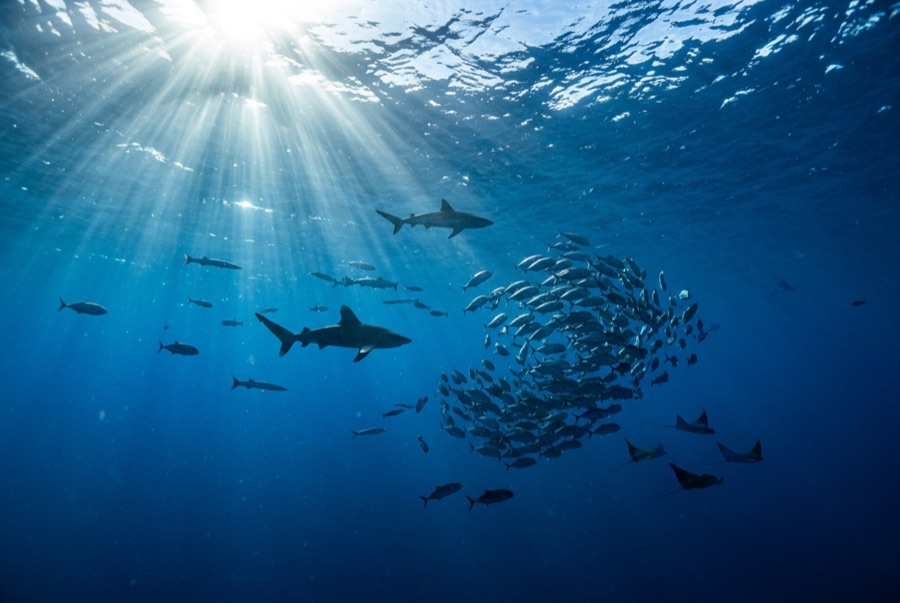
The first time a shark fills your viewfinder, your heart rate will tell you this is not reef photography. Shark images are made in the overlap between wildlife craft and strict protocol, and the protocol comes first: for your safety, for the animal, and for the operators whose access depends on every guest behaving.
The rules come before the pictures
Listen to the briefing as if it were a checklist, because it is. Structured encounters (the baited dives of Tiger Beach in the Bahamas, oceanic whitetip encounters in the Egyptian offshore marine parks, channel drifts in French Polynesia) run on positioning rules: stay in the group, stay low or against the reef as directed, keep your hands close, never chase, never block an animal's path, and never touch. Some operators restrict strobes for certain species or stages of a dive; comply without argument. Never introduce food yourself under any circumstances. And a sobering footnote for list-keepers: the famous great white cage diving at Guadalupe Island has been closed by Mexico since 2023, a reminder that access to these animals is a privilege that can be withdrawn.
Settings for fast animals in blue water
Sharks move quickly and rarely pass twice. Start around shutter 1/200–1/320 to freeze motion, aperture f/8 for depth of field, and let ISO ride between 400 and 800 in open blue water: grain is recoverable, motion blur is not. Continuous autofocus with a single active point on the head keeps the eye sharp. Many strong shark images are pure ambient light; strobes matter for close passes, where they lift the white underside and put a catchlight in the eye, but they must be feathered wide to avoid lighting the plankton between you. Ambient-only also frees you from recycle times when the action stacks up.
Composition that respects the animal
Shoot slightly upward so the shark stands against blue rather than dissolving into the bottom. Leave space in the frame ahead of its nose, wait for the turn toward you rather than firing at tails, and include context (the reef edge, the bait box, other divers) when it tells the story of the encounter. Eye contact through the lens transforms a fish picture into a portrait. The discipline is staying planted: the diver who holds position calmly gets the close pass; the diver who lunges gets a wide, wary circle and ruins the pass for everyone else.
Species notes
- Reef sharks patrol predictable circuits; find the lane and let them use it.
- Hammerheads are famously shy of bubbles. Keep breathing slow and stay tight to the reef; schooling species reward patience at cleaning stations.
- Tiger sharks are handled under close guide supervision: grouped divers, defined positions, eyes on the animal at all times.
- Whale sharks come with distance codes at aggregation sites, commonly 3–4 m, with touching banned everywhere and flash restricted at some sites. Snorkel rules often apply; follow the local code exactly.
Shark populations are in global decline, and photographs taken under good protocols are part of the case for their value alive. Bring back the portrait, and bring back the standard of behavior that keeps these dives possible.