Cold Water
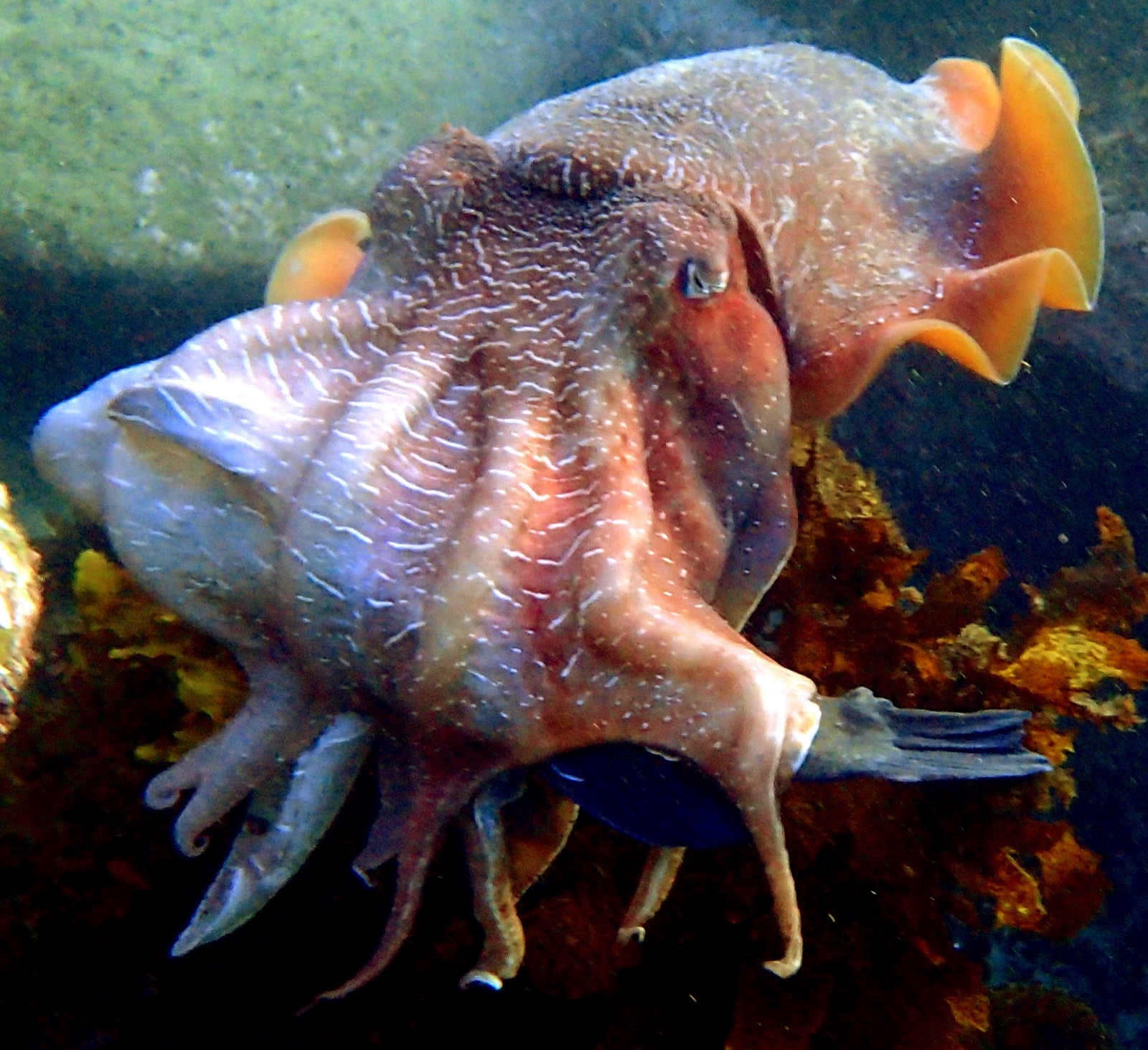
Australian Giant Cuttlefish
Sepia apama · Cephalopod mollusk, family Sepiidae; the largest cuttlefish species
Every austral winter the upper Spencer Gulf hosts the only known dense breeding aggregation of cuttlefish anywhere: tens of thousands of Sepia apama packed onto a few kilometers of shallow rocky reef near Whyalla, in green water that can drop below 12 °C. Males outnumber females several times over, so the reef becomes a tournament: meter-long heavyweights strobing zebra patterns at rivals while smaller sneaker males dim their colors, tuck their arms, and pass as females to slip through the cordon. It all happens in two to eight meters, snorkel-accessible, roughly May through August with a June–July peak. Across the rest of southern Australia the species lives as solitary, frankly curious reef residents that study divers as openly as they are studied. Bring drysuit-grade insulation, move slowly, and touch nothing: these animals breed once and die.
Wo und wann man eines sieht
„Resident" bedeutet, dass die meisten Tauchgänge am jeweiligen Tauchziel eine Begegnung erwarten lassen; „saisonal" bedeutet, dass die Art in den genannten Monaten zuverlässig anzutreffen ist; alles andere ist ein Bonus, keine Planungsgrundlage.
| Ziel | Zuverlässigkeit | Monate | Hinweise |
|---|---|---|---|
| South AustraliaAustralia | Seasonal: reliable in season | May–Aug |
Bester Monat auf einen Blick
| Monat | Zuverlässige Reiseziele |
|---|---|
| May | South Australia |
| June | South Australia |
| July | South Australia |
| August | South Australia |
Sie verstehen
Lebensraum: Temperate rocky reef, kelp, and seagrass; the famous breeding aggregation packs onto a few kilometers of shallow stone reef in the upper Spencer Gulf.
Verbreitung: Southern Australian coast from Queensland's border waters around to Western Australia, including Tasmania.
Verhalten: Solitary and curious most of the year; each austral winter tens of thousands converge near Whyalla to breed, males dueling in color while smaller sneaker males dim their patterns and pass as females to reach mates.
Ernährung: Crabs, shrimp, and fishes taken with ambush patience and tentacle strikes.
Größe: typischerweise rund 0.4 m; dokumentiert bis zu 0.5 m (mantle length; total length approaches 1 m and big males exceed 10 kg).
Wie man sich in ihrer Nähe verhält
Thick exposure protection, slow fins, and no touching at the aggregation: the animals die after breeding, and every disrupted pairing spends a genuine last chance. Follow local sanctuary-zone rules.
Naturschutz
Assessed Near Threatened; the Whyalla aggregation crashed in the early 2010s before rebounding under fishing closures and a sanctuary zone that remain load-bearing.
Bekannte Tauchplätze dafür
Hervorgehobene Tauchplätze wurden von unseren Redakteuren für diese Art kartiert; die Zahlen sind GBIF-Vorkommensdatensätze, die seit 1990 im Umkreis von etwa 5 km um einen Tauchplatz protokolliert wurden.
Ansehen
Aus den offiziellen Kanälen

Wildlife of Monterey | New film in our auditorium

Live Aviary Cam | Monterey Bay Aquarium

Live Aviary Cam | Monterey Bay Aquarium
Videos sind eingebettete Links zu den Kanälen der jeweiligen Ersteller – wir hosten nichts und geben für alles die Quelle an.