Cold Water
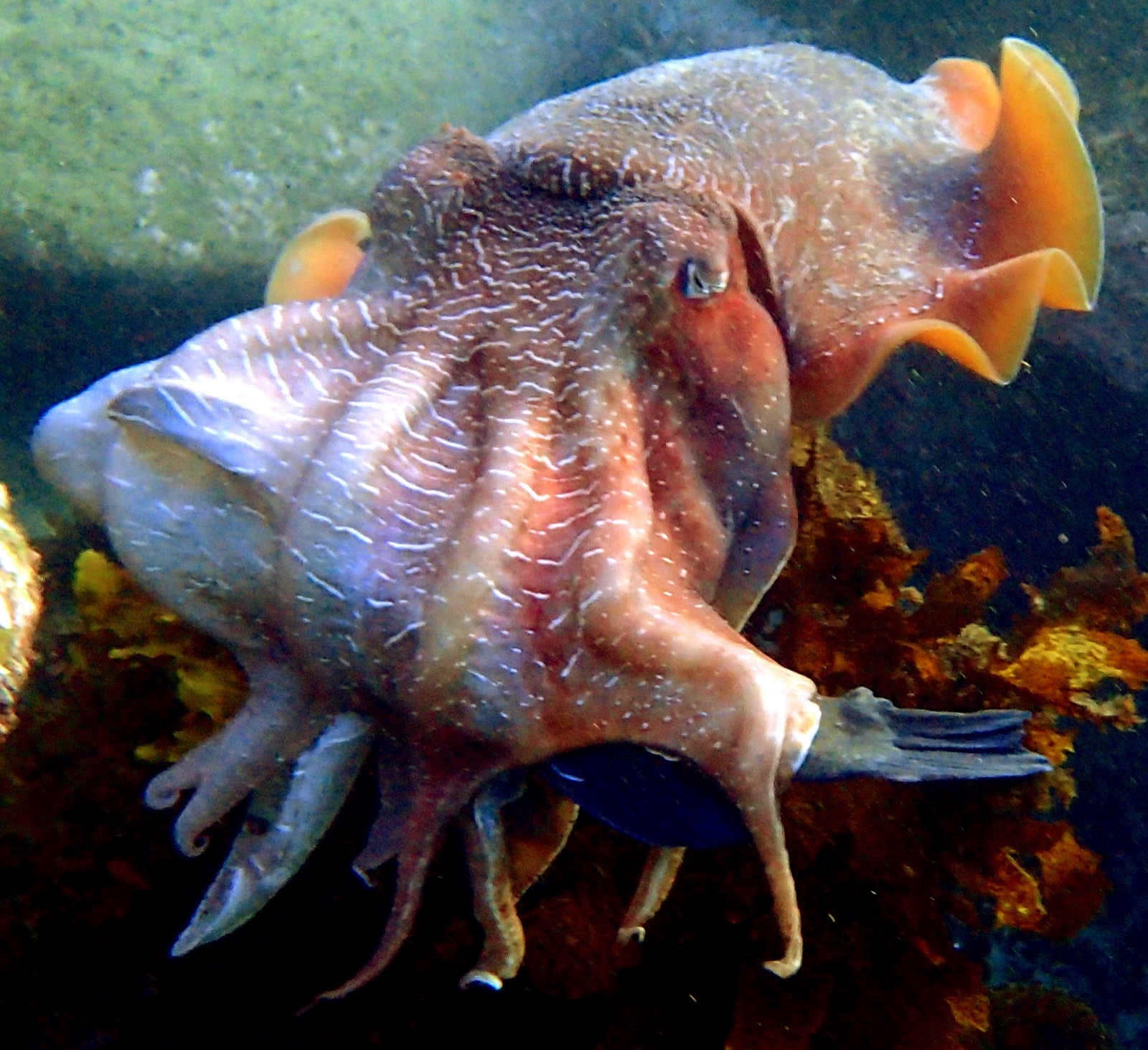
Australian Giant Cuttlefish
Sepia apama · Cephalopod mollusk, family Sepiidae; the largest cuttlefish species
Every austral winter the upper Spencer Gulf hosts the only known dense breeding aggregation of cuttlefish anywhere: tens of thousands of Sepia apama packed onto a few kilometers of shallow rocky reef near Whyalla, in green water that can drop below 12 °C. Males outnumber females several times over, so the reef becomes a tournament: meter-long heavyweights strobing zebra patterns at rivals while smaller sneaker males dim their colors, tuck their arms, and pass as females to slip through the cordon. It all happens in two to eight meters, snorkel-accessible, roughly May through August with a June–July peak. Across the rest of southern Australia the species lives as solitary, frankly curious reef residents that study divers as openly as they are studied. Bring drysuit-grade insulation, move slowly, and touch nothing: these animals breed once and die.
Dove e quando avvistarne uno
"Residente" significa che la maggior parte delle immersioni in quella destinazione li incontra; "stagionale" significa che sono presenti in modo affidabile nei mesi indicati; qualsiasi altra cosa è un bonus, non un piano.
| Destinazione | Affidabilità | Mesi | Note |
|---|---|---|---|
| South AustraliaAustralia | Seasonal: reliable in season | May–Aug |
Il mese migliore, a colpo d'occhio
| Mese | Destinazioni affidabili |
|---|---|
| May | South Australia |
| June | South Australia |
| July | South Australia |
| August | South Australia |
Capirle
Habitat: Temperate rocky reef, kelp, and seagrass; the famous breeding aggregation packs onto a few kilometers of shallow stone reef in the upper Spencer Gulf.
Distribuzione: Southern Australian coast from Queensland's border waters around to Western Australia, including Tasmania.
Comportamento: Solitary and curious most of the year; each austral winter tens of thousands converge near Whyalla to breed, males dueling in color while smaller sneaker males dim their patterns and pass as females to reach mates.
Dieta: Crabs, shrimp, and fishes taken with ambush patience and tentacle strikes.
Dimensioni: tipicamente intorno a 0.4 m; documentato fino a 0.5 m (mantle length; total length approaches 1 m and big males exceed 10 kg).
Come comportarsi in sua presenza
Thick exposure protection, slow fins, and no touching at the aggregation: the animals die after breeding, and every disrupted pairing spends a genuine last chance. Follow local sanctuary-zone rules.
Conservazione
Assessed Near Threatened; the Whyalla aggregation crashed in the early 2010s before rebounding under fishing closures and a sanctuary zone that remain load-bearing.
Siti mappati noti per avvistamenti
I siti evidenziati sono stati schedati per questa specie dai nostri redattori; i numeri sono record di occorrenza GBIF registrati entro circa 5 km dal sito a partire dal 1990.
Guarda
Dai canali ufficiali

Wildlife of Monterey | New film in our auditorium

Live Aviary Cam | Monterey Bay Aquarium

Live Aviary Cam | Monterey Bay Aquarium
I video sono link incorporati ai canali dei rispettivi autori. Non ospitiamo nulla e accreditiamo tutto.