Rays
Blue-Spotted Ribbontail Ray
Taeniura lymma · Cartilaginous fish, family Dasyatidae
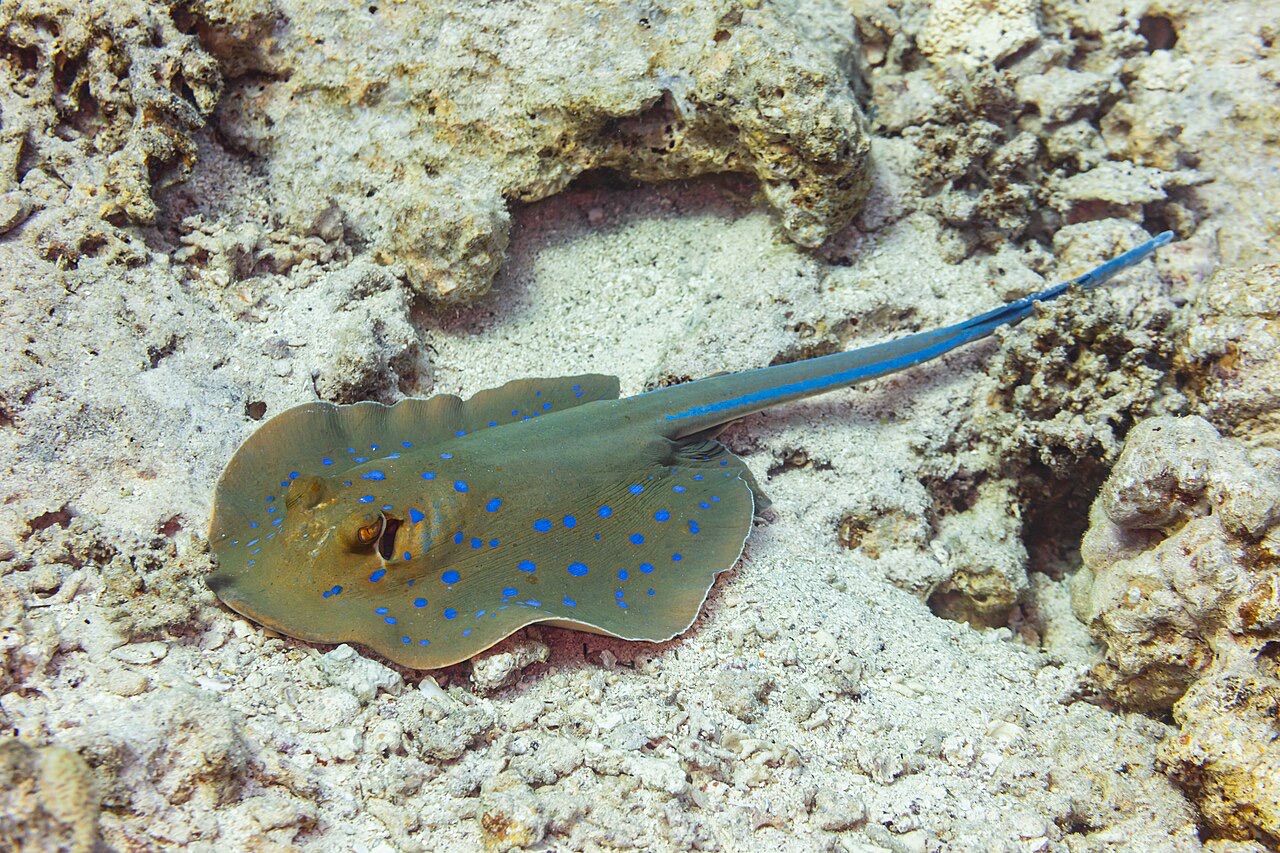
Few reef animals photograph as improbably as this ray: an oval of ochre-gold scattered with neon-blue spots that look airbrushed on, a blue-striped ribbon of tail trailing behind. Red Sea divers meet it constantly: a flash of color retreating deeper under a table coral, or gliding across the sand at Ras Mohammed like a small flying carpet. The vivid spots advertise the venomous spines honestly, aposematic warning rather than decoration. It is a fixture of shallow Indo-Pacific reefs from Dahab to Sipadan, and its twitchy shyness is the correct response to a world of octopuses, hammerheads, and grabby photographers.
Nơi và thời điểm có thể gặp
"Thường trú" nghĩa là hầu hết các lần lặn tại điểm đó đều gặp được chúng; "theo mùa" nghĩa là chúng xuất hiện đáng tin cậy trong các tháng được liệt kê; bất kỳ điều gì ngoài ra là điểm thưởng, không phải kế hoạch.
| Điểm đến | Độ tin cậy | Các tháng | Ghi chú |
|---|---|---|---|
| Sharm El Sheikh & Ras MohammedEgypt | Resident: seen on most dives | Quanh năm | |
| Sipadan & MabulMalaysia | Resident: seen on most dives | Quanh năm | |
| DahabEgypt | Resident: seen on most dives | Quanh năm | |
| Similan Islands & Richelieu RockThailand | Resident: seen on most dives | Oct–May |
Tháng tốt nhất, nhìn tổng quan
Tìm hiểu về chúng
Môi trường sống: Coral reefs: tucked under table corals and ledges by day, hunting sand aprons on the rising tide
Phạm vi phân bố: Tropical Indo-Pacific from the Red Sea and East Africa through Southeast Asia to northern Australia and the western Pacific
Hành vi: A shy, jewel-bright little ray that spends daylight wedged into reef crevices with just the tail showing, emerging over sand in the shallows to feed. Unlike many stingrays it seldom buries itself fully; the electric spots seem to do the warning instead.
Chế độ ăn: Small crustaceans, worms, and mollusks rooted out of sand
Kích thước: thường vào khoảng 0.3 m; ghi nhận đến độ sâu 0.35 m (disc width; total length with tail roughly doubles it).
Cách ứng xử khi ở gần loài này
No prodding animals out of crevices for photos, no blocking the open side of a ledge, and watch fin tips over sand where they feed.
Bảo tồn
Heavily collected historically for the aquarium trade, in which it fares poorly, and pressured by inshore fishing and reef loss across Southeast Asia.
Các điểm lặn đã ghi nhận có loài này
Các điểm được làm nổi bật là những điểm đã được ban biên tập ghi chép cho loài này; các con số là bản ghi xuất hiện từ GBIF được ghi nhận trong phạm vi khoảng 5 km của điểm lặn kể từ năm 1990.
Xem
Từ kênh chính thức

Wildlife of Monterey | New film in our auditorium

Live Aviary Cam | Monterey Bay Aquarium

Live Aviary Cam | Monterey Bay Aquarium
Video là các liên kết nhúng dẫn đến kênh của chính tác giả. Chúng tôi không lưu trữ gì và ghi công đầy đủ.