Rays
Blue-Spotted Ribbontail Ray
Taeniura lymma · Cartilaginous fish, family Dasyatidae
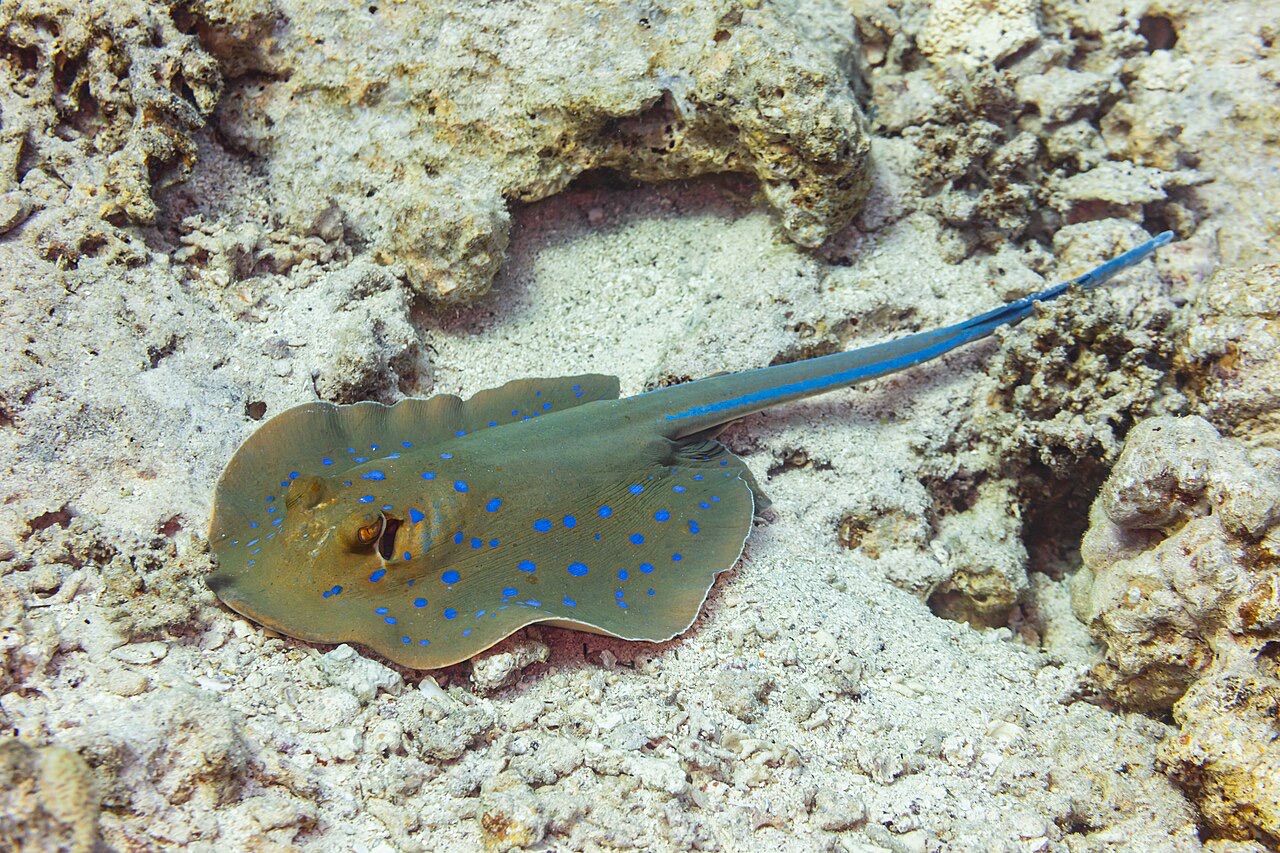
Few reef animals photograph as improbably as this ray: an oval of ochre-gold scattered with neon-blue spots that look airbrushed on, a blue-striped ribbon of tail trailing behind. Red Sea divers meet it constantly: a flash of color retreating deeper under a table coral, or gliding across the sand at Ras Mohammed like a small flying carpet. The vivid spots advertise the venomous spines honestly, aposematic warning rather than decoration. It is a fixture of shallow Indo-Pacific reefs from Dahab to Sipadan, and its twitchy shyness is the correct response to a world of octopuses, hammerheads, and grabby photographers.
Où et quand en observer un
« Résident » signifie que la plupart des plongées sur ce site permettent de les observer ; « saisonnier » signifie qu'ils sont présents de manière fiable durant les mois indiqués ; tout le reste est un bonus, pas une certitude.
| Destination | Fiabilité | Mois | Notes |
|---|---|---|---|
| Sharm El Sheikh & Ras MohammedEgypt | Resident: seen on most dives | Toute l'année | |
| Sipadan & MabulMalaysia | Resident: seen on most dives | Toute l'année | |
| DahabEgypt | Resident: seen on most dives | Toute l'année | |
| Similan Islands & Richelieu RockThailand | Resident: seen on most dives | Oct–May |
Meilleur mois, en un coup d'œil
Les comprendre
Habitat: Coral reefs: tucked under table corals and ledges by day, hunting sand aprons on the rising tide
Aire de répartition: Tropical Indo-Pacific from the Red Sea and East Africa through Southeast Asia to northern Australia and the western Pacific
Comportement: A shy, jewel-bright little ray that spends daylight wedged into reef crevices with just the tail showing, emerging over sand in the shallows to feed. Unlike many stingrays it seldom buries itself fully; the electric spots seem to do the warning instead.
Régime alimentaire: Small crustaceans, worms, and mollusks rooted out of sand
Taille: généralement autour de 0.3 m; documenté jusqu'à 0.35 m (disc width; total length with tail roughly doubles it).
Comment se comporter avec lui
No prodding animals out of crevices for photos, no blocking the open side of a ledge, and watch fin tips over sand where they feed.
Conservation
Heavily collected historically for the aquarium trade, in which it fares poorly, and pressured by inshore fishing and reef loss across Southeast Asia.
Sites répertoriés connus pour leur présence
Les sites mis en évidence ont été cartographiés pour cette espèce par nos éditeurs ; les chiffres correspondent aux occurrences GBIF enregistrées dans un rayon d'environ 5 km d'un site depuis 1990.
Regarder
Depuis les canaux officiels

Wildlife of Monterey | New film in our auditorium

Live Aviary Cam | Monterey Bay Aquarium

Live Aviary Cam | Monterey Bay Aquarium
Les vidéos sont des liens intégrés vers les chaînes de leurs créateurs. Nous n'hébergeons rien et créditons tout.