Big Fish
Bumphead Parrotfish
Bolbometopon muricatum · Bony fish, family Scaridae
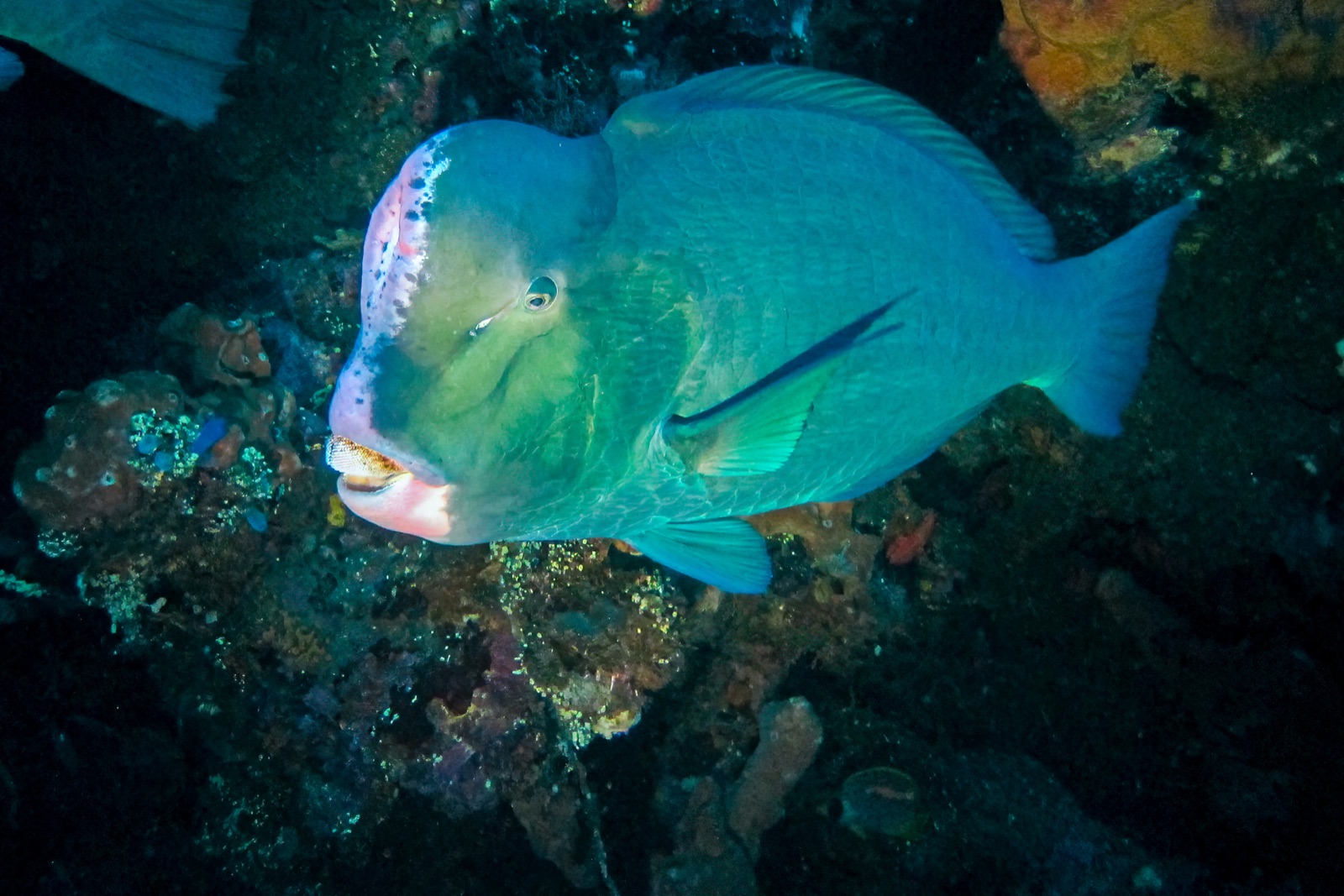
An oncoming herd of bumphead parrotfish sounds like road repair: the crunch of beaks shearing coral carries meters ahead of the fish themselves, olive-gray hulks with pink foreheads and pale beaks, moving in loose formation across the reef crest. They are ecosystem engineers on a heroic scale, each adult converting living rock into a yearly tonnage of white sand; entire beaches are, in part, their output. Sipadan's dawn parade of bumpheads along the reef edge is the species' showcase, and Palau protects spawning aggregations that gather at new moons. Slow-growing, communal, and easy to spear at night, they vanish quickly without protection. Their presence is a reef's good-conduct medal.
Où et quand en observer un
« Résident » signifie que la plupart des plongées sur ce site permettent de les observer ; « saisonnier » signifie qu'ils sont présents de manière fiable durant les mois indiqués ; tout le reste est un bonus, pas une certitude.
| Destination | Fiabilité | Mois | Notes |
|---|---|---|---|
| Sipadan & MabulMalaysia | Resident: seen on most dives | Toute l'année | |
| PalauPalau | Resident: seen on most dives | Toute l'année | |
| Raja AmpatIndonesia | Resident: seen on most dives | Toute l'année | |
| Tubbataha ReefsPhilippines | Resident: seen on most dives | Mar–Jun |
Meilleur mois, en un coup d'œil
| Mois | Destinations fiables |
|---|---|
| January | Sipadan & Mabul · Palau · Raja Ampat |
| February | Sipadan & Mabul · Palau · Raja Ampat |
| March | Sipadan & Mabul · Palau · Raja Ampat · Tubbataha Reefs |
| April | Sipadan & Mabul · Palau · Raja Ampat · Tubbataha Reefs |
| May | Sipadan & Mabul · Palau · Raja Ampat · Tubbataha Reefs |
| June | Sipadan & Mabul · Palau · Raja Ampat · Tubbataha Reefs |
| July | Sipadan & Mabul · Palau · Raja Ampat |
| August | Sipadan & Mabul · Palau · Raja Ampat |
| September | Sipadan & Mabul · Palau · Raja Ampat |
| October | Sipadan & Mabul · Palau · Raja Ampat |
| November | Sipadan & Mabul · Palau · Raja Ampat |
| December | Sipadan & Mabul · Palau · Raja Ampat |
Les comprendre
Habitat: Coral reefs and lagoons; sleeps in wrecks, caves, and channels in packed herds, grazes reef flats by day
Aire de répartition: Indo-Pacific from the Red Sea and East Africa through the Coral Triangle to Micronesia and the western Pacific; scarce or gone near heavy fishing
Comportement: Travels in herds of a dozen to a hundred, grazing in slow bulldozer lines with audible crunches, trailing plumes of coral sand. Males headbutt audibly in dawn dominance contests, the function of the bump made literal. Sleeps communally and predictably, which made night spearfishing so devastating.
Régime alimentaire: Live coral and coralline algae: an adult crunches through tonnes of reef a year and excretes it as sand
Taille: généralement autour de 1.0 m; documenté jusqu'à 1.3 m (total length; the largest parrotfish, to around 45 kg).
Comment se comporter avec lui
Never disturb sleeping herds on night dives: a panicked exodus injures fish on the reef. By day, position yourself beside the grazing line, not in it, and skip flash on close sleeping fish.
Conservation
Vulnerable; night spearfishing of sleeping herds emptied much of its range, and recovery is slow. Protected aggregations at Palau, Sipadan, and Tubbataha are the benchmarks.
Sites répertoriés connus pour leur présence
Les sites mis en évidence ont été cartographiés pour cette espèce par nos éditeurs ; les chiffres correspondent aux occurrences GBIF enregistrées dans un rayon d'environ 5 km d'un site depuis 1990.
Regarder
Depuis les canaux officiels

Wildlife of Monterey | New film in our auditorium

Live Aviary Cam | Monterey Bay Aquarium

Live Aviary Cam | Monterey Bay Aquarium
Les vidéos sont des liens intégrés vers les chaînes de leurs créateurs. Nous n'hébergeons rien et créditons tout.