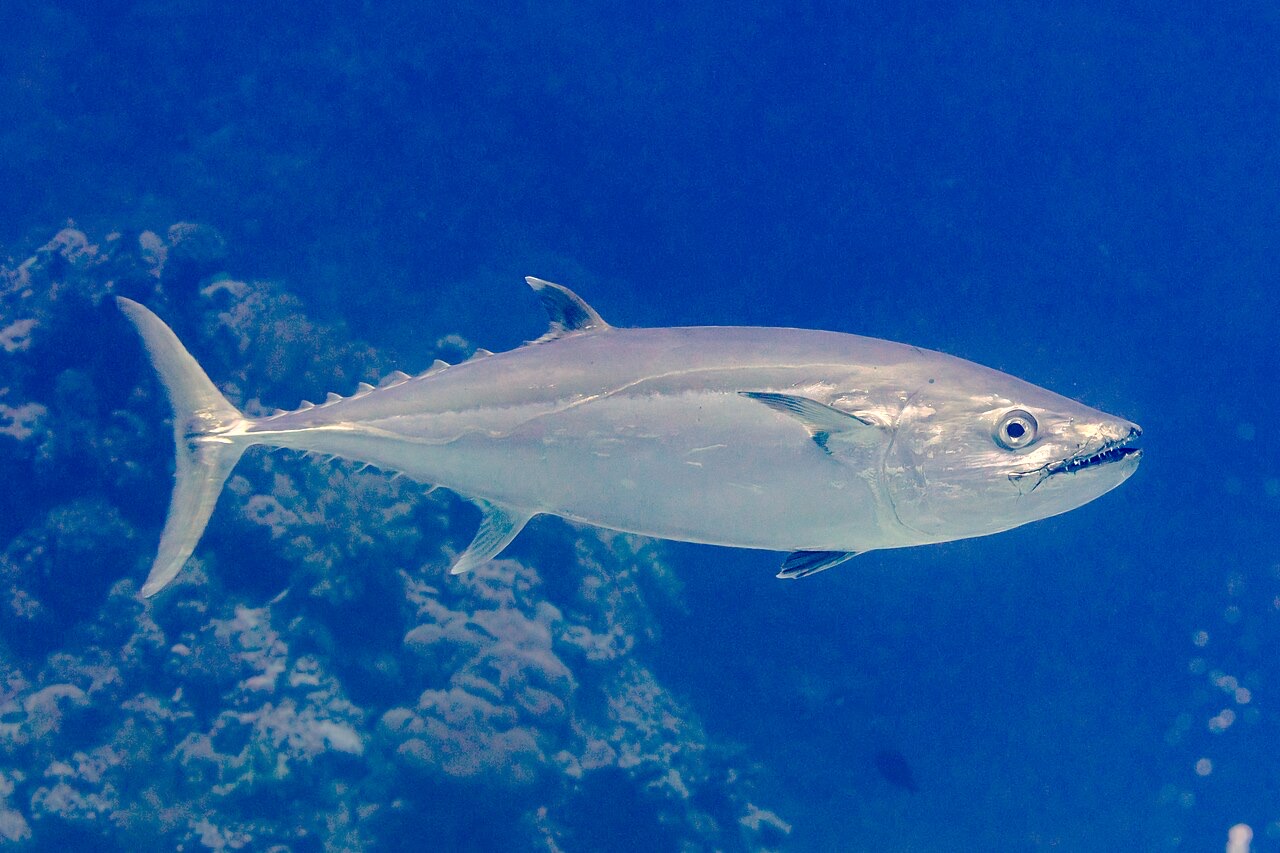
Big Fish
Dogtooth Tuna
Gymnosarda unicolor · Bony fish, family Scombridae
The dogtooth is the wolf of the drop-off: not a true bluefin-style tuna but a giant reef-bound mackerel with a mouthful of visible canines and a habit of appearing exactly where the wall meets deep water. Its presence is a mark of a healthy, current-washed reef; sites like Sipadan's corners, Osprey's North Horn, and Tubbataha's walls almost always hold one cruising the 30-meter line, chrome flanks flashing as it banks. Watching a big doggie hit a fusilier school from below, a detonation of scales in the blue, is one of wall diving's underrated spectacles. It grows slowly and holds territory, so heavily fished reefs go quiet of them fast.
Where and when to see one
"Resident" means most dives at that destination encounter them; "seasonal" means reliably present in the listed months; anything else is a bonus, not a plan.
| Destination | Reliability | Months | Notes |
|---|---|---|---|
| Sipadan & MabulMalaysia | Resident: seen on most dives | Year-round | |
| North & South Malé AtollsMaldives | Resident: seen on most dives | Year-round | |
| Tubbataha ReefsPhilippines | Resident: seen on most dives | Mar–Jun | |
| Coral Sea & Osprey ReefAustralia | Resident: seen on most dives | Year-round |
Best month, at a glance
Understanding them
Habitat: Steep outer-reef walls, seamounts, and current-swept channels; a reef-associated tuna rather than an open-ocean roamer
Range: Tropical Indo-Pacific from the Red Sea and East Africa through Indonesia and Micronesia to the central Pacific
Behavior: A solitary or small-group hunter that patrols the blue edge of walls with slow menace, then vanishes upward through a baitball in a silver blur. Divers meet it hanging in current at channel mouths or rising curiously toward bubble streams: a long, pale torpedo with a line of visible teeth even at rest.
Diet: Schooling reef and mid-water fish (fusiliers, rainbow runners, small trevally) taken in high-speed vertical ambushes
Size: typically around 1.0 m; documented up to 2.0 m (total length; trophy fish exceed 80 kg).
How to behave around one
Nothing special beyond the usual: hold your line in the current, no feeding, and let the fish make its inspection pass without pursuit.
Conservation
Least Concern but slow-growing and site-attached for a scombrid, and prized by spearfishers. Abundance now tracks protection closely.
Charted sites known for them
Highlighted sites were charted for this species by our editors; numbers are GBIF occurrence records logged within about 5 km of a site since 1990.
Watch
From the official channels

Wildlife of Monterey | New film in our auditorium

Live Aviary Cam | Monterey Bay Aquarium

Live Aviary Cam | Monterey Bay Aquarium
Videos are embedded links to their creators' own channels. We host nothing and credit everything.