Big Fish
Dogtooth Tuna
Gymnosarda unicolor · Bony fish, family Scombridae
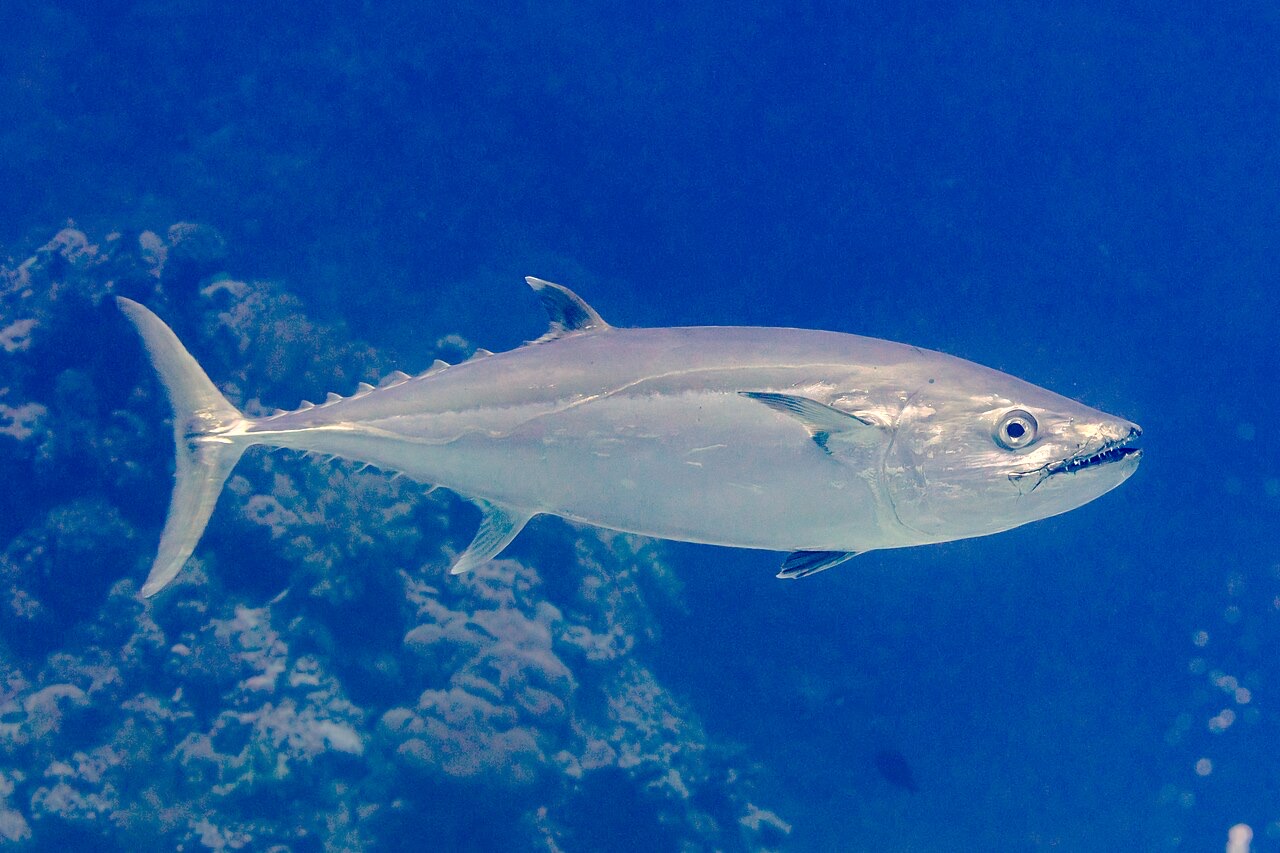
The dogtooth is the wolf of the drop-off: not a true bluefin-style tuna but a giant reef-bound mackerel with a mouthful of visible canines and a habit of appearing exactly where the wall meets deep water. Its presence is a mark of a healthy, current-washed reef; sites like Sipadan's corners, Osprey's North Horn, and Tubbataha's walls almost always hold one cruising the 30-meter line, chrome flanks flashing as it banks. Watching a big doggie hit a fusilier school from below, a detonation of scales in the blue, is one of wall diving's underrated spectacles. It grows slowly and holds territory, so heavily fished reefs go quiet of them fast.
Dove e quando avvistarne uno
"Residente" significa che la maggior parte delle immersioni in quella destinazione li incontra; "stagionale" significa che sono presenti in modo affidabile nei mesi indicati; qualsiasi altra cosa è un bonus, non un piano.
| Destinazione | Affidabilità | Mesi | Note |
|---|---|---|---|
| Sipadan & MabulMalaysia | Resident: seen on most dives | Tutto l'anno | |
| North & South Malé AtollsMaldives | Resident: seen on most dives | Tutto l'anno | |
| Tubbataha ReefsPhilippines | Resident: seen on most dives | Mar–Jun | |
| Coral Sea & Osprey ReefAustralia | Resident: seen on most dives | Tutto l'anno |
Il mese migliore, a colpo d'occhio
Capirle
Habitat: Steep outer-reef walls, seamounts, and current-swept channels; a reef-associated tuna rather than an open-ocean roamer
Distribuzione: Tropical Indo-Pacific from the Red Sea and East Africa through Indonesia and Micronesia to the central Pacific
Comportamento: A solitary or small-group hunter that patrols the blue edge of walls with slow menace, then vanishes upward through a baitball in a silver blur. Divers meet it hanging in current at channel mouths or rising curiously toward bubble streams: a long, pale torpedo with a line of visible teeth even at rest.
Dieta: Schooling reef and mid-water fish (fusiliers, rainbow runners, small trevally) taken in high-speed vertical ambushes
Dimensioni: tipicamente intorno a 1.0 m; documentato fino a 2.0 m (total length; trophy fish exceed 80 kg).
Come comportarsi in sua presenza
Nothing special beyond the usual: hold your line in the current, no feeding, and let the fish make its inspection pass without pursuit.
Conservazione
Least Concern but slow-growing and site-attached for a scombrid, and prized by spearfishers. Abundance now tracks protection closely.
Siti mappati noti per avvistamenti
I siti evidenziati sono stati schedati per questa specie dai nostri redattori; i numeri sono record di occorrenza GBIF registrati entro circa 5 km dal sito a partire dal 1990.
Guarda
Dai canali ufficiali

Wildlife of Monterey | New film in our auditorium

Live Aviary Cam | Monterey Bay Aquarium

Live Aviary Cam | Monterey Bay Aquarium
I video sono link incorporati ai canali dei rispettivi autori. Non ospitiamo nulla e accreditiamo tutto.