Reef Fish
Frogfish
Antennariidae · Bony fish, family Antennariidae (frogfishes, order Lophiiformes, the anglerfishes); family-level overview of roughly 50 species
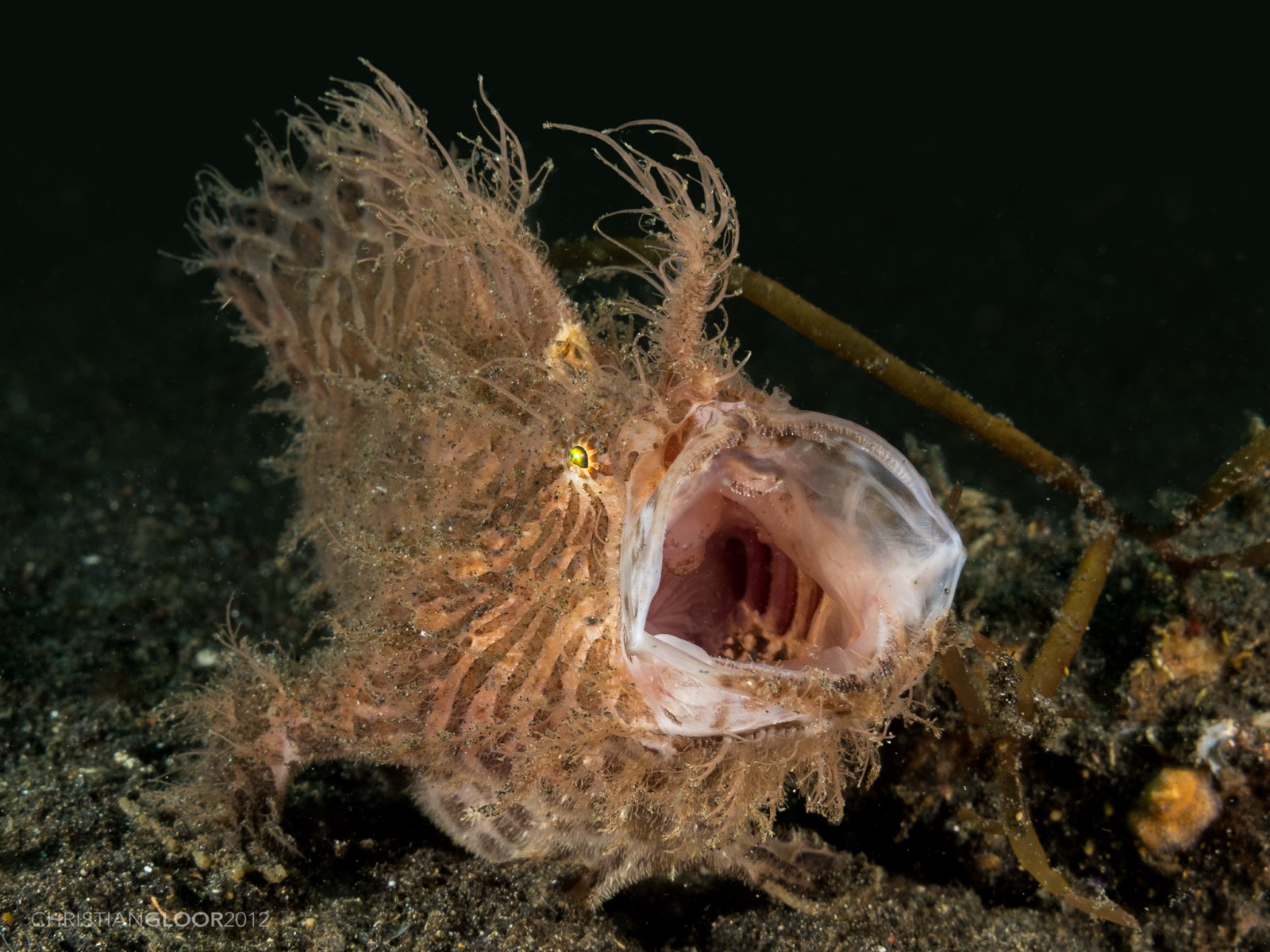
Finding the frogfish is the dive. Some fifty species of these globular anglerfishes sit motionless for days impersonating sponges, tunicates, algae-covered rock, or, in the hairy frogfish's case, a tuft of drifting weed, and even hand-sized individuals vanish against the right background. The first dorsal spine has evolved into a fishing rod tipped with a lure, a wriggling worm shape in some species and a shrimp shape in others, twitched above the mouth to call prey in. The strike is among the fastest feeding movements measured in fishes, the mouth ballooning open in a few milliseconds to inhale fish nearly the hunter's own length. Frogfishes walk rather than swim, ambling on limb-like pectoral fins. Muck guides track individuals for weeks, so ask what the site is holding.
Wo und wann man eines sieht
„Resident" bedeutet, dass die meisten Tauchgänge am jeweiligen Tauchziel eine Begegnung erwarten lassen; „saisonal" bedeutet, dass die Art in den genannten Monaten zuverlässig anzutreffen ist; alles andere ist ein Bonus, keine Planungsgrundlage.
| Ziel | Zuverlässigkeit | Monate | Hinweise |
|---|---|---|---|
| Bali & Nusa PenidaIndonesia | Resident: seen on most dives | Ganzjährig | |
| Lembeh StraitIndonesia | Resident: seen on most dives | Ganzjährig | |
| AnilaoPhilippines | Resident: seen on most dives | Ganzjährig | |
| Banda Sea & AmbonIndonesia | Resident: seen on most dives | Ganzjährig | |
| Dumaguete, Dauin & Apo IslandPhilippines | Resident: seen on most dives | Ganzjährig | |
| BonaireBonaire | Occasional | Ganzjährig |
Bester Monat auf einen Blick
Sie verstehen
Lebensraum: Sponges, rubble, wreck surfaces, jetty piles, and weed on both muck slopes and coral reefs; the sargassumfish drifts at the surface in floating weed.
Verbreitung: Warm seas worldwide; greatest variety in the Coral Triangle, with the longlure frogfish standing in across the Caribbean.
Verhalten: Sits motionless for days matching a sponge or weed tuft, twitching a modified dorsal-spine fishing rod and lure above the mouth; walks on limb-like pectoral fins rather than swimming.
Ernährung: Fishes and crustaceans lured within range and inhaled whole, including prey nearly the frogfish's own length.
Größe: typischerweise rund 0.1 m; dokumentiert bis zu 0.4 m (family range in total length; most diver-found species run 5–20 cm, the giant frogfish to about 40 cm).
Wie man sich in ihrer Nähe verhält
Never move a frogfish or its perch for a cleaner shot, and skip repeated strobe volleys at close range; a relocated ambusher loses its hunting spot.
Naturschutz
Few species have been formally assessed; the practical threats are habitat loss on muck coastlines and collection for aquaria.
Bekannte Tauchplätze dafür
Hervorgehobene Tauchplätze wurden von unseren Redakteuren für diese Art kartiert; die Zahlen sind GBIF-Vorkommensdatensätze, die seit 1990 im Umkreis von etwa 5 km um einen Tauchplatz protokolliert wurden.
Ansehen
Aus den offiziellen Kanälen

Wildlife of Monterey | New film in our auditorium

Live Aviary Cam | Monterey Bay Aquarium

Live Aviary Cam | Monterey Bay Aquarium
Videos sind eingebettete Links zu den Kanälen der jeweiligen Ersteller – wir hosten nichts und geben für alles die Quelle an.