Reef Fish
Frogfish
Antennariidae · Bony fish, family Antennariidae (frogfishes, order Lophiiformes, the anglerfishes); family-level overview of roughly 50 species
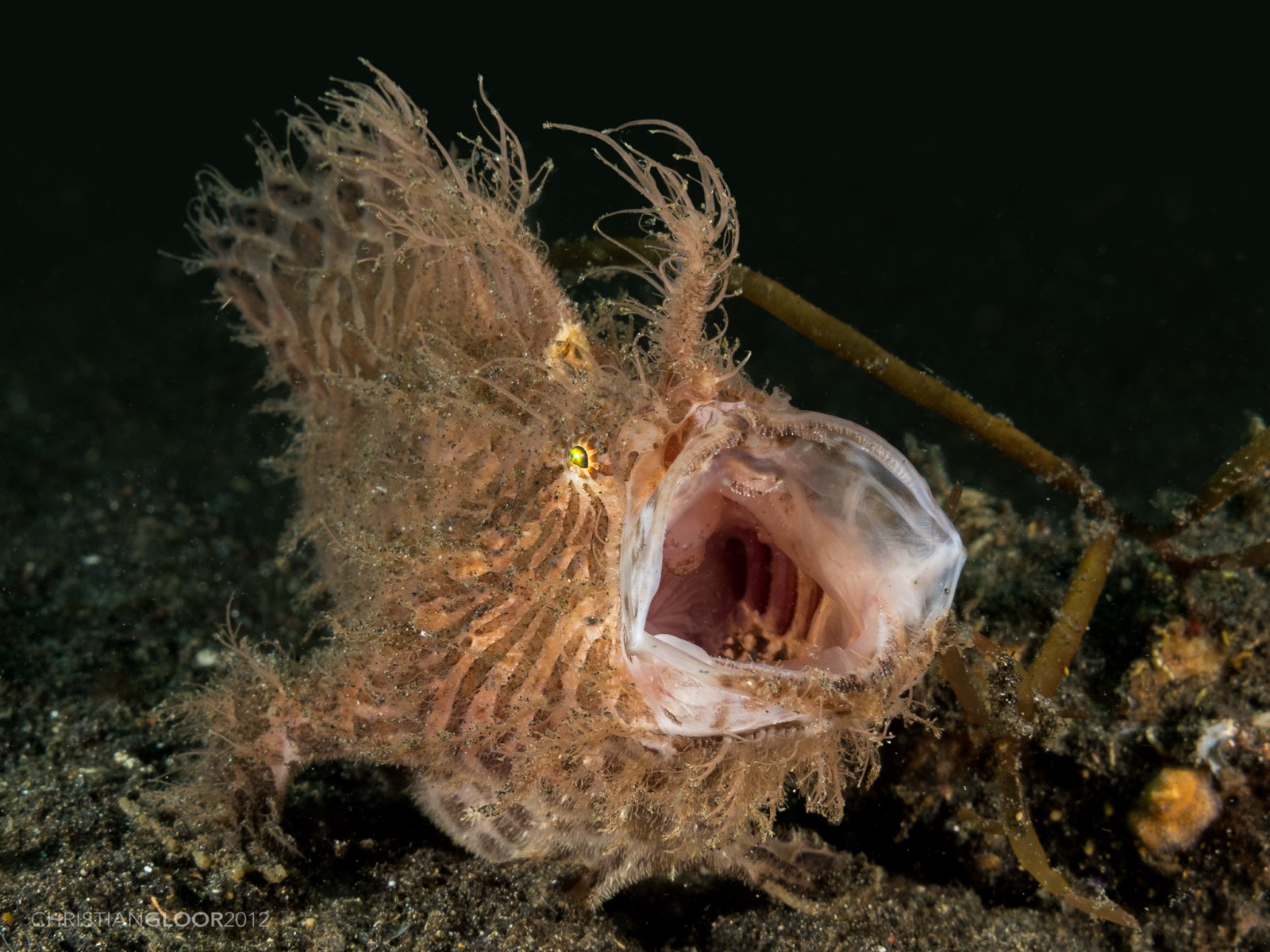
Finding the frogfish is the dive. Some fifty species of these globular anglerfishes sit motionless for days impersonating sponges, tunicates, algae-covered rock, or, in the hairy frogfish's case, a tuft of drifting weed, and even hand-sized individuals vanish against the right background. The first dorsal spine has evolved into a fishing rod tipped with a lure, a wriggling worm shape in some species and a shrimp shape in others, twitched above the mouth to call prey in. The strike is among the fastest feeding movements measured in fishes, the mouth ballooning open in a few milliseconds to inhale fish nearly the hunter's own length. Frogfishes walk rather than swim, ambling on limb-like pectoral fins. Muck guides track individuals for weeks, so ask what the site is holding.
Onde e quando ver um
"Residente" significa que a maioria dos mergulhos naquele destino os encontra; "sazonal" significa presença confiável nos meses listados; qualquer outra coisa é um bônus, não um plano.
| Destino | Fiabilidade | Meses | Notas |
|---|---|---|---|
| Bali & Nusa PenidaIndonesia | Resident: seen on most dives | Todo o ano | |
| Lembeh StraitIndonesia | Resident: seen on most dives | Todo o ano | |
| AnilaoPhilippines | Resident: seen on most dives | Todo o ano | |
| Banda Sea & AmbonIndonesia | Resident: seen on most dives | Todo o ano | |
| Dumaguete, Dauin & Apo IslandPhilippines | Resident: seen on most dives | Todo o ano | |
| BonaireBonaire | Occasional | Todo o ano |
Melhor mês, em resumo
Entendendo-os
Habitat: Sponges, rubble, wreck surfaces, jetty piles, and weed on both muck slopes and coral reefs; the sargassumfish drifts at the surface in floating weed.
Distribuição: Warm seas worldwide; greatest variety in the Coral Triangle, with the longlure frogfish standing in across the Caribbean.
Comportamento: Sits motionless for days matching a sponge or weed tuft, twitching a modified dorsal-spine fishing rod and lure above the mouth; walks on limb-like pectoral fins rather than swimming.
Dieta: Fishes and crustaceans lured within range and inhaled whole, including prey nearly the frogfish's own length.
Tamanho: normalmente cerca de 0.1 m; documentado até 0.4 m (family range in total length; most diver-found species run 5–20 cm, the giant frogfish to about 40 cm).
Como se comportar perto de um
Never move a frogfish or its perch for a cleaner shot, and skip repeated strobe volleys at close range; a relocated ambusher loses its hunting spot.
Conservação
Few species have been formally assessed; the practical threats are habitat loss on muck coastlines and collection for aquaria.
Pontos mapeados conhecidos por eles
Os locais destacados foram cartografados para esta espécie pelos nossos editores; os números são registos de ocorrência do GBIF num raio de cerca de 5 km do local desde 1990.
Assista
Dos canais oficiais

Wildlife of Monterey | New film in our auditorium

Live Aviary Cam | Monterey Bay Aquarium

Live Aviary Cam | Monterey Bay Aquarium
Os vídeos são ligações incorporadas para os canais dos próprios criadores. Não alojamos nada e creditamos tudo.