Macro
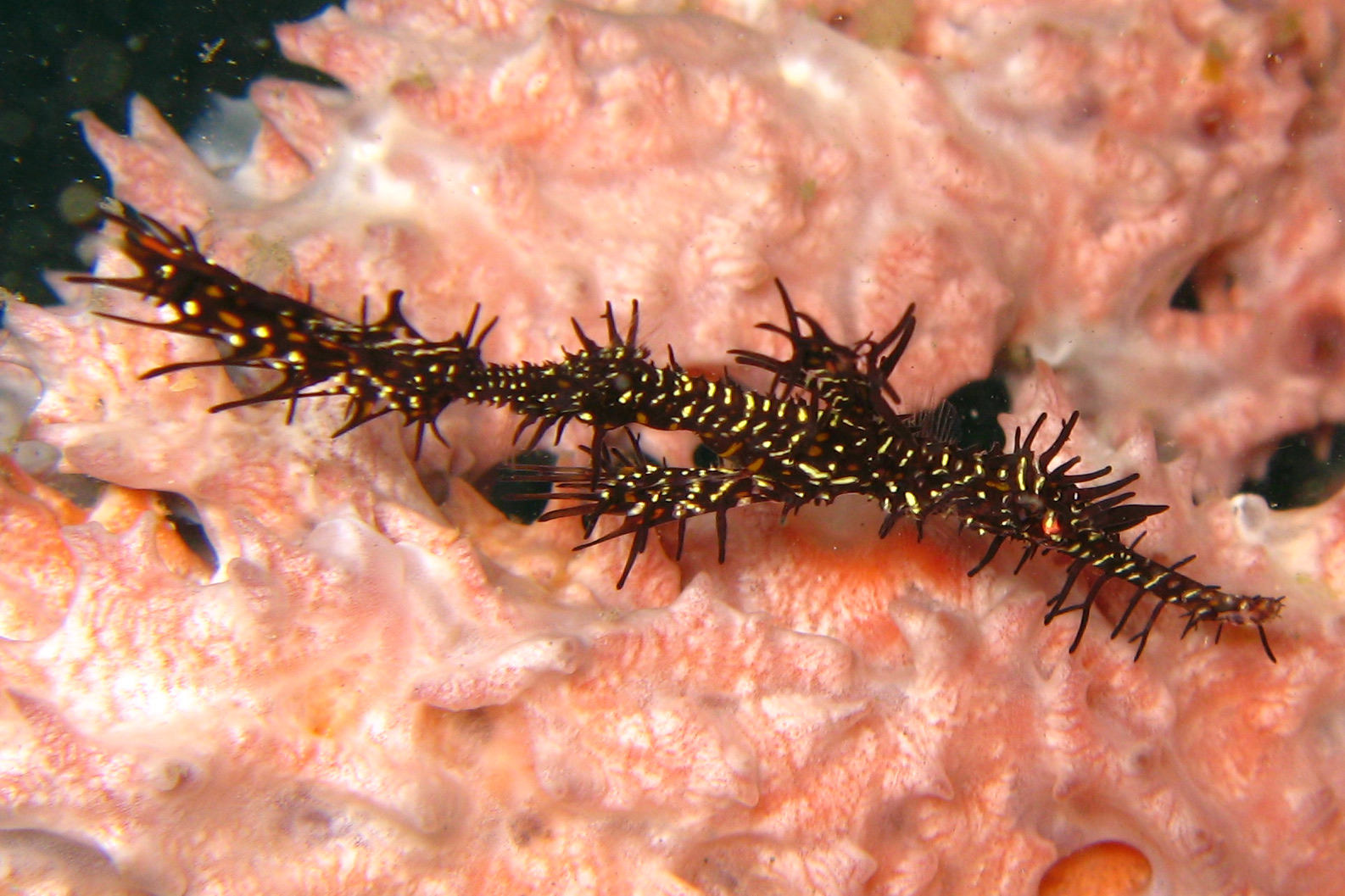
Ornate Ghost Pipefish
Solenostomus paradoxus · Bony fish, family Solenostomidae (ghost pipefishes), relatives of seahorses and pipefishes
An ornate ghost pipefish hangs head-down beside a crinoid pretending to be part of it, and the disguise nearly works: lacy spiked fins, a fringed profile, colors running crinoid black-and-yellow through burgundy and white. Unlike its seahorse cousins the female does the brooding, cupping eggs in a pouch formed by her broad pelvic fins, and the classic find is a pair: a larger female with a smaller male drifting a hand-span away. The species appears at muck and reef sites in pulses, arriving from the plankton, settling, breeding, and vanishing within weeks or months, so ask guides what has been showing lately rather than expecting fixtures. Check feather stars, black coral bushes, and seagrass margins, and look twice at any debris drifting wrong-way-up against the current. Stillness beats pursuit every time.
Où et quand en observer un
« Résident » signifie que la plupart des plongées sur ce site permettent de les observer ; « saisonnier » signifie qu'ils sont présents de manière fiable durant les mois indiqués ; tout le reste est un bonus, pas une certitude.
| Destination | Fiabilité | Mois | Notes |
|---|---|---|---|
| Bali & Nusa PenidaIndonesia | Occasional | Toute l'année | |
| Lembeh StraitIndonesia | Occasional | Toute l'année | |
| AnilaoPhilippines | Occasional | Toute l'année | |
| Similan Islands & Richelieu RockThailand | Occasional | Toute l'année | |
| Dumaguete, Dauin & Apo IslandPhilippines | Occasional | Toute l'année | |
| Banda Sea & AmbonIndonesia | Occasional | Toute l'année |
Meilleur mois, en un coup d'œil
Les comprendre
Habitat: Drifts head-down beside crinoids, black corals, gorgonians, and seagrass edges on reef slopes and muck bottoms.
Aire de répartition: Indo-West Pacific from the Red Sea and East Africa to Fiji, north to southern Japan, south to northern Australia.
Comportement: Appears seasonally in pulses after a planktonic phase, pairs up, breeds, and vanishes; unlike seahorses the female broods eggs in a pouch formed by her large pelvic fins.
Régime alimentaire: Tiny crustaceans plucked from the water and the host with a rapid pipette strike.
Taille: généralement autour de 0.09 m; documenté jusqu'à 0.12 m (total length; females larger than males).
Comment se comporter avec lui
Search along crinoids without touching them, and shoot from the side rather than herding the fish; pairs abandon a host that gets crowded.
Conservation
Not reliably assessed; short lifespans and planktonic dispersal make populations naturally patchy from year to year.
Sites répertoriés connus pour leur présence
Les sites mis en évidence ont été cartographiés pour cette espèce par nos éditeurs ; les chiffres correspondent aux occurrences GBIF enregistrées dans un rayon d'environ 5 km d'un site depuis 1990.
Regarder
Depuis les canaux officiels

Wildlife of Monterey | New film in our auditorium

Live Aviary Cam | Monterey Bay Aquarium

Live Aviary Cam | Monterey Bay Aquarium
Les vidéos sont des liens intégrés vers les chaînes de leurs créateurs. Nous n'hébergeons rien et créditons tout.