Reef Fish
Giant Moray Eel
Gymnothorax javanicus · Bony fish, family Muraenidae (moray eels); the largest moray by mass on Indo-Pacific reefs
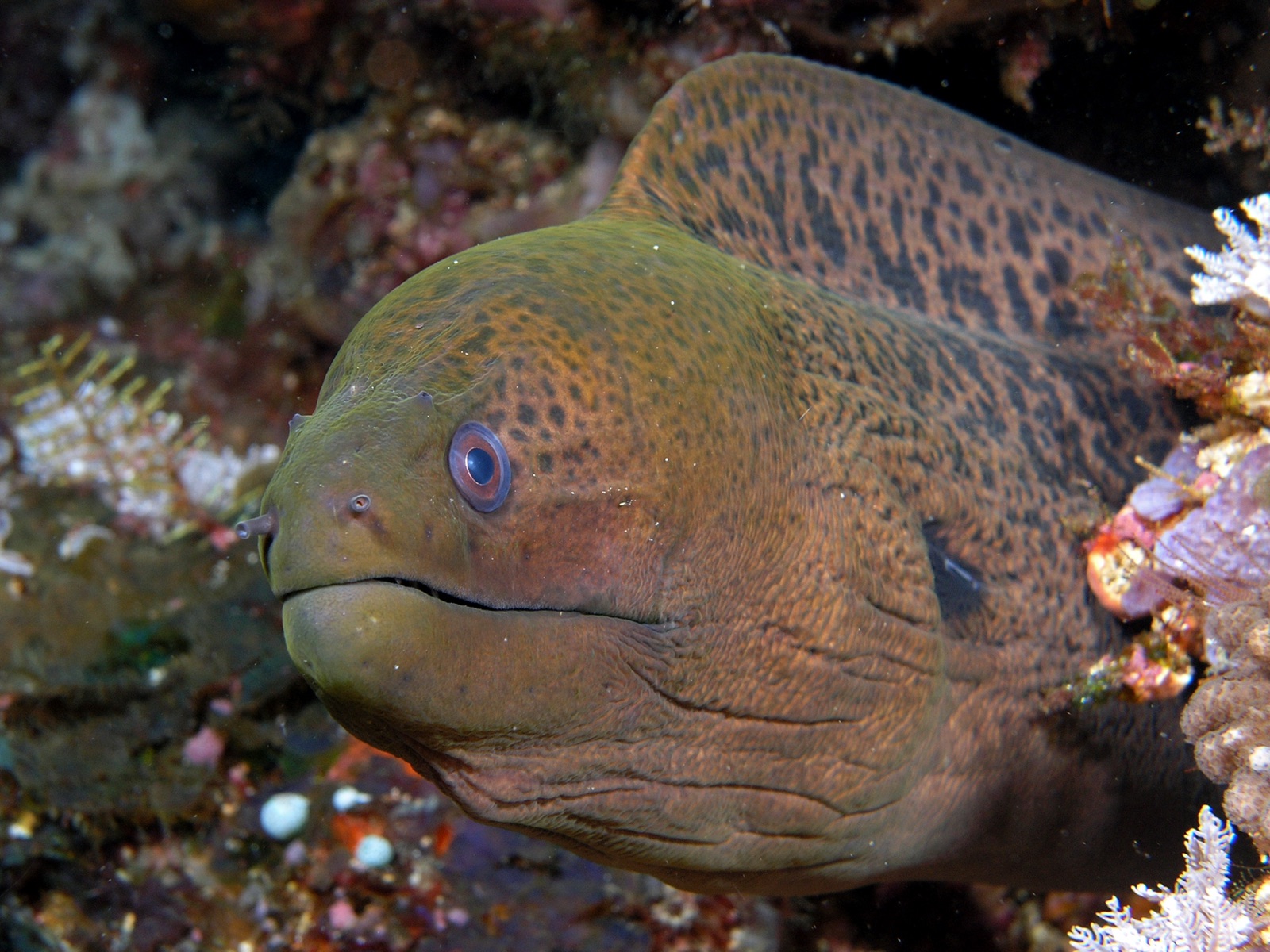
The open mouth reads as menace but is only breathing: morays pump water over their gills by gaping, and the giant moray spends daylight doing exactly that from a favorite crevice. It is the largest moray on Indo-Pacific reefs, thick as a diver's thigh, patterned in leopard spots that darken with age. Cleaner wrasses and shrimp work inside the open jaws at station after station; hang back and let the appointment finish. In the Red Sea, giant morays have been documented hunting cooperatively with roving coral groupers, the grouper signaling over a hidden fish and the eel flushing it out. Bites almost always trace back to feeding attempts or hands placed into holes. Look into a crevice before you brace on anything, and keep fingers off the reef.
Where and when to see one
"Resident" means most dives at that destination encounter them; "seasonal" means reliably present in the listed months; anything else is a bonus, not a plan.
| Destination | Reliability | Months | Notes |
|---|---|---|---|
| Sharm El Sheikh & Ras MohammedEgypt | Resident: seen on most dives | Year-round | |
| North & South Malé AtollsMaldives | Resident: seen on most dives | Year-round | |
| Sipadan & MabulMalaysia | Resident: seen on most dives | Year-round | |
| PalauPalau | Resident: seen on most dives | Year-round | |
| Cairns & the Ribbon ReefsAustralia | Resident: seen on most dives | Year-round | |
| Hurghada & El GounaEgypt | Resident: seen on most dives | Year-round |
Best month, at a glance
Understanding them
Habitat: Crevices, overhangs, and wreck recesses on lagoon and seaward reefs; a favored hole is reused for long periods.
Range: Indo-Pacific and Red Sea, from East Africa to French Polynesia and southern Japan.
Behavior: Gapes rhythmically to breathe, holds still for cleaner wrasses and shrimp working inside the mouth, and in the Red Sea has been documented hunting cooperatively with roving coral groupers.
Diet: Fishes and occasionally crustaceans, mostly hunted at night by scent along the reef.
Size: typically around 1.8 m; documented up to 3.0 m (total length; heavy-bodied, with large adults approaching 30 kg).
How to behave around one
Give cleaner stations room to finish, approach the crevice from the front at an unhurried pace, and keep bare hands off the reef around any occupied hole.
Conservation
Widespread and not considered threatened; large individuals are a known ciguatera risk and are rarely fished.
Charted sites known for them
Highlighted sites were charted for this species by our editors; numbers are GBIF occurrence records logged within about 5 km of a site since 1990.
Watch
From the official channels

Wildlife of Monterey | New film in our auditorium

Live Aviary Cam | Monterey Bay Aquarium

Live Aviary Cam | Monterey Bay Aquarium
Videos are embedded links to their creators' own channels. We host nothing and credit everything.