Cephalopods
Mimic Octopus
Thaumoctopus mimicus · Cephalopod mollusk, family Octopodidae; described in 2005 after its late-1990s discovery on Indonesian muck
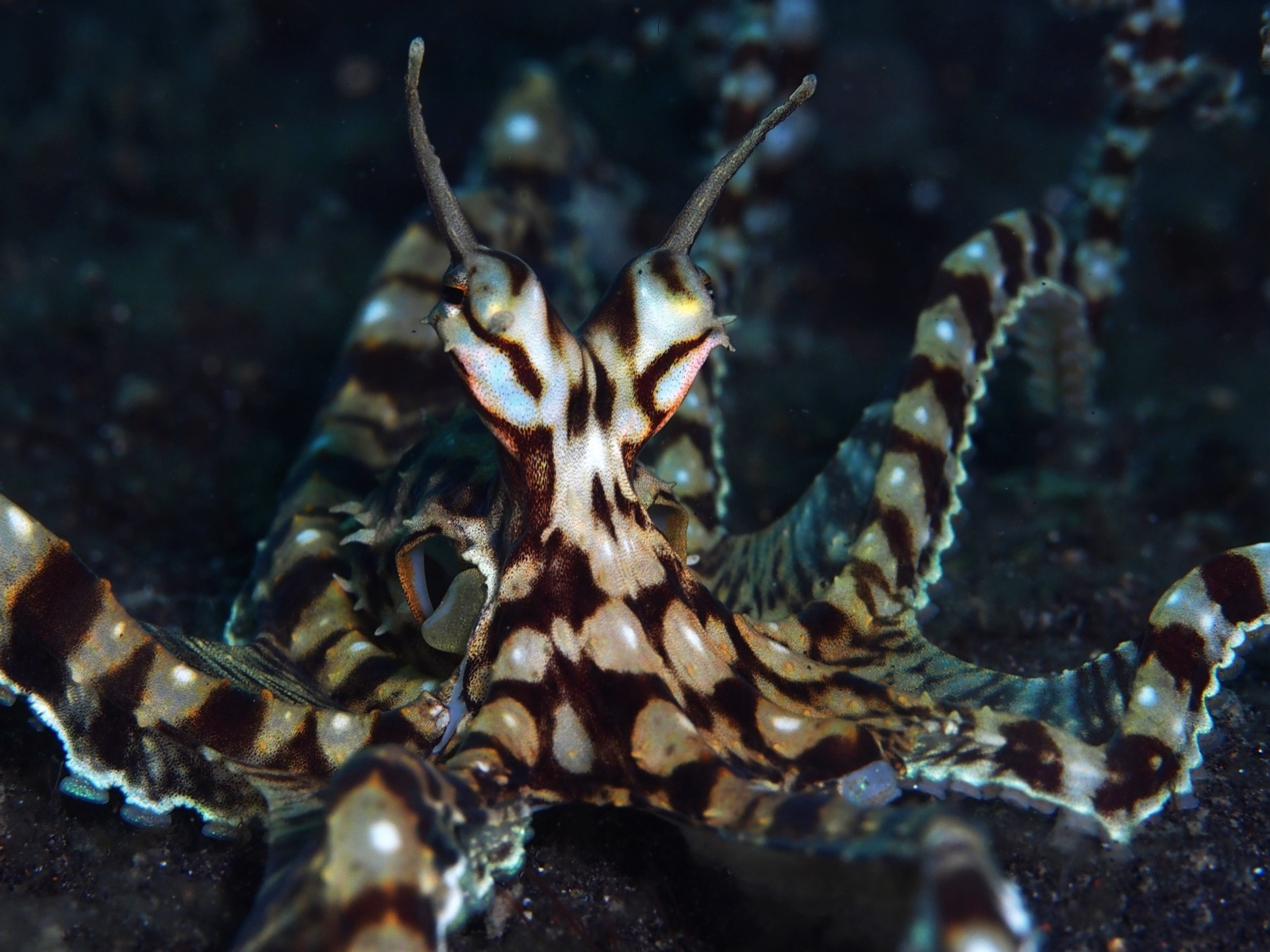
Plenty of octopuses match backgrounds; the mimic octopus impersonates other animals. First noticed on Sulawesi muck in the late 1990s, it forages exposed on bare silt in daylight, and its survival act is a repertoire: flattening into a gliding flounder, trailing banded arms like lionfish spines, or hiding all but two arms in a burrow and waving a convincing banded sea krait. Which impression appears seems to track which predator threatens. Longer lists get claimed (jellyfish, anemones, mantis shrimp) and deserve some skepticism; the core three are well documented. The animal itself is slight, brown-and-white banded, arms like linguine, probing worm holes across featureless slopes. Whole dives at black-sand sites are built around finding one. Stay off the silt, follow at arm's length, and let the show be voluntary.
Wo und wann man eines sieht
„Resident" bedeutet, dass die meisten Tauchgänge am jeweiligen Tauchziel eine Begegnung erwarten lassen; „saisonal" bedeutet, dass die Art in den genannten Monaten zuverlässig anzutreffen ist; alles andere ist ein Bonus, keine Planungsgrundlage.
| Ziel | Zuverlässigkeit | Monate | Hinweise |
|---|---|---|---|
| Bali & Nusa PenidaIndonesia | Occasional | Ganzjährig | |
| Lembeh StraitIndonesia | Occasional | Ganzjährig | |
| AnilaoPhilippines | Occasional | Ganzjährig | |
| Dumaguete, Dauin & Apo IslandPhilippines | Occasional | Ganzjährig | |
| Banda Sea & AmbonIndonesia | Occasional | Ganzjährig |
Bester Monat auf einen Blick
Sie verstehen
Lebensraum: Bare silt and black-sand flats near river mouths and muck bays, foraging around worm holes and burrows it can dive into.
Verbreitung: Indo-Malayan region: Indonesia and the Philippines through to northern Australia and New Guinea.
Verhalten: Forages exposed in daylight on featureless bottom, switching between impersonations (a gliding flounder, trailing lionfish-like arms, or a banded sea krait waved from a burrow), apparently matched to the threat at hand.
Ernährung: Small crustaceans and fishes probed out of burrows with linguine-thin arms.
Größe: typischerweise rund 0.4 m; dokumentiert bis zu 0.6 m (arm-span; the arms are strikingly slender).
Wie man sich in ihrer Nähe verhält
Follow at arm's length off the bottom, never dig, corral, or bait, and let every impersonation be the animal's own idea.
Naturschutz
Not reliably assessed; its narrow, developable coastal habitat and value to dive tourism argue for keeping muck bays healthy.
Bekannte Tauchplätze dafür
Hervorgehobene Tauchplätze wurden von unseren Redakteuren für diese Art kartiert; die Zahlen sind GBIF-Vorkommensdatensätze, die seit 1990 im Umkreis von etwa 5 km um einen Tauchplatz protokolliert wurden.
Ansehen
Aus den offiziellen Kanälen

Wildlife of Monterey | New film in our auditorium

Live Aviary Cam | Monterey Bay Aquarium

Live Aviary Cam | Monterey Bay Aquarium
Videos sind eingebettete Links zu den Kanälen der jeweiligen Ersteller – wir hosten nichts und geben für alles die Quelle an.