Cephalopods
Mimic Octopus
Thaumoctopus mimicus · Cephalopod mollusk, family Octopodidae; described in 2005 after its late-1990s discovery on Indonesian muck
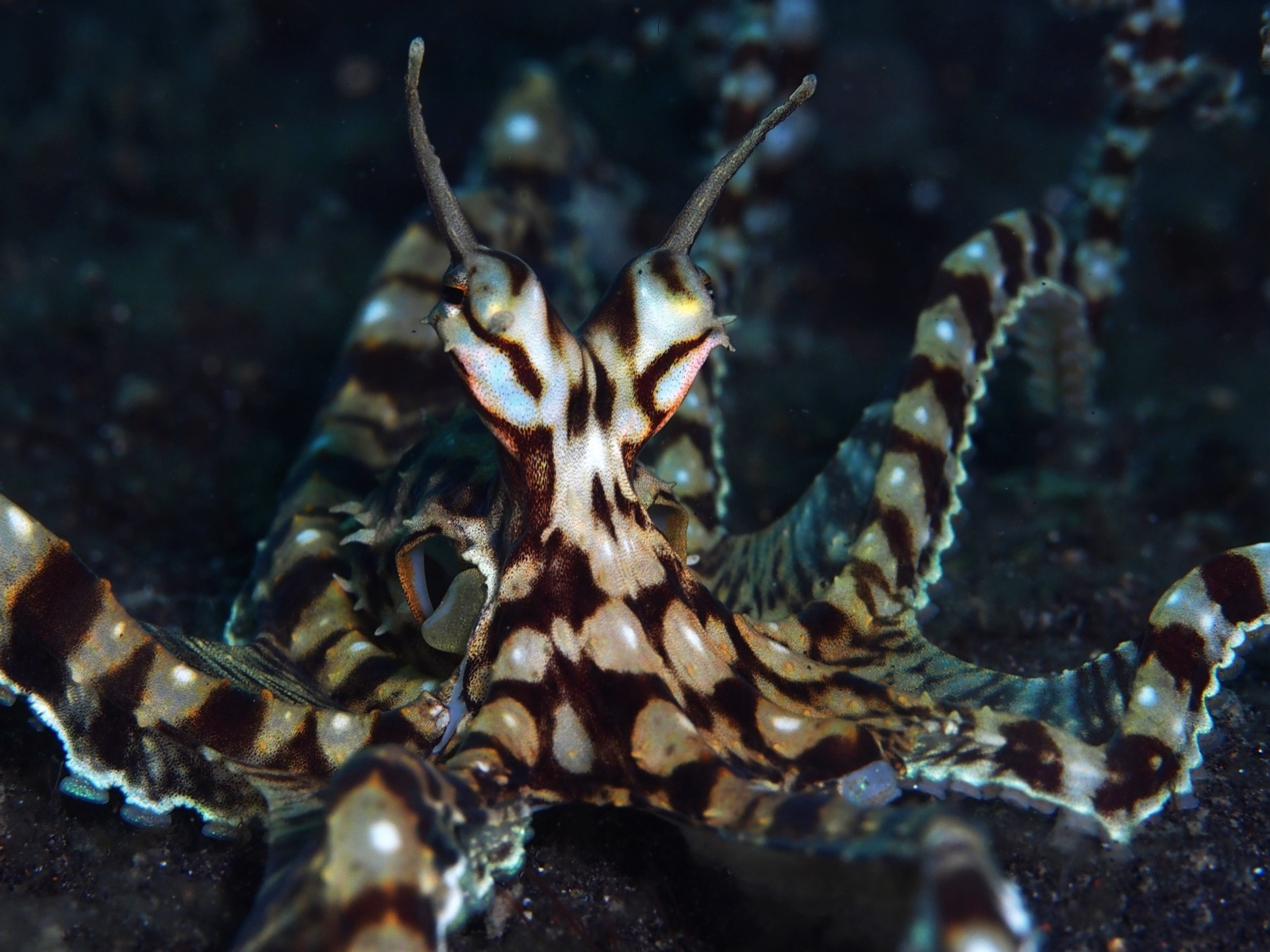
Plenty of octopuses match backgrounds; the mimic octopus impersonates other animals. First noticed on Sulawesi muck in the late 1990s, it forages exposed on bare silt in daylight, and its survival act is a repertoire: flattening into a gliding flounder, trailing banded arms like lionfish spines, or hiding all but two arms in a burrow and waving a convincing banded sea krait. Which impression appears seems to track which predator threatens. Longer lists get claimed (jellyfish, anemones, mantis shrimp) and deserve some skepticism; the core three are well documented. The animal itself is slight, brown-and-white banded, arms like linguine, probing worm holes across featureless slopes. Whole dives at black-sand sites are built around finding one. Stay off the silt, follow at arm's length, and let the show be voluntary.
Où et quand en observer un
« Résident » signifie que la plupart des plongées sur ce site permettent de les observer ; « saisonnier » signifie qu'ils sont présents de manière fiable durant les mois indiqués ; tout le reste est un bonus, pas une certitude.
| Destination | Fiabilité | Mois | Notes |
|---|---|---|---|
| Bali & Nusa PenidaIndonesia | Occasional | Toute l'année | |
| Lembeh StraitIndonesia | Occasional | Toute l'année | |
| AnilaoPhilippines | Occasional | Toute l'année | |
| Dumaguete, Dauin & Apo IslandPhilippines | Occasional | Toute l'année | |
| Banda Sea & AmbonIndonesia | Occasional | Toute l'année |
Meilleur mois, en un coup d'œil
Les comprendre
Habitat: Bare silt and black-sand flats near river mouths and muck bays, foraging around worm holes and burrows it can dive into.
Aire de répartition: Indo-Malayan region: Indonesia and the Philippines through to northern Australia and New Guinea.
Comportement: Forages exposed in daylight on featureless bottom, switching between impersonations (a gliding flounder, trailing lionfish-like arms, or a banded sea krait waved from a burrow), apparently matched to the threat at hand.
Régime alimentaire: Small crustaceans and fishes probed out of burrows with linguine-thin arms.
Taille: généralement autour de 0.4 m; documenté jusqu'à 0.6 m (arm-span; the arms are strikingly slender).
Comment se comporter avec lui
Follow at arm's length off the bottom, never dig, corral, or bait, and let every impersonation be the animal's own idea.
Conservation
Not reliably assessed; its narrow, developable coastal habitat and value to dive tourism argue for keeping muck bays healthy.
Sites répertoriés connus pour leur présence
Les sites mis en évidence ont été cartographiés pour cette espèce par nos éditeurs ; les chiffres correspondent aux occurrences GBIF enregistrées dans un rayon d'environ 5 km d'un site depuis 1990.
Regarder
Depuis les canaux officiels

Wildlife of Monterey | New film in our auditorium

Live Aviary Cam | Monterey Bay Aquarium

Live Aviary Cam | Monterey Bay Aquarium
Les vidéos sont des liens intégrés vers les chaînes de leurs créateurs. Nous n'hébergeons rien et créditons tout.