Reef Fish
Oriental Sweetlips
Plectorhinchus vittatus · Bony fish, family Haemulidae (grunts and sweetlips)
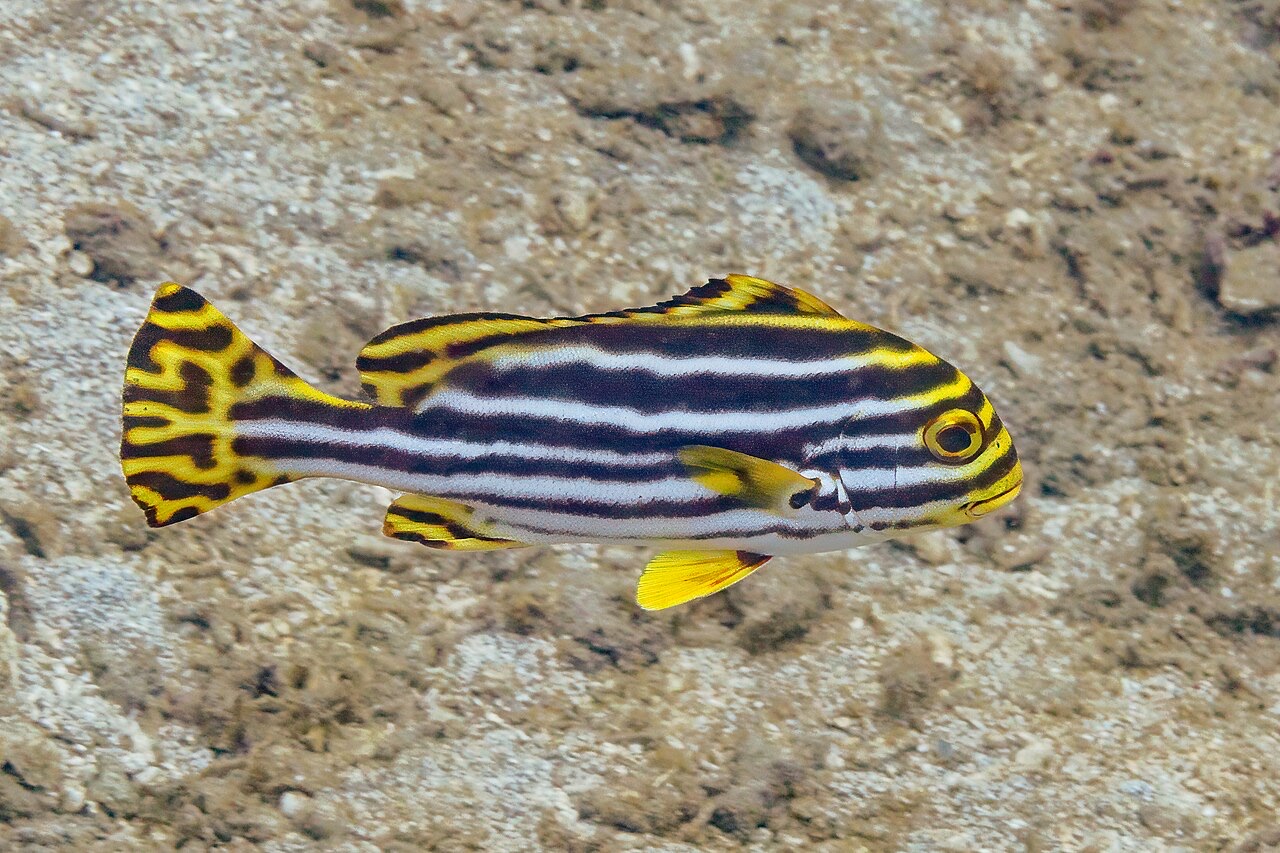
Adult oriental sweetlips have perfected standing still in public. Schools of a few dozen hover in tight formation under table corals and overhangs through the day, thick lips and painted stripes all facing the current, barely finning: an arrangement photographers structure whole dives around, especially in the Maldives. They disperse at night to root crustaceans and worms out of the sand. The juveniles seem like a different animal entirely: blotched brown-and-white clowns that swim in exaggerated, flopping loops, a performance widely interpreted as mimicry of toxic flatworms, advertising unpalatability before the fish has size on its side. Day schools tolerate a slow, level approach to within a body length; rush them and the formation dissolves over the reef edge. The family name is earned: disturbed fish grunt audibly by grinding pharyngeal teeth.
Wo und wann man eines sieht
„Resident" bedeutet, dass die meisten Tauchgänge am jeweiligen Tauchziel eine Begegnung erwarten lassen; „saisonal" bedeutet, dass die Art in den genannten Monaten zuverlässig anzutreffen ist; alles andere ist ein Bonus, keine Planungsgrundlage.
| Ziel | Zuverlässigkeit | Monate | Hinweise |
|---|---|---|---|
| North & South Malé AtollsMaldives | Resident: seen on most dives | Ganzjährig | |
| Sipadan & MabulMalaysia | Resident: seen on most dives | Ganzjährig | |
| Ari AtollMaldives | Resident: seen on most dives | Ganzjährig | |
| Similan Islands & Richelieu RockThailand | Resident: seen on most dives | Ganzjährig | |
| Zanzibar & MnembaTanzania | Resident: seen on most dives | Ganzjährig |
Bester Monat auf einen Blick
Sie verstehen
Lebensraum: Clear lagoon and seaward reefs, schooling by day under table corals, overhangs, and bommie shadows.
Verbreitung: Indian Ocean and western Pacific, from East Africa and the Maldives to Indonesia, Micronesia, and Samoa.
Verhalten: Day-resting schools hold tight formation facing the current, dispersing after dark to feed; boldly patterned juveniles swim in exaggerated flopping loops widely read as flatworm mimicry.
Ernährung: Crustaceans, worms, and other invertebrates rooted from sand and rubble at night.
Größe: typischerweise rund 0.4 m; dokumentiert bis zu 0.6 m (total length).
Wie man sich in ihrer Nähe verhält
Approach a resting school slow and level from down-current; rushing the formation scatters it and costs every diver behind you the sight.
Naturschutz
Taken in local fisheries across parts of the range; day-schooling behavior makes populations easy to deplete where spearfishing is common.
Bekannte Tauchplätze dafür
Hervorgehobene Tauchplätze wurden von unseren Redakteuren für diese Art kartiert; die Zahlen sind GBIF-Vorkommensdatensätze, die seit 1990 im Umkreis von etwa 5 km um einen Tauchplatz protokolliert wurden.
Ansehen
Aus den offiziellen Kanälen

Wildlife of Monterey | New film in our auditorium

Live Aviary Cam | Monterey Bay Aquarium

Live Aviary Cam | Monterey Bay Aquarium
Videos sind eingebettete Links zu den Kanälen der jeweiligen Ersteller – wir hosten nichts und geben für alles die Quelle an.