Reef Fish
Oriental Sweetlips
Plectorhinchus vittatus · Bony fish, family Haemulidae (grunts and sweetlips)
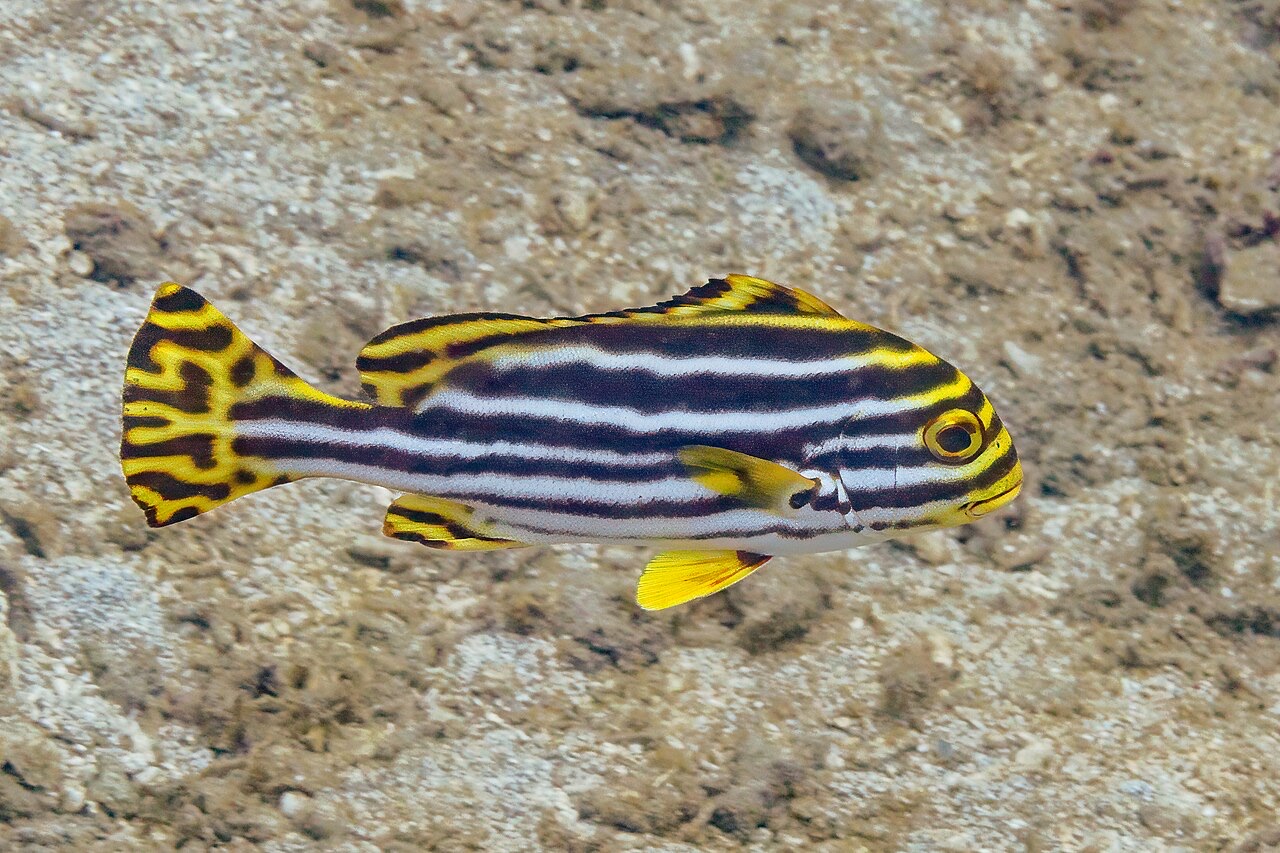
Adult oriental sweetlips have perfected standing still in public. Schools of a few dozen hover in tight formation under table corals and overhangs through the day, thick lips and painted stripes all facing the current, barely finning: an arrangement photographers structure whole dives around, especially in the Maldives. They disperse at night to root crustaceans and worms out of the sand. The juveniles seem like a different animal entirely: blotched brown-and-white clowns that swim in exaggerated, flopping loops, a performance widely interpreted as mimicry of toxic flatworms, advertising unpalatability before the fish has size on its side. Day schools tolerate a slow, level approach to within a body length; rush them and the formation dissolves over the reef edge. The family name is earned: disturbed fish grunt audibly by grinding pharyngeal teeth.
Où et quand en observer un
« Résident » signifie que la plupart des plongées sur ce site permettent de les observer ; « saisonnier » signifie qu'ils sont présents de manière fiable durant les mois indiqués ; tout le reste est un bonus, pas une certitude.
| Destination | Fiabilité | Mois | Notes |
|---|---|---|---|
| North & South Malé AtollsMaldives | Resident: seen on most dives | Toute l'année | |
| Sipadan & MabulMalaysia | Resident: seen on most dives | Toute l'année | |
| Ari AtollMaldives | Resident: seen on most dives | Toute l'année | |
| Similan Islands & Richelieu RockThailand | Resident: seen on most dives | Toute l'année | |
| Zanzibar & MnembaTanzania | Resident: seen on most dives | Toute l'année |
Meilleur mois, en un coup d'œil
Les comprendre
Habitat: Clear lagoon and seaward reefs, schooling by day under table corals, overhangs, and bommie shadows.
Aire de répartition: Indian Ocean and western Pacific, from East Africa and the Maldives to Indonesia, Micronesia, and Samoa.
Comportement: Day-resting schools hold tight formation facing the current, dispersing after dark to feed; boldly patterned juveniles swim in exaggerated flopping loops widely read as flatworm mimicry.
Régime alimentaire: Crustaceans, worms, and other invertebrates rooted from sand and rubble at night.
Taille: généralement autour de 0.4 m; documenté jusqu'à 0.6 m (total length).
Comment se comporter avec lui
Approach a resting school slow and level from down-current; rushing the formation scatters it and costs every diver behind you the sight.
Conservation
Taken in local fisheries across parts of the range; day-schooling behavior makes populations easy to deplete where spearfishing is common.
Sites répertoriés connus pour leur présence
Les sites mis en évidence ont été cartographiés pour cette espèce par nos éditeurs ; les chiffres correspondent aux occurrences GBIF enregistrées dans un rayon d'environ 5 km d'un site depuis 1990.
Regarder
Depuis les canaux officiels

Wildlife of Monterey | New film in our auditorium

Live Aviary Cam | Monterey Bay Aquarium

Live Aviary Cam | Monterey Bay Aquarium
Les vidéos sont des liens intégrés vers les chaînes de leurs créateurs. Nous n'hébergeons rien et créditons tout.