Reef Fish
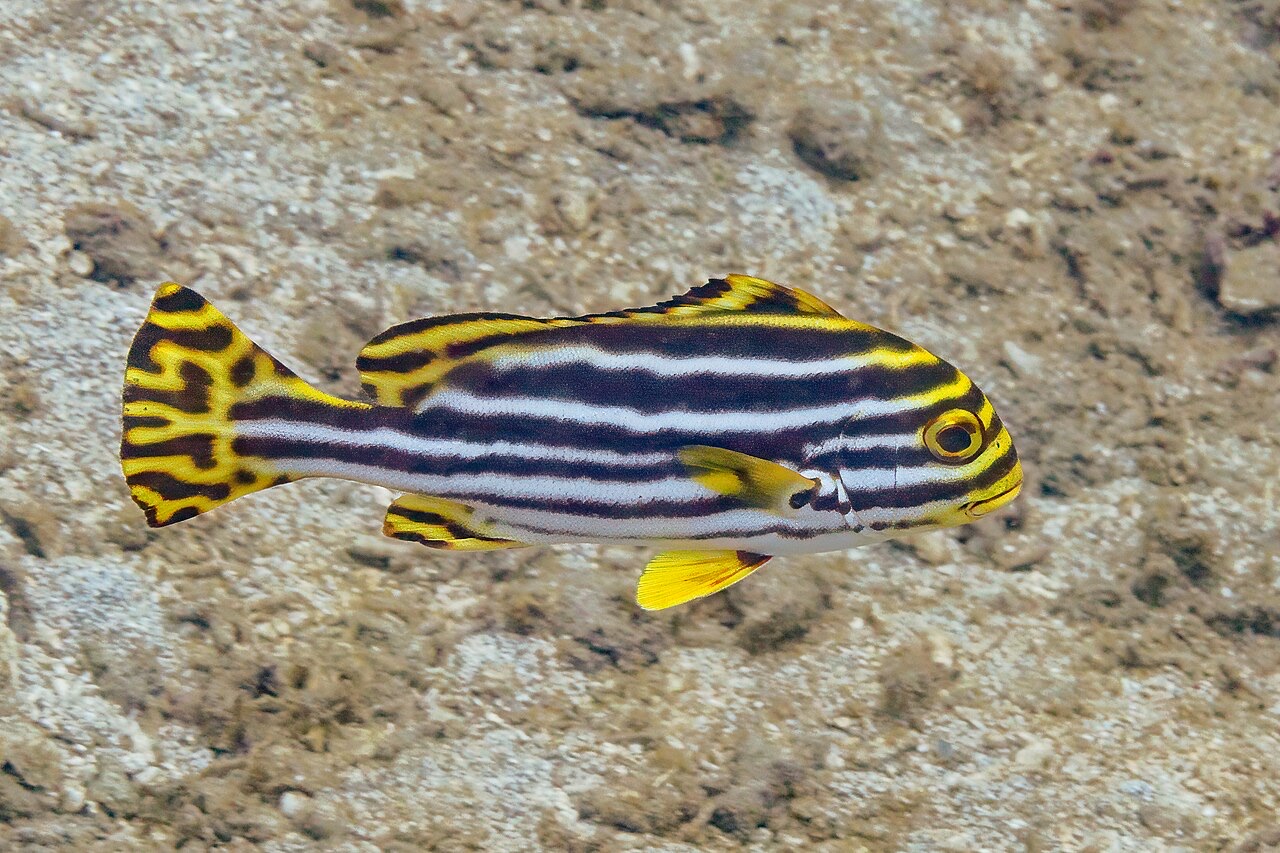
Oriental Sweetlips
Plectorhinchus vittatus · Bony fish, family Haemulidae (grunts and sweetlips)
Adult oriental sweetlips have perfected standing still in public. Schools of a few dozen hover in tight formation under table corals and overhangs through the day, thick lips and painted stripes all facing the current, barely finning: an arrangement photographers structure whole dives around, especially in the Maldives. They disperse at night to root crustaceans and worms out of the sand. The juveniles seem like a different animal entirely: blotched brown-and-white clowns that swim in exaggerated, flopping loops, a performance widely interpreted as mimicry of toxic flatworms, advertising unpalatability before the fish has size on its side. Day schools tolerate a slow, level approach to within a body length; rush them and the formation dissolves over the reef edge. The family name is earned: disturbed fish grunt audibly by grinding pharyngeal teeth.
Dove e quando avvistarne uno
"Residente" significa che la maggior parte delle immersioni in quella destinazione li incontra; "stagionale" significa che sono presenti in modo affidabile nei mesi indicati; qualsiasi altra cosa è un bonus, non un piano.
| Destinazione | Affidabilità | Mesi | Note |
|---|---|---|---|
| North & South Malé AtollsMaldives | Resident: seen on most dives | Tutto l'anno | |
| Sipadan & MabulMalaysia | Resident: seen on most dives | Tutto l'anno | |
| Ari AtollMaldives | Resident: seen on most dives | Tutto l'anno | |
| Similan Islands & Richelieu RockThailand | Resident: seen on most dives | Tutto l'anno | |
| Zanzibar & MnembaTanzania | Resident: seen on most dives | Tutto l'anno |
Il mese migliore, a colpo d'occhio
Capirle
Habitat: Clear lagoon and seaward reefs, schooling by day under table corals, overhangs, and bommie shadows.
Distribuzione: Indian Ocean and western Pacific, from East Africa and the Maldives to Indonesia, Micronesia, and Samoa.
Comportamento: Day-resting schools hold tight formation facing the current, dispersing after dark to feed; boldly patterned juveniles swim in exaggerated flopping loops widely read as flatworm mimicry.
Dieta: Crustaceans, worms, and other invertebrates rooted from sand and rubble at night.
Dimensioni: tipicamente intorno a 0.4 m; documentato fino a 0.6 m (total length).
Come comportarsi in sua presenza
Approach a resting school slow and level from down-current; rushing the formation scatters it and costs every diver behind you the sight.
Conservazione
Taken in local fisheries across parts of the range; day-schooling behavior makes populations easy to deplete where spearfishing is common.
Siti mappati noti per avvistamenti
I siti evidenziati sono stati schedati per questa specie dai nostri redattori; i numeri sono record di occorrenza GBIF registrati entro circa 5 km dal sito a partire dal 1990.
Guarda
Dai canali ufficiali

Wildlife of Monterey | New film in our auditorium

Live Aviary Cam | Monterey Bay Aquarium

Live Aviary Cam | Monterey Bay Aquarium
I video sono link incorporati ai canali dei rispettivi autori. Non ospitiamo nulla e accreditiamo tutto.