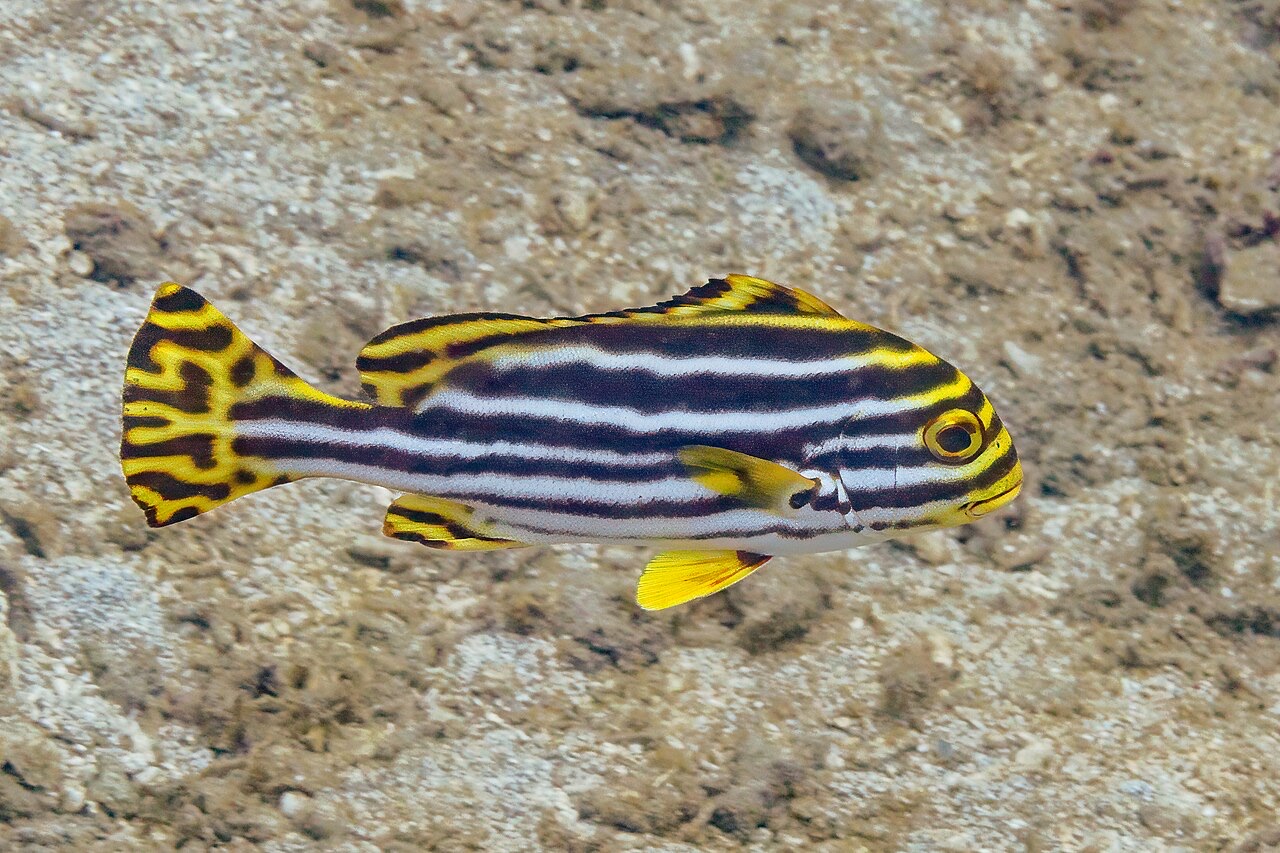
Reef Fish
Oriental Sweetlips
Plectorhinchus vittatus · Bony fish, family Haemulidae (grunts and sweetlips)
Adult oriental sweetlips have perfected standing still in public. Schools of a few dozen hover in tight formation under table corals and overhangs through the day, thick lips and painted stripes all facing the current, barely finning: an arrangement photographers structure whole dives around, especially in the Maldives. They disperse at night to root crustaceans and worms out of the sand. The juveniles seem like a different animal entirely: blotched brown-and-white clowns that swim in exaggerated, flopping loops, a performance widely interpreted as mimicry of toxic flatworms, advertising unpalatability before the fish has size on its side. Day schools tolerate a slow, level approach to within a body length; rush them and the formation dissolves over the reef edge. The family name is earned: disturbed fish grunt audibly by grinding pharyngeal teeth.
Onde e quando ver um
"Residente" significa que a maioria dos mergulhos naquele destino os encontra; "sazonal" significa presença confiável nos meses listados; qualquer outra coisa é um bônus, não um plano.
| Destino | Fiabilidade | Meses | Notas |
|---|---|---|---|
| North & South Malé AtollsMaldives | Resident: seen on most dives | Todo o ano | |
| Sipadan & MabulMalaysia | Resident: seen on most dives | Todo o ano | |
| Ari AtollMaldives | Resident: seen on most dives | Todo o ano | |
| Similan Islands & Richelieu RockThailand | Resident: seen on most dives | Todo o ano | |
| Zanzibar & MnembaTanzania | Resident: seen on most dives | Todo o ano |
Melhor mês, em resumo
Entendendo-os
Habitat: Clear lagoon and seaward reefs, schooling by day under table corals, overhangs, and bommie shadows.
Distribuição: Indian Ocean and western Pacific, from East Africa and the Maldives to Indonesia, Micronesia, and Samoa.
Comportamento: Day-resting schools hold tight formation facing the current, dispersing after dark to feed; boldly patterned juveniles swim in exaggerated flopping loops widely read as flatworm mimicry.
Dieta: Crustaceans, worms, and other invertebrates rooted from sand and rubble at night.
Tamanho: normalmente cerca de 0.4 m; documentado até 0.6 m (total length).
Como se comportar perto de um
Approach a resting school slow and level from down-current; rushing the formation scatters it and costs every diver behind you the sight.
Conservação
Taken in local fisheries across parts of the range; day-schooling behavior makes populations easy to deplete where spearfishing is common.
Pontos mapeados conhecidos por eles
Os locais destacados foram cartografados para esta espécie pelos nossos editores; os números são registos de ocorrência do GBIF num raio de cerca de 5 km do local desde 1990.
Assista
Dos canais oficiais

Wildlife of Monterey | New film in our auditorium

Live Aviary Cam | Monterey Bay Aquarium

Live Aviary Cam | Monterey Bay Aquarium
Os vídeos são ligações incorporadas para os canais dos próprios criadores. Não alojamos nada e creditamos tudo.