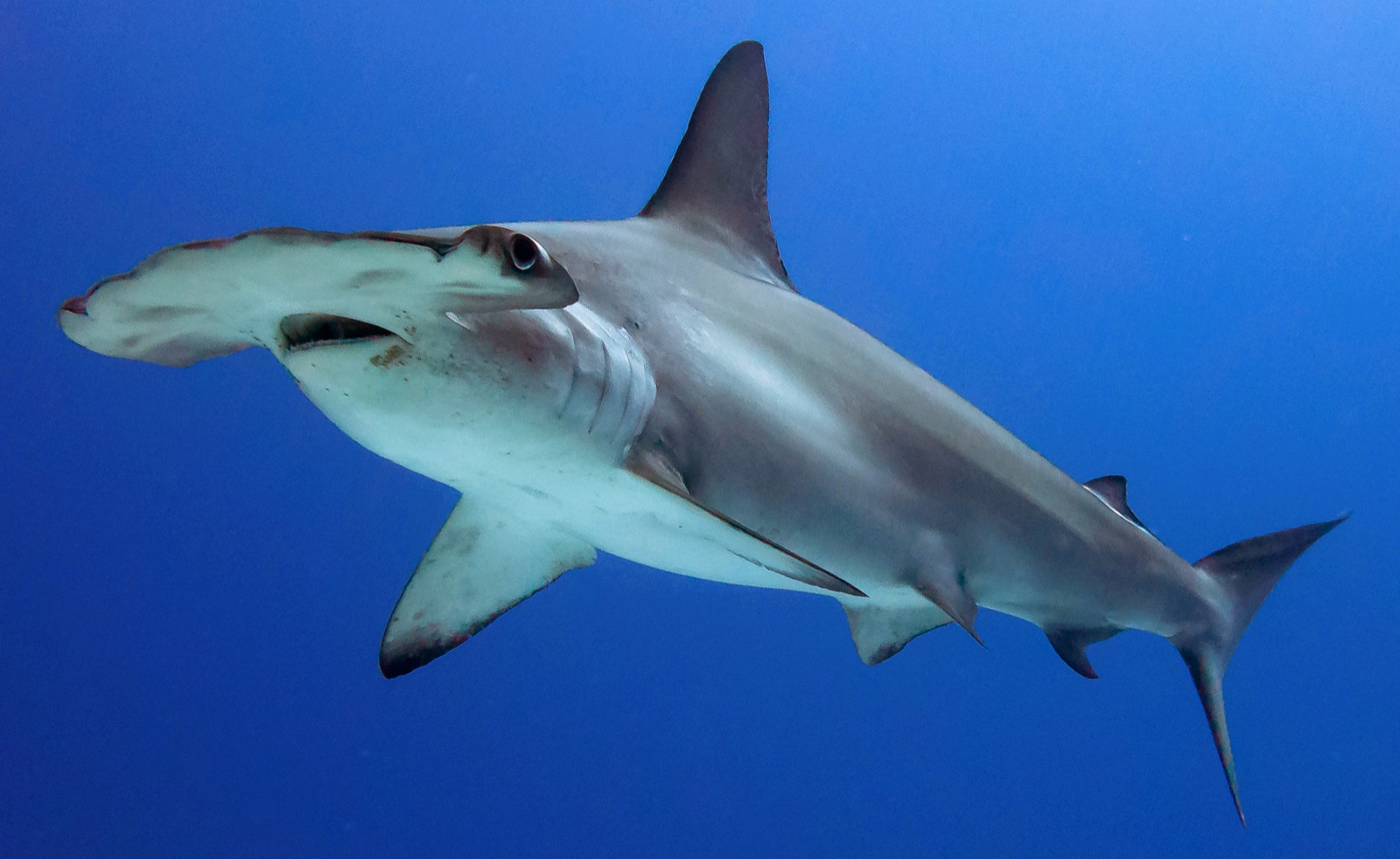
Sharks
Scalloped Hammerhead
Sphyrna lewini · Cartilaginous fish, family Sphyrnidae
A scalloped hammerhead school is the sight that built entire liveaboard industries: dozens to hundreds of animals stacked into the current above a seamount, heads swinging in lazy unison, the edges of the formation dissolving into blue. Up close each shark is modest in size, notched along the front of its cephalofoil, and visibly nervous of divers: the school parts around exhaled bubbles like smoke. They gather by day and vanish at dusk to hunt squid in deep water. Heavy industrial and illegal fishing at the very seamounts that concentrate them has made this Critically Endangered species a symbol of high-seas protection.
Dónde y cuándo ver uno
"Residente" significa que la mayoría de las inmersiones en ese destino tienen encuentros con ellos; "estacional" significa que su presencia es fiable en los meses indicados; cualquier otra cosa es un extra, no algo con lo que contar.
| Destino | Fiabilidad | Meses | Notas |
|---|---|---|---|
| Galápagos IslandsEcuador | Resident: seen on most dives | Year-round | |
| Cocos IslandCosta Rica | Resident: seen on most dives | Jun–Nov | |
| MalpeloColombia | Resident: seen on most dives | Todo el año | |
| Brothers, Daedalus & St John'sEgypt | Seasonal: reliable in season | May–Sep | |
| YonaguniJapan | Seasonal: reliable in season | Dec–Feb | |
| Port Sudan & SanganebSudan | Seasonal: reliable in season | Feb–May |
El mejor mes, de un vistazo
| Mes | Destinos fiables |
|---|---|
| January | Galápagos Islands · Malpelo · Yonaguni |
| February | Galápagos Islands · Malpelo · Yonaguni · Port Sudan & Sanganeb |
| March | Galápagos Islands · Malpelo · Port Sudan & Sanganeb |
| April | Galápagos Islands · Malpelo · Port Sudan & Sanganeb |
| May | Galápagos Islands · Malpelo · Brothers, Daedalus & St John's · Port Sudan & Sanganeb |
| June | Galápagos Islands · Cocos Island · Malpelo · Brothers, Daedalus & St John's |
| July | Galápagos Islands · Cocos Island · Malpelo · Brothers, Daedalus & St John's |
| August | Galápagos Islands · Cocos Island · Malpelo · Brothers, Daedalus & St John's |
| September | Galápagos Islands · Cocos Island · Malpelo · Brothers, Daedalus & St John's |
| October | Galápagos Islands · Cocos Island · Malpelo |
| November | Galápagos Islands · Cocos Island · Malpelo |
| December | Galápagos Islands · Malpelo · Yonaguni |
Comprendiéndolos
Hábitat: Seamounts, offshore islands, and current-swept drop-offs by day; disperses into deep water at night to hunt
Rango: Circumglobal in warm temperate and tropical seas; the famous schools gather at Eastern Pacific seamounts, in the Red Sea, and off Japan
Comportamiento: The schooling hammerhead. Hundreds of females may stack into slow-moving daytime schools around seamounts, thought to serve social and navigational functions between night feeding runs. Schools are famously shy of bubbles and noise: breath control and patience produce close passes, chasing produces an empty blue.
Dieta: Fish, squid, and rays taken on nocturnal hunts in deep water
Tamaño: normalmente alrededor de 2.5 m; documentado hasta 4.0 m (total length; schooling females at seamounts typically run 2–3 m).
Cómo comportarse cerca de uno
Tuck into the rocks down-current, slow your breathing or hold exhalations as the school passes, and never swim at the wall of sharks. Many operators brief a no-strobe or limited-strobe approach on first contact.
Conservación
Critically Endangered from decades of fin-driven overfishing; listed on CITES Appendix II. Marine reserves at Cocos, Malpelo, and Galápagos protect key aggregations, though enforcement on the surrounding high seas remains the weak point.
Puntos conocidos por avistamientos
Los puntos destacados fueron registrados para esta especie por nuestros editores; los números son registros de ocurrencia de GBIF anotados en un radio de unos 5 km de un punto desde 1990.
Ver
Desde los canales oficiales

Wildlife of Monterey | New film in our auditorium

Live Aviary Cam | Monterey Bay Aquarium

Live Aviary Cam | Monterey Bay Aquarium
Los vídeos son enlaces insertados a los canales de sus propios creadores. No alojamos nada y acreditamos todo.