Sharks
Silvertip Shark
Carcharhinus albimarginatus · Cartilaginous fish, family Carcharhinidae
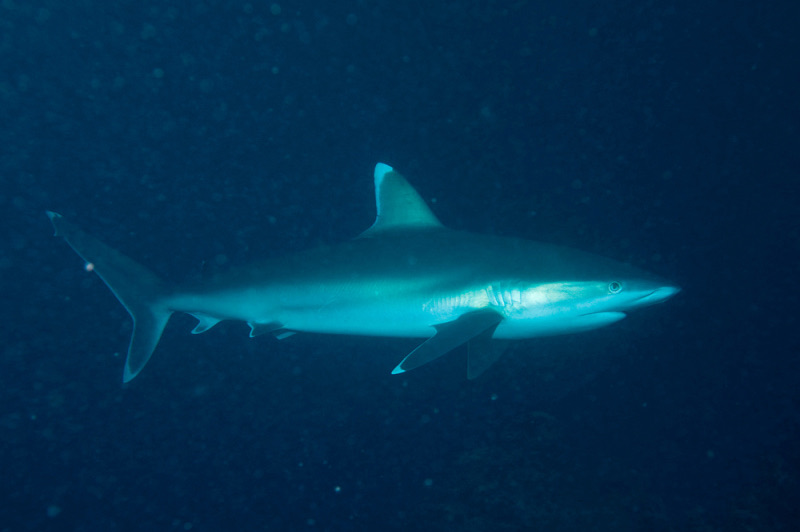
A silvertip's arrival changes the temperature of a dive. The shape reads at distance (heavier than a grey reef shark, every fin edged in white as if dipped in paint), and the approach is pure confidence, a straight line ending in a slow bank a meter or two away. They own the deep edges of remote reefs: Osprey's North Horn, the Burma Banks, the seamounts of the Revillagigedos. Encounters feel like an audience granted rather than a sighting achieved. Slow to mature and faithful to isolated sites, silvertips vanish quickly when longlines find their banks, so the remaining strongholds sit mostly inside marine parks and far from ports.
Où et quand en observer un
« Résident » signifie que la plupart des plongées sur ce site permettent de les observer ; « saisonnier » signifie qu'ils sont présents de manière fiable durant les mois indiqués ; tout le reste est un bonus, pas une certitude.
| Destination | Fiabilité | Mois | Notes |
|---|---|---|---|
| Socorro & the RevillagigedosMexico | Resident: seen on most dives | Toute l'année | |
| Coral Sea & Osprey ReefAustralia | Resident: seen on most dives | Toute l'année | |
| Mergui ArchipelagoMyanmar | Seasonal: reliable in season | Nov–Apr | |
| RangiroaFrench Polynesia | Occasional | Toute l'année | |
| Kimbe BayPapua New Guinea | Occasional | Toute l'année |
Meilleur mois, en un coup d'œil
Les comprendre
Habitat: Offshore banks, seamount flanks, and steep outer-reef drop-offs, typically deeper than its reef-shark relatives
Aire de répartition: Patchy across the tropical Indo-Pacific and Eastern Pacific: East Africa, the Andaman Sea, Indonesia, Papua New Guinea, the Coral Sea, French Polynesia, and offshore Mexico and Colombia
Comportement: The boss of the drop-off. Silvertips carry themselves with a directness that greys and blacktips lack, approaching divers head-on for a close inspection pass before resuming patrol. Every fin wears a brilliant white margin, unmistakable when the animal banks in the blue.
Régime alimentaire: Reef and pelagic fish, including smaller sharks and rays; frequently dominant over other species at a carcass or feed
Taille: généralement autour de 1.8 m; documenté jusqu'à 2.7 m (total length; a heavier, broader-shouldered build than the grey reef sharks it resembles).
Comment se comporter avec lui
Meet the head-on approach calmly without retreating mid-pass, stay off the bait line at feeds, and keep gauges and hoses clipped tight: silvertips are known to test dangling objects.
Conservation
Assessed Vulnerable in 2020; isolated island populations show sharp declines wherever offshore fishing reaches, and recolonization between distant banks is slow.
Sites répertoriés connus pour leur présence
Les sites mis en évidence ont été cartographiés pour cette espèce par nos éditeurs ; les chiffres correspondent aux occurrences GBIF enregistrées dans un rayon d'environ 5 km d'un site depuis 1990.
Regarder
Depuis les canaux officiels

Wildlife of Monterey | New film in our auditorium

Live Aviary Cam | Monterey Bay Aquarium

Live Aviary Cam | Monterey Bay Aquarium
Les vidéos sont des liens intégrés vers les chaînes de leurs créateurs. Nous n'hébergeons rien et créditons tout.