Big Fish
Atlantic Tarpon
Megalops atlanticus · Bony fish, family Megalopidae
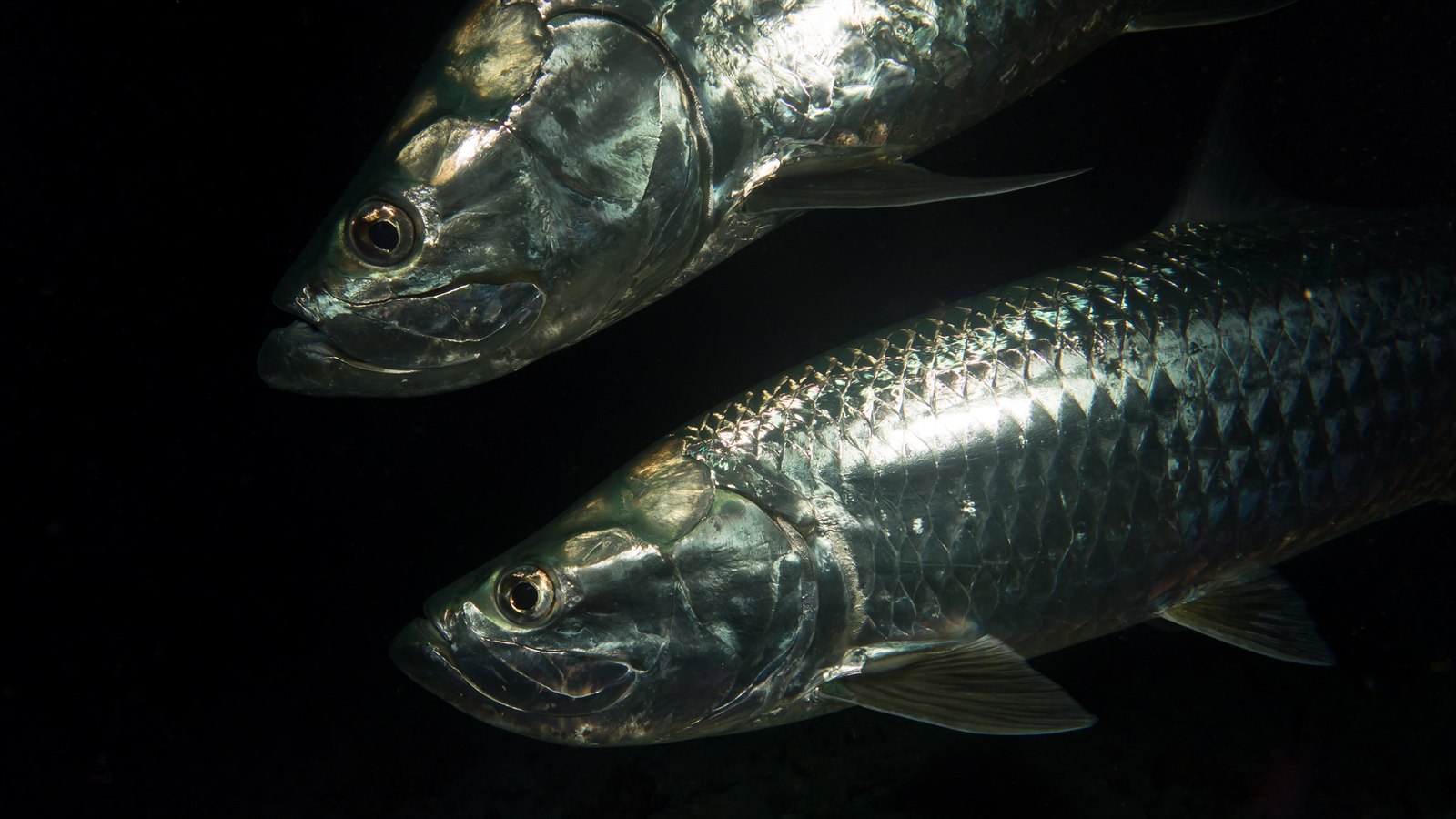
Tarpon are armored in the ocean's shiniest currency: scales like minted coins, a scoop jaw set in permanent skepticism, eyes the size of golf balls. By day they hover in silver rows inside Cayman grottos and cenote mouths, unbothered by divers a fin's length away; by night they turn into muscle and reflex, using dive lights as hunting lamps and hitting baitfish with strikes you feel as pressure. The species barely registers as food fish through much of its range (the sport is in the jump, anglers say), which leaves big, old, diver-tolerant schools decorating the Caribbean's ledges like heirlooms.
Wo und wann man eines sieht
„Resident" bedeutet, dass die meisten Tauchgänge am jeweiligen Tauchziel eine Begegnung erwarten lassen; „saisonal" bedeutet, dass die Art in den genannten Monaten zuverlässig anzutreffen ist; alles andere ist ein Bonus, keine Planungsgrundlage.
| Ziel | Zuverlässigkeit | Monate | Hinweise |
|---|---|---|---|
| CozumelMexico | Resident: seen on most dives | Ganzjährig | |
| Riviera Maya & the CenotesMexico | Resident: seen on most dives | Ganzjährig | |
| BonaireBonaire | Resident: seen on most dives | Ganzjährig | |
| Grand CaymanCayman Islands | Resident: seen on most dives | Ganzjährig | |
| Florida KeysUnited States | Resident: seen on most dives | Ganzjährig |
Bester Monat auf einen Blick
Sie verstehen
Lebensraum: Coastal waters, lagoons, mangrove channels, and reef overhangs; gulps surface air with a modified swim bladder, which lets it thrive in stagnant backwaters
Verbreitung: Western Atlantic from Virginia to Brazil including the entire Caribbean and Gulf of Mexico, plus tropical West Africa
Verhalten: Daytime tarpon idle in packs under ledges, in cavern mouths, and beneath docks, all mirror-chrome scales and disdain, letting divers approach within touching distance. At night they switch on: riding dive lights to ambush silversides, detonating through bait clouds in silver flashes. The rolling surface gulp of air is the species' signature.
Ernährung: Schooling fish and crustaceans, taken in explosive inhaling strikes, mostly at night
Größe: typischerweise rund 1.5 m; dokumentiert bis zu 2.5 m (total length; large females exceed 100 kg).
Wie man sich in ihrer Nähe verhält
On night dives, hold your beam steady and off other divers so hunting fish work the edge of it rather than the group; no feeding, and no crowding cavern schools against the rock.
Naturschutz
Vulnerable: a slow-growing, late-maturing fish pressured by harvest in parts of Latin America and West Africa and by loss of mangrove nurseries; largely catch-and-release where the sport fishery rules.
Bekannte Tauchplätze dafür
Hervorgehobene Tauchplätze wurden von unseren Redakteuren für diese Art kartiert; die Zahlen sind GBIF-Vorkommensdatensätze, die seit 1990 im Umkreis von etwa 5 km um einen Tauchplatz protokolliert wurden.
Ansehen
Aus den offiziellen Kanälen

Wildlife of Monterey | New film in our auditorium

Live Aviary Cam | Monterey Bay Aquarium

Live Aviary Cam | Monterey Bay Aquarium
Videos sind eingebettete Links zu den Kanälen der jeweiligen Ersteller – wir hosten nichts und geben für alles die Quelle an.