Big Fish
Atlantic Tarpon
Megalops atlanticus · Bony fish, family Megalopidae
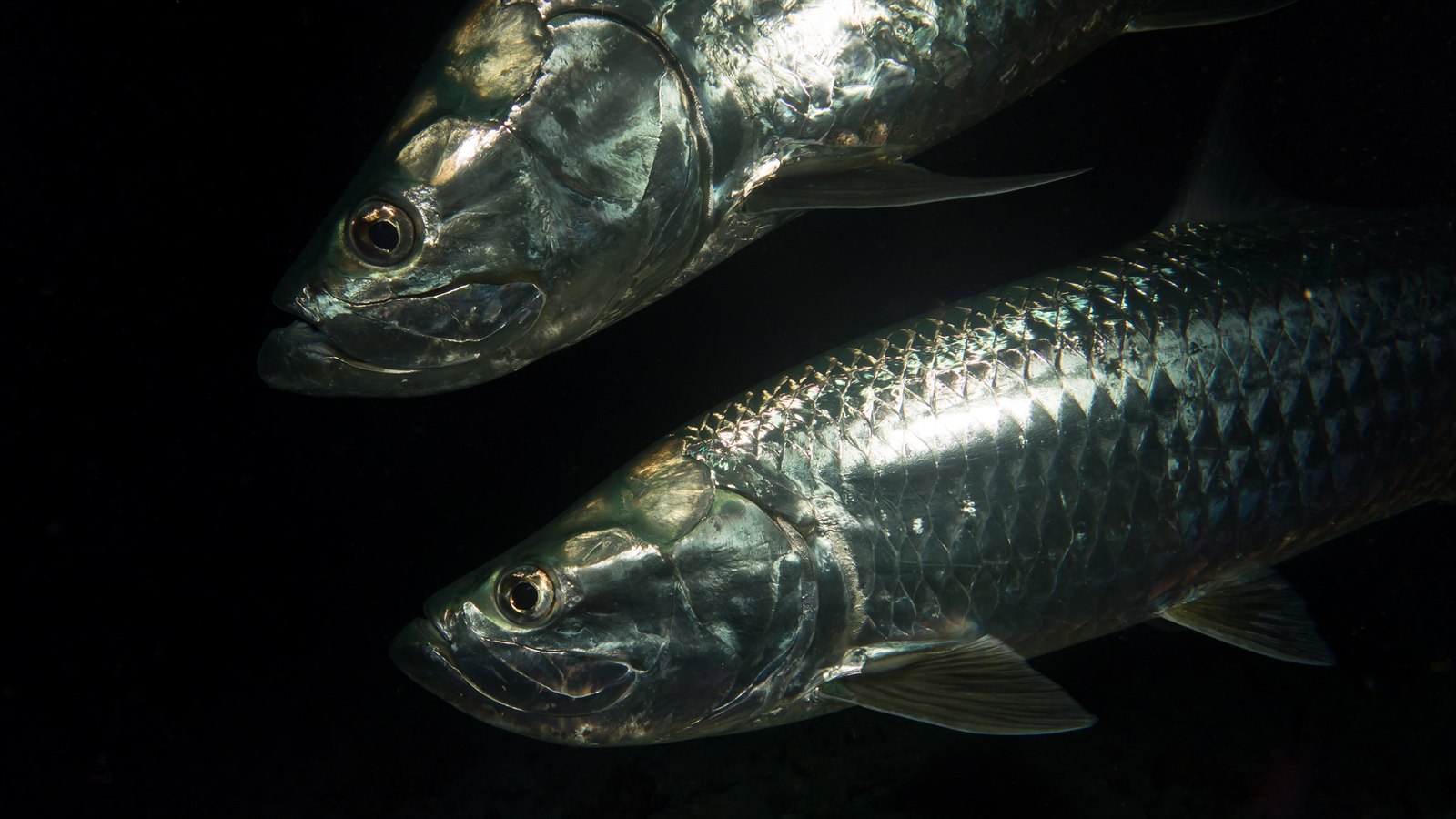
Tarpon are armored in the ocean's shiniest currency: scales like minted coins, a scoop jaw set in permanent skepticism, eyes the size of golf balls. By day they hover in silver rows inside Cayman grottos and cenote mouths, unbothered by divers a fin's length away; by night they turn into muscle and reflex, using dive lights as hunting lamps and hitting baitfish with strikes you feel as pressure. The species barely registers as food fish through much of its range (the sport is in the jump, anglers say), which leaves big, old, diver-tolerant schools decorating the Caribbean's ledges like heirlooms.
Où et quand en observer un
« Résident » signifie que la plupart des plongées sur ce site permettent de les observer ; « saisonnier » signifie qu'ils sont présents de manière fiable durant les mois indiqués ; tout le reste est un bonus, pas une certitude.
| Destination | Fiabilité | Mois | Notes |
|---|---|---|---|
| CozumelMexico | Resident: seen on most dives | Toute l'année | |
| Riviera Maya & the CenotesMexico | Resident: seen on most dives | Toute l'année | |
| BonaireBonaire | Resident: seen on most dives | Toute l'année | |
| Grand CaymanCayman Islands | Resident: seen on most dives | Toute l'année | |
| Florida KeysUnited States | Resident: seen on most dives | Toute l'année |
Meilleur mois, en un coup d'œil
Les comprendre
Habitat: Coastal waters, lagoons, mangrove channels, and reef overhangs; gulps surface air with a modified swim bladder, which lets it thrive in stagnant backwaters
Aire de répartition: Western Atlantic from Virginia to Brazil including the entire Caribbean and Gulf of Mexico, plus tropical West Africa
Comportement: Daytime tarpon idle in packs under ledges, in cavern mouths, and beneath docks, all mirror-chrome scales and disdain, letting divers approach within touching distance. At night they switch on: riding dive lights to ambush silversides, detonating through bait clouds in silver flashes. The rolling surface gulp of air is the species' signature.
Régime alimentaire: Schooling fish and crustaceans, taken in explosive inhaling strikes, mostly at night
Taille: généralement autour de 1.5 m; documenté jusqu'à 2.5 m (total length; large females exceed 100 kg).
Comment se comporter avec lui
On night dives, hold your beam steady and off other divers so hunting fish work the edge of it rather than the group; no feeding, and no crowding cavern schools against the rock.
Conservation
Vulnerable: a slow-growing, late-maturing fish pressured by harvest in parts of Latin America and West Africa and by loss of mangrove nurseries; largely catch-and-release where the sport fishery rules.
Sites répertoriés connus pour leur présence
Les sites mis en évidence ont été cartographiés pour cette espèce par nos éditeurs ; les chiffres correspondent aux occurrences GBIF enregistrées dans un rayon d'environ 5 km d'un site depuis 1990.
Regarder
Depuis les canaux officiels

Wildlife of Monterey | New film in our auditorium

Live Aviary Cam | Monterey Bay Aquarium

Live Aviary Cam | Monterey Bay Aquarium
Les vidéos sont des liens intégrés vers les chaînes de leurs créateurs. Nous n'hébergeons rien et créditons tout.