Sharks
Tasselled Wobbegong
Eucrossorhinus dasypogon · Cartilaginous fish, family Orectolobidae
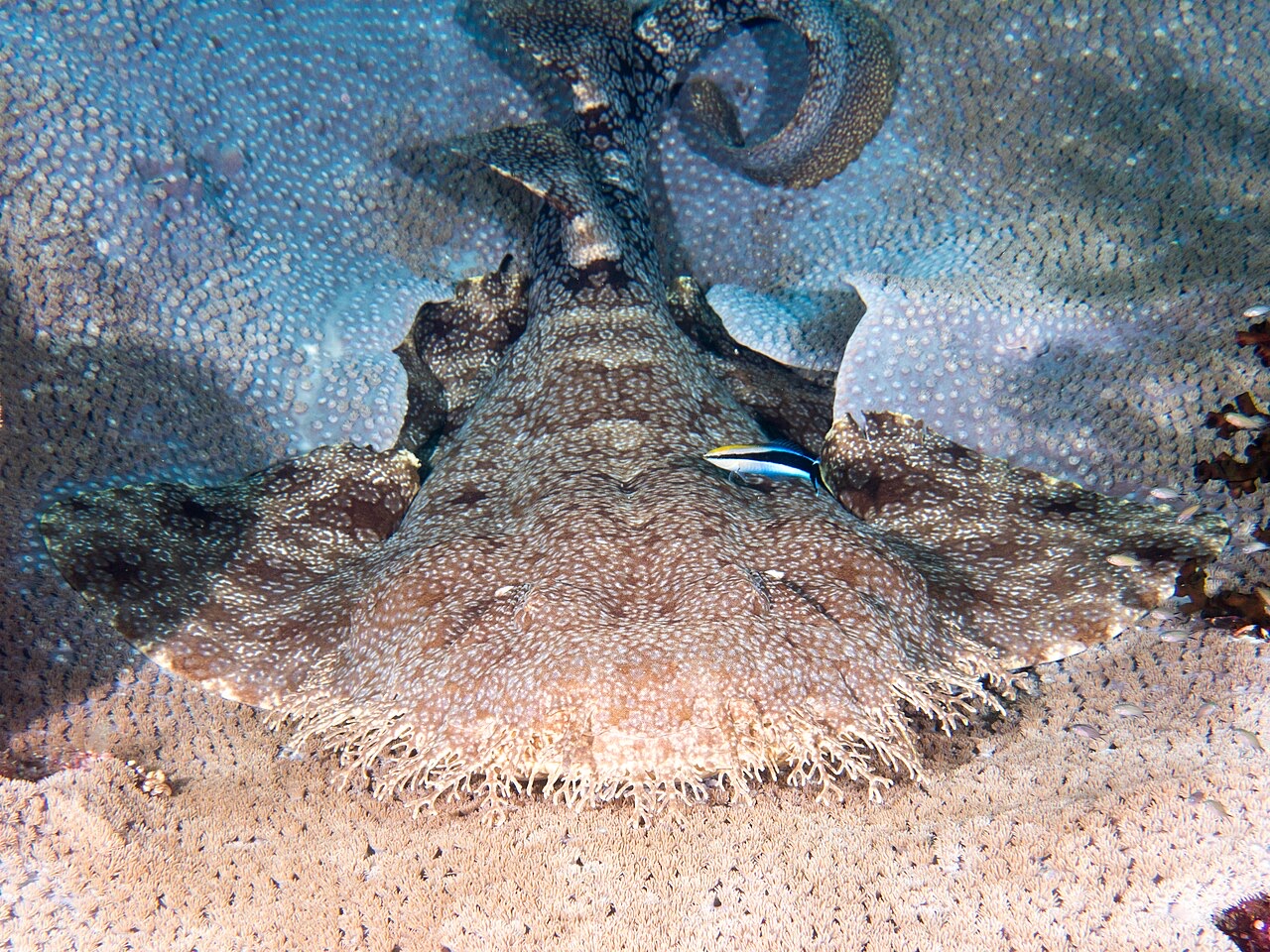
Half the pleasure of a tasselled wobbegong is the moment of resolution: what read as a patch of algae-furred reef assembles itself into a shark, flattened, marbled in fawn and umber, chin frilled with weedy tassels, eyes like slits in upholstery. Raja Ampat made it famous; nearly every site there hides one under a table coral, sometimes with its tail wedged in a barrel sponge and its head cocked toward passing fusiliers. The strike, if you're lucky enough to witness one, is a white blur and a shut mouth. It is camouflage elevated to a career, and a mascot for the strangeness of Coral Triangle diving.
Où et quand en observer un
« Résident » signifie que la plupart des plongées sur ce site permettent de les observer ; « saisonnier » signifie qu'ils sont présents de manière fiable durant les mois indiqués ; tout le reste est un bonus, pas une certitude.
| Destination | Fiabilité | Mois | Notes |
|---|---|---|---|
| Raja AmpatIndonesia | Resident: seen on most dives | Toute l'année | |
| Milne BayPapua New Guinea | Resident: seen on most dives | Toute l'année | |
| Cairns & the Ribbon ReefsAustralia | Occasional | Toute l'année | |
| Kimbe BayPapua New Guinea | Occasional | Toute l'année |
Meilleur mois, en un coup d'œil
| Mois | Destinations fiables |
|---|---|
| January | Raja Ampat · Milne Bay · Cairns & the Ribbon Reefs · Kimbe Bay |
| February | Raja Ampat · Milne Bay · Cairns & the Ribbon Reefs · Kimbe Bay |
| March | Raja Ampat · Milne Bay · Cairns & the Ribbon Reefs · Kimbe Bay |
| April | Raja Ampat · Milne Bay · Cairns & the Ribbon Reefs · Kimbe Bay |
| May | Raja Ampat · Milne Bay · Cairns & the Ribbon Reefs · Kimbe Bay |
| June | Raja Ampat · Milne Bay · Cairns & the Ribbon Reefs · Kimbe Bay |
| July | Raja Ampat · Milne Bay · Cairns & the Ribbon Reefs · Kimbe Bay |
| August | Raja Ampat · Milne Bay · Cairns & the Ribbon Reefs · Kimbe Bay |
| September | Raja Ampat · Milne Bay · Cairns & the Ribbon Reefs · Kimbe Bay |
| October | Raja Ampat · Milne Bay · Cairns & the Ribbon Reefs · Kimbe Bay |
| November | Raja Ampat · Milne Bay · Cairns & the Ribbon Reefs · Kimbe Bay |
| December | Raja Ampat · Milne Bay · Cairns & the Ribbon Reefs · Kimbe Bay |
Les comprendre
Habitat: Coral reefs: under table corals, inside barrel sponges, and on ledges, where it lies flattened and all but invisible
Aire de répartition: The Coral Triangle's eastern arc: eastern Indonesia (Raja Ampat above all), Papua New Guinea, and northern Australia
Comportement: The definitive ambush shark. A fringe of branching dermal tassels erases its outline against coral, and it can lie unmoving for hours, luring fish with subtle tail movements before a strike faster than the eye. Mostly nocturnal on the move; by day divers find it coiled under plate corals.
Régime alimentaire: Fish and crustaceans ambushed at point-blank range; capable of swallowing surprisingly large prey, including other sharks
Taille: généralement autour de 1.2 m; documenté jusqu'à 1.8 m (total length).
Comment se comporter avec lui
Never touch, lift, or drag one into the open; keep fingers off ledges you haven't scanned; give a walking wobbegong right of way at night.
Conservation
Least Concern, with most of its core range inside Indonesian and PNG reef systems; localized pressure comes from reef degradation and the aquarium trade.
Sites répertoriés connus pour leur présence
Les sites mis en évidence ont été cartographiés pour cette espèce par nos éditeurs ; les chiffres correspondent aux occurrences GBIF enregistrées dans un rayon d'environ 5 km d'un site depuis 1990.
Regarder
Depuis les canaux officiels

Wildlife of Monterey | New film in our auditorium

Live Aviary Cam | Monterey Bay Aquarium

Live Aviary Cam | Monterey Bay Aquarium
Les vidéos sont des liens intégrés vers les chaînes de leurs créateurs. Nous n'hébergeons rien et créditons tout.