Sharks
Whale Shark
Rhincodon typus · Cartilaginous fish, family Rhincodontidae
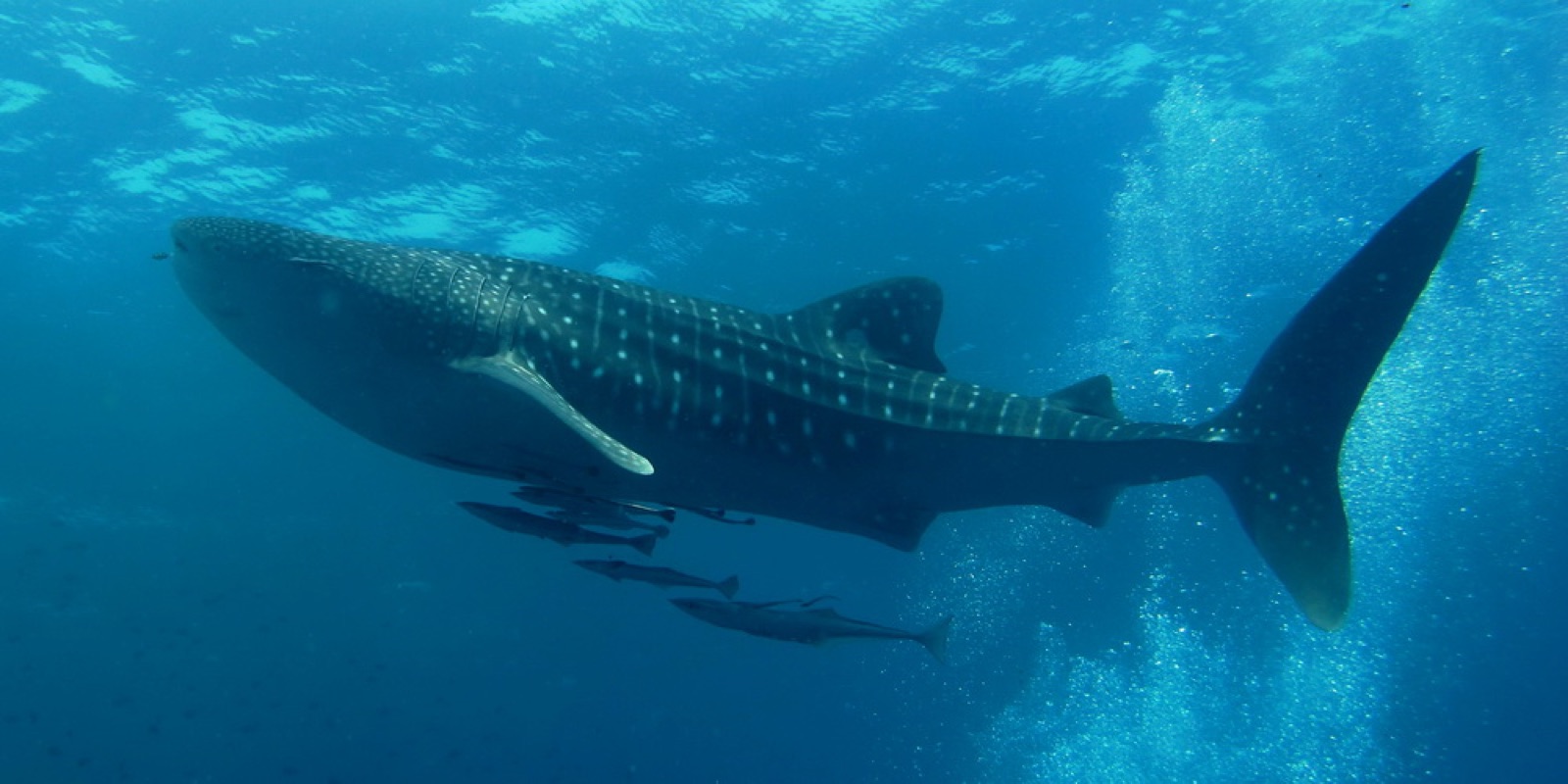
Nothing else in diving prepares you for the first sight of a whale shark: a checkerboard of pale spots on slate-blue flanks resolving out of the haze, a meter-wide mouth pushed along at strolling pace. The largest fish on Earth is a plankton eater that behaves, around people, with almost complete indifference. Encounters are mostly surface snorkels above feeding animals, so the classic view is down the length of a huge, gently sculling body silhouetted against sunlight. Every individual carries a unique spot pattern, which is why photo-ID libraries built from tourist pictures underpin much of what science knows about their movements.
Où et quand en observer un
« Résident » signifie que la plupart des plongées sur ce site permettent de les observer ; « saisonnier » signifie qu'ils sont présents de manière fiable durant les mois indiqués ; tout le reste est un bonus, pas une certitude.
| Destination | Fiabilité | Mois | Notes |
|---|---|---|---|
| Ari AtollMaldives | Resident: seen on most dives | Year-round | |
| Galápagos IslandsEcuador | Seasonal: reliable in season | Jun–Nov | |
| Isla Mujeres & CancúnMexico | Seasonal: reliable in season | Jun–Sep | |
| Ningaloo ReefAustralia | Seasonal: reliable in season | Mar–Jul | |
| Mafia IslandTanzania | Seasonal: reliable in season | Oct–Feb | |
| Tofo BeachMozambique | Seasonal: reliable in season | Oct–Mar | |
| Similan Islands & Richelieu RockThailand | Occasional | Feb–Apr |
Meilleur mois, en un coup d'œil
| Mois | Destinations fiables |
|---|---|
| January | Ari Atoll · Mafia Island · Tofo Beach |
| February | Ari Atoll · Mafia Island · Tofo Beach · Similan Islands & Richelieu Rock |
| March | Ari Atoll · Ningaloo Reef · Tofo Beach · Similan Islands & Richelieu Rock |
| April | Ari Atoll · Ningaloo Reef · Similan Islands & Richelieu Rock |
| May | Ari Atoll · Ningaloo Reef |
| June | Ari Atoll · Galápagos Islands · Isla Mujeres & Cancún · Ningaloo Reef |
| July | Ari Atoll · Galápagos Islands · Isla Mujeres & Cancún · Ningaloo Reef |
| August | Ari Atoll · Galápagos Islands · Isla Mujeres & Cancún |
| September | Ari Atoll · Galápagos Islands · Isla Mujeres & Cancún |
| October | Ari Atoll · Galápagos Islands · Mafia Island · Tofo Beach |
| November | Ari Atoll · Galápagos Islands · Mafia Island · Tofo Beach |
| December | Ari Atoll · Mafia Island · Tofo Beach |
Les comprendre
Habitat: Open ocean and productive coastal waters; feeds at the surface over plankton blooms and spawning events, though tagged animals dive far below 1,000 m
Aire de répartition: Circumtropical in warm seas, roughly between 30°N and 35°S, with predictable coastal feeding aggregations off Australia, Mexico, the Maldives, Tanzania, Mozambique, and the Philippines
Comportement: A slow, steady swimmer that tolerates snorkelers well when not crowded. Feeding animals track plankton at the surface, sometimes bobbing vertically to gulp concentrated prey. Most aggregation sites are dominated by juvenile males; where the giant pregnant females go remains only partly understood.
Régime alimentaire: Filter feeder: plankton, krill, fish eggs, and small baitfish strained through gill rakers while ram-feeding or vertical suction-feeding
Taille: généralement autour de 9.0 m; documenté jusqu'à 18.0 m (total length; most encountered animals are 4–10 m juveniles and subadults, with reliable records approaching 18 m).
Comment se comporter avec lui
Snorkel-only at most managed sites. Keep roughly 3 m from the body and 4 m from the tail, never touch or ride, no flash close to the eye, stay out of its path, and let the operator control entries. Touching bans and distance rules are written into regulations at Ningaloo, Isla Mujeres, and Hanifaru.
Conservation
Listed Endangered in 2016 after steep Indo-Pacific declines driven by fisheries and ship strikes. Well-run tourism now gives living whale sharks measurable economic value, but crowding and propeller injuries at hotspots are real concerns.
Sites répertoriés connus pour leur présence
Les sites mis en évidence ont été cartographiés pour cette espèce par nos éditeurs ; les chiffres correspondent aux occurrences GBIF enregistrées dans un rayon d'environ 5 km d'un site depuis 1990.
Regarder
Depuis les canaux officiels

Wildlife of Monterey | New film in our auditorium

Live Aviary Cam | Monterey Bay Aquarium

Live Aviary Cam | Monterey Bay Aquarium
Les vidéos sont des liens intégrés vers les chaînes de leurs créateurs. Nous n'hébergeons rien et créditons tout.