Sharks
Whale Shark
Rhincodon typus · Cartilaginous fish, family Rhincodontidae
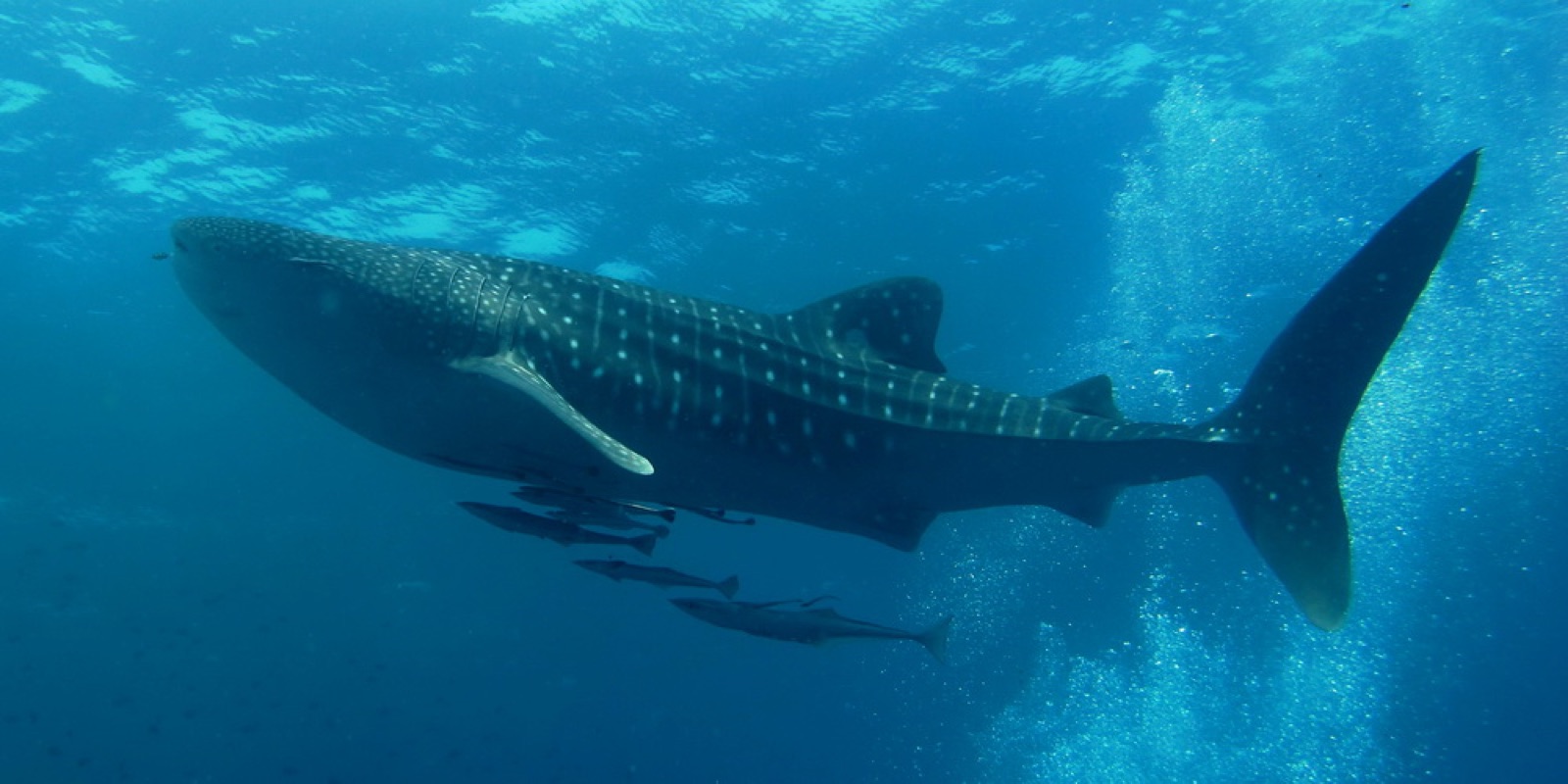
Nothing else in diving prepares you for the first sight of a whale shark: a checkerboard of pale spots on slate-blue flanks resolving out of the haze, a meter-wide mouth pushed along at strolling pace. The largest fish on Earth is a plankton eater that behaves, around people, with almost complete indifference. Encounters are mostly surface snorkels above feeding animals, so the classic view is down the length of a huge, gently sculling body silhouetted against sunlight. Every individual carries a unique spot pattern, which is why photo-ID libraries built from tourist pictures underpin much of what science knows about their movements.
इसे कहाँ और कब देखें
"निवासी" का अर्थ है कि उस गंतव्य पर अधिकांश डाइव्स में उनसे मुलाकात होती है; "मौसमी" का अर्थ है कि वे सूचीबद्ध महीनों में विश्वसनीय रूप से मौजूद रहते हैं; इसके अलावा जो भी मिले वह बोनस है, योजना नहीं।
| गंतव्य | विश्वसनीयता | माह | नोट्स |
|---|---|---|---|
| Ari AtollMaldives | Resident: seen on most dives | Year-round | |
| Galápagos IslandsEcuador | Seasonal: reliable in season | Jun–Nov | |
| Isla Mujeres & CancúnMexico | Seasonal: reliable in season | Jun–Sep | |
| Ningaloo ReefAustralia | Seasonal: reliable in season | Mar–Jul | |
| Mafia IslandTanzania | Seasonal: reliable in season | Oct–Feb | |
| Tofo BeachMozambique | Seasonal: reliable in season | Oct–Mar | |
| Similan Islands & Richelieu RockThailand | Occasional | Feb–Apr |
एक नज़र में सर्वश्रेष्ठ महीना
| माह | विश्वसनीय गंतव्य |
|---|---|
| January | Ari Atoll · Mafia Island · Tofo Beach |
| February | Ari Atoll · Mafia Island · Tofo Beach · Similan Islands & Richelieu Rock |
| March | Ari Atoll · Ningaloo Reef · Tofo Beach · Similan Islands & Richelieu Rock |
| April | Ari Atoll · Ningaloo Reef · Similan Islands & Richelieu Rock |
| May | Ari Atoll · Ningaloo Reef |
| June | Ari Atoll · Galápagos Islands · Isla Mujeres & Cancún · Ningaloo Reef |
| July | Ari Atoll · Galápagos Islands · Isla Mujeres & Cancún · Ningaloo Reef |
| August | Ari Atoll · Galápagos Islands · Isla Mujeres & Cancún |
| September | Ari Atoll · Galápagos Islands · Isla Mujeres & Cancún |
| October | Ari Atoll · Galápagos Islands · Mafia Island · Tofo Beach |
| November | Ari Atoll · Galápagos Islands · Mafia Island · Tofo Beach |
| December | Ari Atoll · Mafia Island · Tofo Beach |
इन्हें समझना
आवास: Open ocean and productive coastal waters; feeds at the surface over plankton blooms and spawning events, though tagged animals dive far below 1,000 m
रेंज: Circumtropical in warm seas, roughly between 30°N and 35°S, with predictable coastal feeding aggregations off Australia, Mexico, the Maldives, Tanzania, Mozambique, and the Philippines
व्यवहार: A slow, steady swimmer that tolerates snorkelers well when not crowded. Feeding animals track plankton at the surface, sometimes bobbing vertically to gulp concentrated prey. Most aggregation sites are dominated by juvenile males; where the giant pregnant females go remains only partly understood.
आहार: Filter feeder: plankton, krill, fish eggs, and small baitfish strained through gill rakers while ram-feeding or vertical suction-feeding
आकार: आमतौर पर लगभग 9.0 m; दर्ज अधिकतम गहराई 18.0 m (total length; most encountered animals are 4–10 m juveniles and subadults, with reliable records approaching 18 m).
इसके आसपास कैसे व्यवहार करें
Snorkel-only at most managed sites. Keep roughly 3 m from the body and 4 m from the tail, never touch or ride, no flash close to the eye, stay out of its path, and let the operator control entries. Touching bans and distance rules are written into regulations at Ningaloo, Isla Mujeres, and Hanifaru.
संरक्षण
Listed Endangered in 2016 after steep Indo-Pacific declines driven by fisheries and ship strikes. Well-run tourism now gives living whale sharks measurable economic value, but crowding and propeller injuries at hotspots are real concerns.
इनके लिए जाने-जाने वाले चार्टेड साइट
हाइलाइट की गई साइट्स हमारे संपादकों द्वारा इस प्रजाति के लिए चार्ट की गई हैं; संख्याएँ 1990 के बाद से किसी साइट के लगभग 5 किमी के भीतर दर्ज GBIF ऑकरेंस रिकॉर्ड हैं।
देखें
आधिकारिक चैनलों से

Wildlife of Monterey | New film in our auditorium

Live Aviary Cam | Monterey Bay Aquarium

Live Aviary Cam | Monterey Bay Aquarium
वीडियो उनके निर्माताओं के अपने चैनलों के एम्बेडेड लिंक हैं। हम कुछ भी होस्ट नहीं करते और हर चीज़ का श्रेय देते हैं।