Cold Water
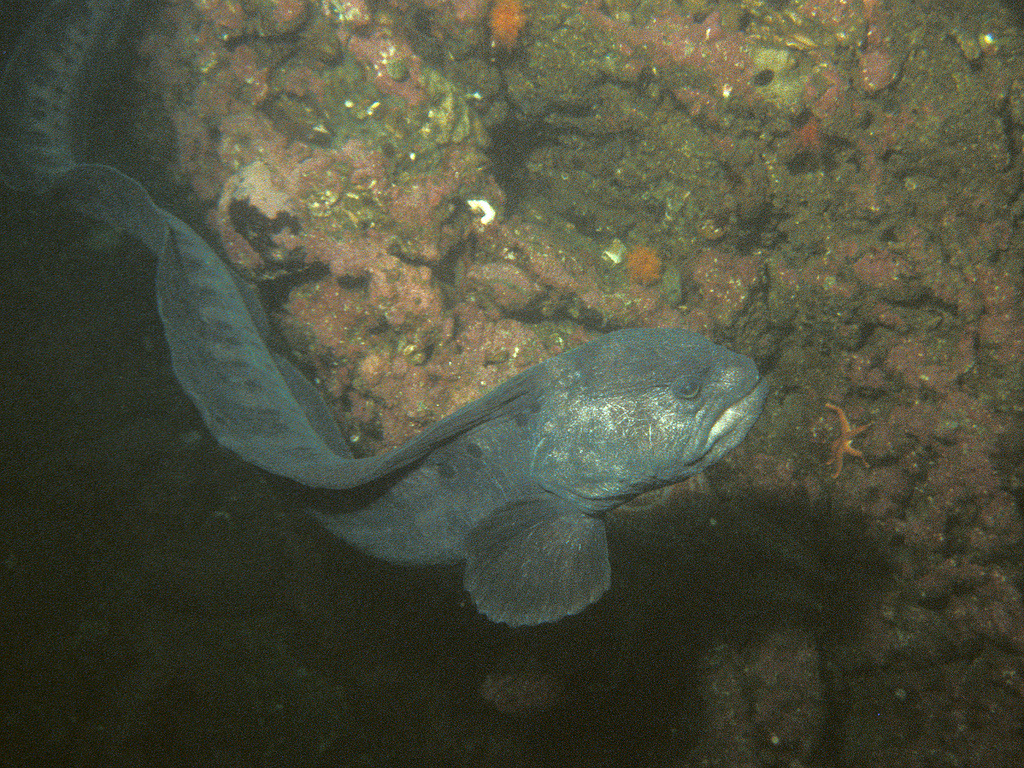
Wolf Eel
Anarrhichthys ocellatus · Bony fish, family Anarhichadidae (wolffishes); an elongated wolffish, not a true eel
Wolf-eels are the gargoyles of the Pacific Northwest (huge gray heads, swollen jowls, teeth like broken crockery) and among its gentlest residents. Not true eels but elongated wolffishes, they pair long-term and share a den, sometimes two faces stacked in one crevice watching the water column go by. The crushing dentition is for urchins, crabs, and clams; divers get curiosity instead, and pairs at well-known dens will ease halfway out to inspect visitors. Juveniles look like a different species, burnt orange with a purple sheen, swimming open water before settling into rock. The old practice of hand-feeding urchins to resident pairs has faded for good reason: fed animals lose caution, and teeth meet fingers by accident. Come in low and off to one side, and let a swimming wolf-eel pass; it is likely commuting between dens.
Dove e quando avvistarne uno
"Residente" significa che la maggior parte delle immersioni in quella destinazione li incontra; "stagionale" significa che sono presenti in modo affidabile nei mesi indicati; qualsiasi altra cosa è un bonus, non un piano.
| Destinazione | Affidabilità | Mesi | Note |
|---|---|---|---|
| British ColumbiaCanada | Resident: seen on most dives | Tutto l'anno |
Il mese migliore, a colpo d'occhio
| Mese | Destinazioni affidabili |
|---|---|
| January | British Columbia |
| February | British Columbia |
| March | British Columbia |
| April | British Columbia |
| May | British Columbia |
| June | British Columbia |
| July | British Columbia |
| August | British Columbia |
| September | British Columbia |
| October | British Columbia |
| November | British Columbia |
| December | British Columbia |
Capirle
Habitat: Rocky reef dens, wrecks, and boulder jumbles; established pairs keep the same crevice for years, at depths divers visit and far below.
Distribuzione: North Pacific: from southern California through British Columbia and Alaska to the Sea of Japan.
Comportamento: Pairs share a den long-term, often with both heads visible at the entrance; juveniles are orange with a purple sheen and swim open water before settling. Resident pairs grow tolerant of familiar divers.
Dieta: Sea urchins, crabs, clams, and snails crushed with heavy molar-like teeth and powerful jaws.
Dimensioni: tipicamente intorno a 1.8 m; documentato fino a 2.4 m (total length).
Come comportarsi in sua presenza
Approach a den low and slightly to one side, skip the old urchin hand-feeding routine entirely, and give a free-swimming animal the lane: it is commuting, not fleeing.
Conservazione
Not a fishery target and not considered broadly threatened; den fidelity makes known pairs locally precious and easy to disturb.
Siti mappati noti per avvistamenti
I siti evidenziati sono stati schedati per questa specie dai nostri redattori; i numeri sono record di occorrenza GBIF registrati entro circa 5 km dal sito a partire dal 1990.
Guarda
Dai canali ufficiali

Wildlife of Monterey | New film in our auditorium

Live Aviary Cam | Monterey Bay Aquarium

Live Aviary Cam | Monterey Bay Aquarium
I video sono link incorporati ai canali dei rispettivi autori. Non ospitiamo nulla e accreditiamo tutto.