Cold Water
Wolf Eel
Anarrhichthys ocellatus · Bony fish, family Anarhichadidae (wolffishes); an elongated wolffish, not a true eel
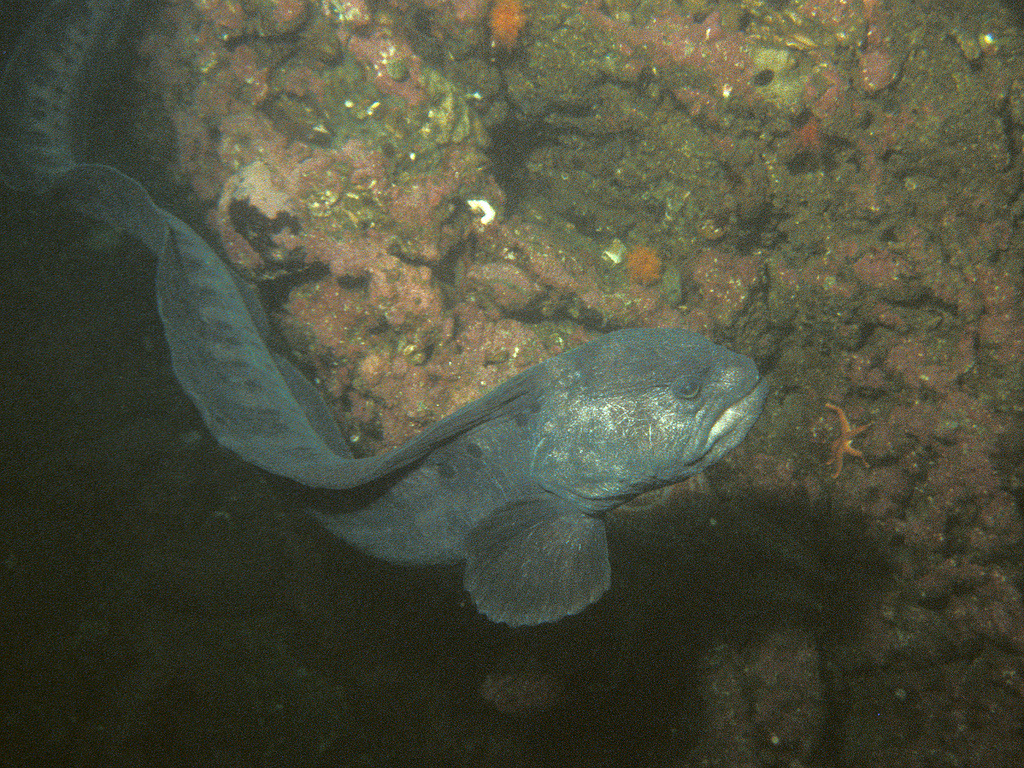
Wolf-eels are the gargoyles of the Pacific Northwest (huge gray heads, swollen jowls, teeth like broken crockery) and among its gentlest residents. Not true eels but elongated wolffishes, they pair long-term and share a den, sometimes two faces stacked in one crevice watching the water column go by. The crushing dentition is for urchins, crabs, and clams; divers get curiosity instead, and pairs at well-known dens will ease halfway out to inspect visitors. Juveniles look like a different species, burnt orange with a purple sheen, swimming open water before settling into rock. The old practice of hand-feeding urchins to resident pairs has faded for good reason: fed animals lose caution, and teeth meet fingers by accident. Come in low and off to one side, and let a swimming wolf-eel pass; it is likely commuting between dens.
どこで・いつ見られるか
「常駐(Resident)」とは、そのダイビングスポットでのほとんどのダイブで遭遇できることを意味します。「季節限定(Seasonal)」とは、記載された月に確実に見られることを意味します。それ以外の出会いはボーナスであり、計画の前提にはなりません。
| 目的地 | 信頼性 | 月 | メモ |
|---|---|---|---|
| British ColumbiaCanada | Resident: seen on most dives | 年間を通じて |
ベストな月、一目でわかる
| 月 | 安定して出会える目的地 |
|---|---|
| January | British Columbia |
| February | British Columbia |
| March | British Columbia |
| April | British Columbia |
| May | British Columbia |
| June | British Columbia |
| July | British Columbia |
| August | British Columbia |
| September | British Columbia |
| October | British Columbia |
| November | British Columbia |
| December | British Columbia |
理解を深める
ハビタット: Rocky reef dens, wrecks, and boulder jumbles; established pairs keep the same crevice for years, at depths divers visit and far below.
分布域: North Pacific: from southern California through British Columbia and Alaska to the Sea of Japan.
生態・行動: Pairs share a den long-term, often with both heads visible at the entrance; juveniles are orange with a purple sheen and swim open water before settling. Resident pairs grow tolerant of familiar divers.
食性: Sea urchins, crabs, clams, and snails crushed with heavy molar-like teeth and powerful jaws.
サイズ: 目安は 1.8 m; 確認済みの最大記録 2.4 m (total length).
出会ったときの正しいふるまい方
Approach a den low and slightly to one side, skip the old urchin hand-feeding routine entirely, and give a free-swimming animal the lane: it is commuting, not fleeing.
保全
Not a fishery target and not considered broadly threatened; den fidelity makes known pairs locally precious and easy to disturb.
目撃情報で知られるダイブサイト
ハイライト表示のサイトは編集部がこの生物種の記録地として登録したもので、数字は1990年以降にサイトから約5km以内で記録されたGBIFの出現件数です。
動画を見る
公式チャンネルより

Wildlife of Monterey | New film in our auditorium

Live Aviary Cam | Monterey Bay Aquarium

Live Aviary Cam | Monterey Bay Aquarium
動画はクリエイター自身のチャンネルへの埋め込みリンクです。当サイトはコンテンツをホストせず、すべての出典を明示しています。